

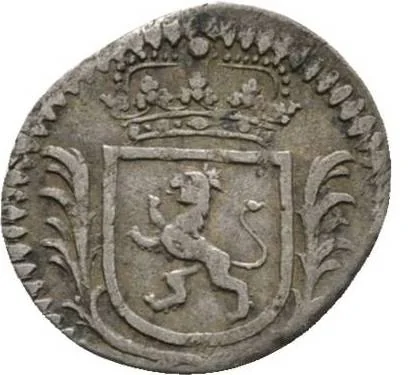
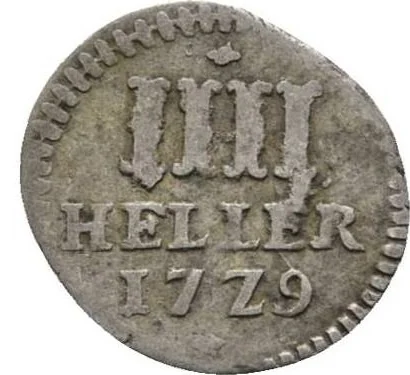
4 Hellers – Landgraviate of Hesse-Cassel
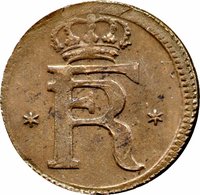
Obverse
Description:
Palm branches flanking a crowned coat of arms.
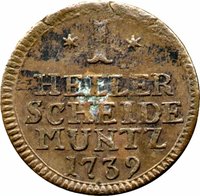
Reverse
Description:
Denomination and date in centered three-line inscription.
Inscription:
IIII
HELLER
1729
HELLER
1729
Script: Latin
Edge
Mints
| Name | Mark |
|---|---|
| Kassel | — |
Mintings
| Year | Mint Mark | Mintage | Quality | Collection |
|---|---|---|---|---|
| 1729 | — | — |
Historical background
In 1729, the currency situation in the Landgraviate of Hesse-Cassel was one of relative stability and strength, a legacy of the prudent fiscal policies of Landgrave Charles I (ruled 1670–1730). Having inherited a debt-ridden state, Charles systematically reformed its finances, most notably by leasing out soldiers as mercenaries to foreign powers—a practice that generated substantial foreign income, particularly in silver. This influx of capital allowed Hesse-Cassel to maintain a stable and reliable currency, the Reichsthaler, at a time when many other German states were debasing their coinage to fund local expenditures. The Landgraviate’s coins, minted from high-quality silver, were widely trusted in regional trade.
This monetary stability was underpinned by a sophisticated financial infrastructure centered in the capital, Kassel. The state bank, the Hessische Landesbank, established earlier in the century, facilitated government credit and helped manage the treasury without resorting to inflationary measures. Furthermore, the economy benefited from a degree of religious tolerance that attracted skilled Huguenot refugees, who bolstered commerce and manufacturing, creating a more diversified economic base less reliant on purely agrarian wealth.
However, this stability was not without underlying pressures. The system depended heavily on the mercenary trade, a source of revenue that was politically volatile and morally contentious. Furthermore, the impending succession of Landgrave Frederick I—who was also King of Sweden and often absent—raised concerns about future fiscal discipline. While 1729 itself represented a high point of monetary reliability, the long-term sustainability of Hesse-Cassel's currency was tied to a political economy that would soon be tested by the changing ambitions and attentions of its rulers.
This monetary stability was underpinned by a sophisticated financial infrastructure centered in the capital, Kassel. The state bank, the Hessische Landesbank, established earlier in the century, facilitated government credit and helped manage the treasury without resorting to inflationary measures. Furthermore, the economy benefited from a degree of religious tolerance that attracted skilled Huguenot refugees, who bolstered commerce and manufacturing, creating a more diversified economic base less reliant on purely agrarian wealth.
However, this stability was not without underlying pressures. The system depended heavily on the mercenary trade, a source of revenue that was politically volatile and morally contentious. Furthermore, the impending succession of Landgrave Frederick I—who was also King of Sweden and often absent—raised concerns about future fiscal discipline. While 1729 itself represented a high point of monetary reliability, the long-term sustainability of Hesse-Cassel's currency was tied to a political economy that would soon be tested by the changing ambitions and attentions of its rulers.
✨ Legendary