

4 Hellers – Landgraviate of Hesse-Cassel
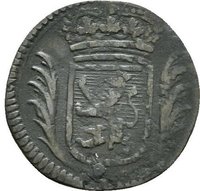
Obverse
Description:
Palm branches flanking a crowned coat of arms.
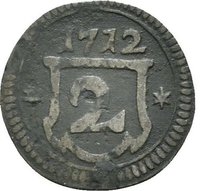
Reverse
Description:
Date top, denomination center.
Inscription:
1704
IIII
HELLER
IIII
HELLER
Edge
Mints
| Name | Mark |
|---|---|
| Kassel | — |
Mintings
| Year | Mint Mark | Mintage | Quality | Collection |
|---|---|---|---|---|
| 1704 | — | — | ||
| 1705 | — | — | ||
| 1707 | — | — | ||
| 1712 | — | — |
Historical background
In 1704, the currency situation in the Landgraviate of Hesse-Cassel was one of significant complexity and strain, characteristic of the Holy Roman Empire's fragmented monetary system. The landgraviate did not have a single, unified currency but rather circulated a mix of coins issued by its own mint and a plethora of foreign coins, particularly from neighboring German states. The primary unit of account was the Reichsthaler, a large silver coin defined by imperial decree, but the everyday circulation was dominated by smaller, often debased, regional coins like Groschen and Kreuzers. This proliferation of coins of varying silver content and origin created chronic confusion and facilitated fraud.
The period was marked by active currency debasement, a common practice among German princes to generate revenue, especially to finance military expenditures. Landgrave Charles, who ruled from 1670 to 1730, was engaged in the War of the Spanish Succession (1701-1714), a conflict that placed immense financial pressure on the state. To meet these costs, the mint in Kassel likely engaged in reducing the silver content of its issued coins, a process known as Kippermünze. This practice, while providing short-term funds, eroded public trust, disrupted commerce, and led to price inflation as merchants adjusted for the poorer coin quality.
Consequently, the monetary landscape was one of instability and administrative challenge. Authorities faced the constant task of publishing exchange-rate ordinances (Kuranttarien) to define the fluctuating value of countless coin types in relation to the Reichsthaler. This environment hindered economic predictability and placed a burden on both merchants and the general population, who were vulnerable to losses when receiving payment in degraded coinage. Thus, in 1704, Hesse-Cassel's currency was less a tool of stable commerce and more a reflection of the fiscal demands of war and the fragmented political structure of the Empire.
The period was marked by active currency debasement, a common practice among German princes to generate revenue, especially to finance military expenditures. Landgrave Charles, who ruled from 1670 to 1730, was engaged in the War of the Spanish Succession (1701-1714), a conflict that placed immense financial pressure on the state. To meet these costs, the mint in Kassel likely engaged in reducing the silver content of its issued coins, a process known as Kippermünze. This practice, while providing short-term funds, eroded public trust, disrupted commerce, and led to price inflation as merchants adjusted for the poorer coin quality.
Consequently, the monetary landscape was one of instability and administrative challenge. Authorities faced the constant task of publishing exchange-rate ordinances (Kuranttarien) to define the fluctuating value of countless coin types in relation to the Reichsthaler. This environment hindered economic predictability and placed a burden on both merchants and the general population, who were vulnerable to losses when receiving payment in degraded coinage. Thus, in 1704, Hesse-Cassel's currency was less a tool of stable commerce and more a reflection of the fiscal demands of war and the fragmented political structure of the Empire.

✨ Legendary