

3 Kreuzer – Austrian Empire
Austria
Context
Years: 1658–1705
Country: Austria 
Issuer: Austrian Empire
Ruler: Leopold I
Currency:
(1520—1754)
Demonetized: Yes
Material
References
KM: #Click to copy to clipboard1115
Numista: #26235
Value
Bullion value: $3.77
Obverse
Description:
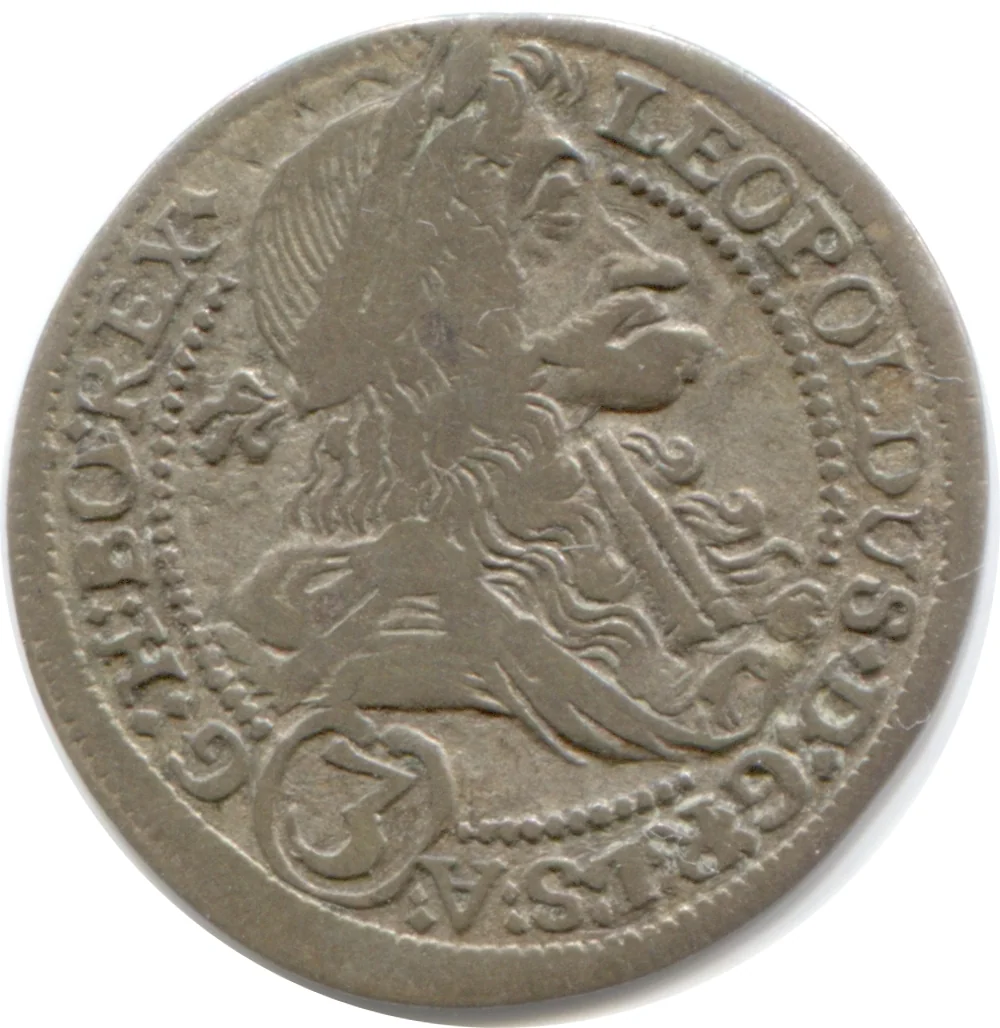
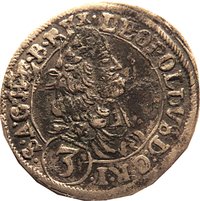
Leopold I of Habsburg (1640-1705), facing right. Circumscribed legend: "Leopoldus... rex".
Inscription:
LEOPOLDVS D G (3) R I S A G H B REX (1658) ou
LEOPOLDUS D G R I S (3) A G H B REX (1694) ou
LEOPOLDUS D G R I S A (3) G H BO REX (1703)
LEOPOLDUS D G R I S (3) A G H B REX (1694) ou
LEOPOLDUS D G R I S A (3) G H BO REX (1703)
Script: Latin
Reverse
Description:
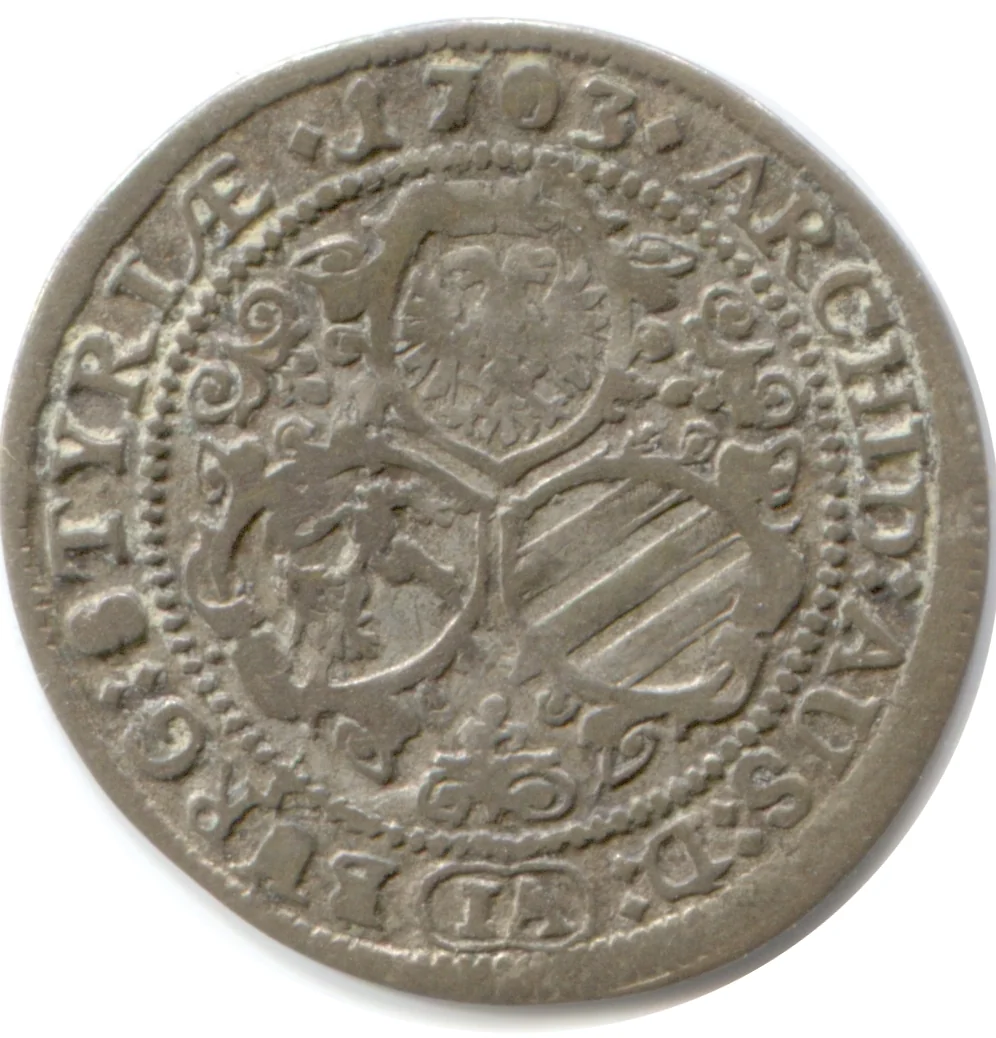
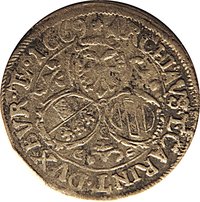
Three shields in a pearl circle, over a double-headed eagle flanked by Burgundy (right) and Styria (left). Legend: "Archidux Austriae Dux Burgundiae et Styriae". Date above, mint mark below dividing the legend.
Inscription:
ARCHI AVS DVX BVR STYRIÆ (1658) ou
ARCHID AUS DUX BUR STYRIÆ (1694) ou
ARCHID AUS D (IA) BURG STYRIÆ (1703)
ARCHID AUS DUX BUR STYRIÆ (1694) ou
ARCHID AUS D (IA) BURG STYRIÆ (1703)
Script: Latin
Edge
Mints
| Name | Mark |
|---|---|
| Graz | — |
Mintings
| Year | Mint Mark | Mintage | Quality | Collection |
|---|---|---|---|---|
| 1658 | HCK | — | ||
| 1659 | HCK | — | ||
| 1659 | L | — | ||
| 1660 | HCK | — | ||
| 1660 | L | — | ||
| 1661 | L | — | ||
| 1662 | — | — | ||
| 1662 | L | — | ||
| 1663 | L | — | ||
| 1664 | L | — | ||
| 1665 | SH | — | ||
| 1666 | — | — | ||
| 1666 | SH | — | ||
| 1667 | — | — | ||
| 1668 | — | — | ||
| 1669 | IAN | — | ||
| 1669 | IGW | — | ||
| 1670 | IGW | — | ||
| 1671 | — | — | ||
| 1673 | — | — | ||
| 1674 | — | — | ||
| 1675 | — | — | ||
| 1676 | — | — | ||
| 1677 | — | — | ||
| 1678 | — | — | ||
| 1679 | — | — | ||
| 1681 | — | — | ||
| 1682 | — | — | ||
| 1684 | — | — | ||
| 1686 | — | — | ||
| 1688 | — | — | ||
| 1693 | — | — | ||
| 1694 | — | — | ||
| 1695 | — | — | ||
| 1696 | — | — | ||
| 1697 | — | — | ||
| 1698 | — | — | ||
| 1699 | — | — | ||
| 1700 | — | — | ||
| 1701 | — | — | ||
| 1702 | — | — | ||
| 1703 | — | — | ||
| 1704 | — | — | ||
| 1705 | — | — |
Historical background
In 1658, the Austrian Habsburg monarchy, a sprawling and diverse empire, was grappling with a severe and protracted currency crisis rooted in the Thirty Years' War (1618-1648). The conflict had drained the imperial treasury, leading successive emperors, including the current Leopold I, to engage in rampant debasement of the coinage. By drastically reducing the silver content in coins like the Reichsthaler and its smaller denominations, the state sought to create more money from the same amount of precious metal, effectively financing its military and administrative costs through inflation. This practice, however, destroyed public trust in the currency and triggered a vicious cycle of rising prices and further monetary instability.
The situation was exacerbated by a chaotic monetary landscape across the Empire's various territories, which included Austria, Bohemia, and parts of Hungary. While the Emperor issued imperial coins, numerous regional princes and cities also minted their own, often of even lower quality. This proliferation of debased coins, alongside an influx of foreign currency from trade, created a bewildering and unreliable monetary system. Gresham's Law—where "bad money drives out good"—was in full effect: people hoarded older, higher-silver coins, leaving only the degraded currency in daily circulation, which further accelerated economic distress for the common population.
Leopold I's government recognized the need for reform, and the year 1658 fell within a period of attempted stabilization. Efforts were underway to standardize the coinage and restore its silver content, culminating more concretely in the Reichsmünzordnung (Imperial Coinage Ordinance) of 1659. However, in 1658 itself, the Empire remained in a precarious transition. The economy still suffered from the inflationary hangover of war finance, with trade hampered and prices volatile, highlighting the profound challenge of restoring fiscal and monetary order to a fragmented realm in the aftermath of continental conflict.
The situation was exacerbated by a chaotic monetary landscape across the Empire's various territories, which included Austria, Bohemia, and parts of Hungary. While the Emperor issued imperial coins, numerous regional princes and cities also minted their own, often of even lower quality. This proliferation of debased coins, alongside an influx of foreign currency from trade, created a bewildering and unreliable monetary system. Gresham's Law—where "bad money drives out good"—was in full effect: people hoarded older, higher-silver coins, leaving only the degraded currency in daily circulation, which further accelerated economic distress for the common population.
Leopold I's government recognized the need for reform, and the year 1658 fell within a period of attempted stabilization. Efforts were underway to standardize the coinage and restore its silver content, culminating more concretely in the Reichsmünzordnung (Imperial Coinage Ordinance) of 1659. However, in 1658 itself, the Empire remained in a precarious transition. The economy still suffered from the inflationary hangover of war finance, with trade hampered and prices volatile, highlighting the profound challenge of restoring fiscal and monetary order to a fragmented realm in the aftermath of continental conflict.

🌟 Limited