

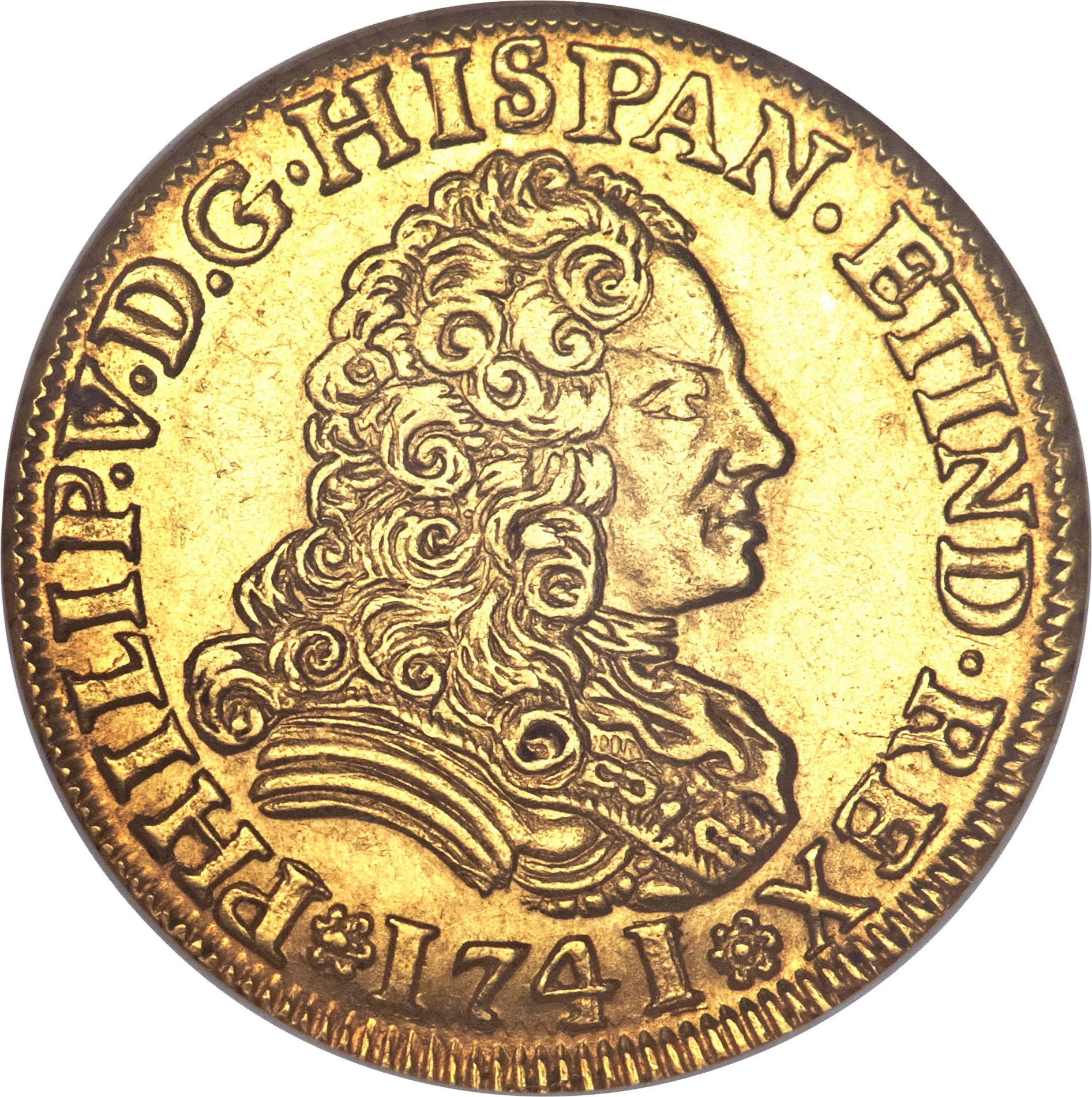
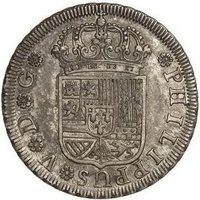
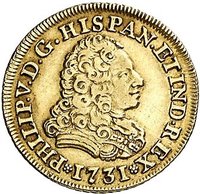
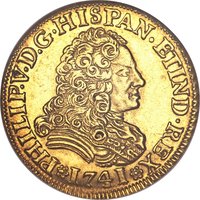
Obverse
Description:
Armored bust of Philip V in profile.
Inscription:
PHILIP · V · D · G · HISPAN · ET IND · REX
❀ 1741 ❀
❀ 1741 ❀
Script: Latin
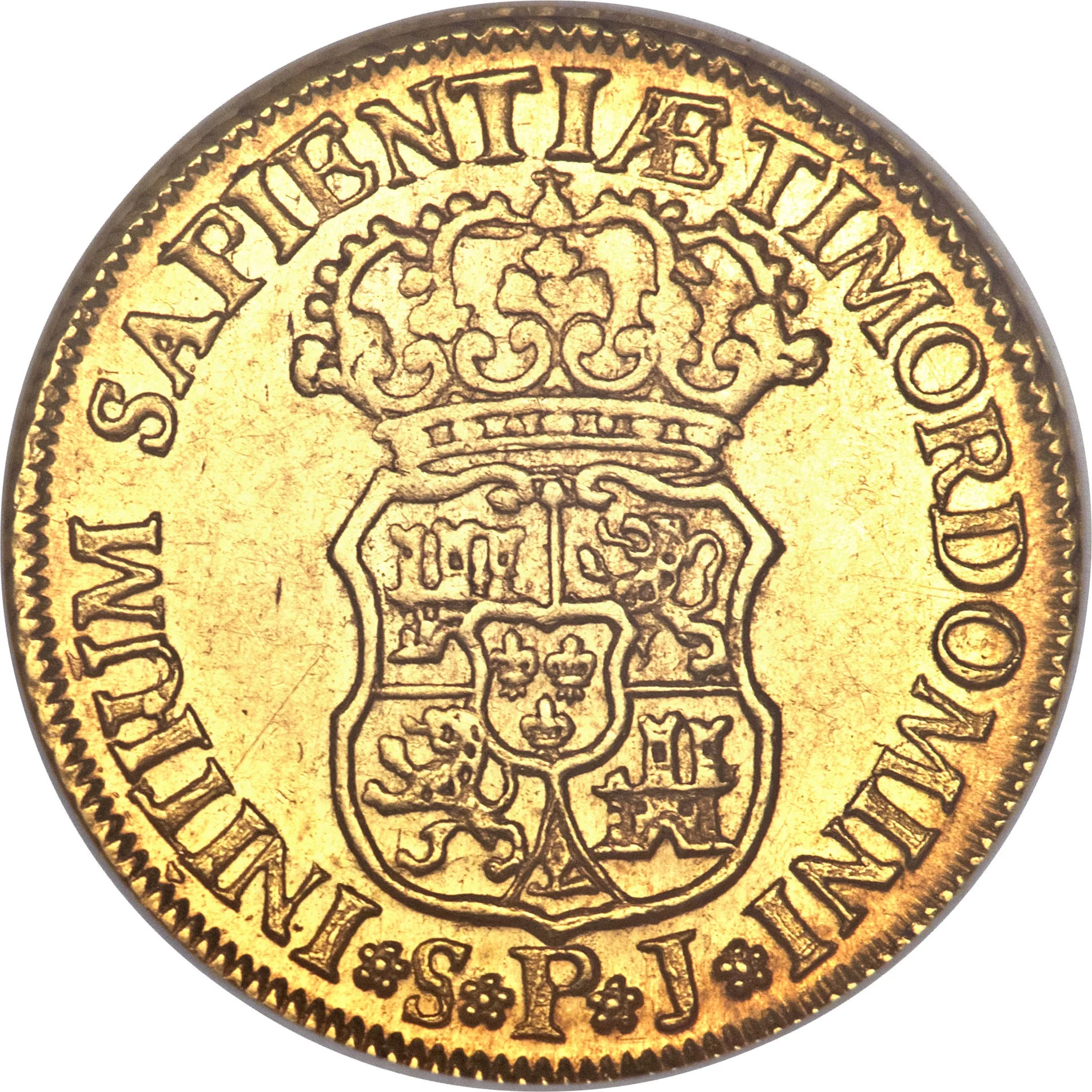
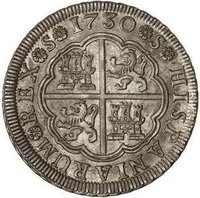
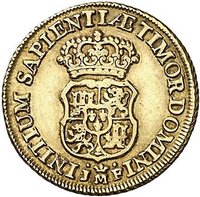
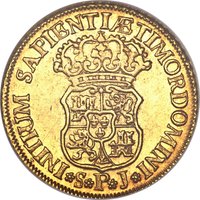
Reverse
Description:
Royal arms of Spain.
Inscription:
INITIUM SAPIENTIÆ TIMOR DOMINI
❀ S ❀ P ❀ J ❀
❀ S ❀ P ❀ J ❀
Script: Latin
Edge
Categories
| Symbols> Coat of Arms |
Mints
| Name | Mark |
|---|---|
| Royal Mint of Seville | S |
Mintings
| Year | Mint Mark | Mintage | Quality | Collection |
|---|---|---|---|---|
| 1730 | S | — | ||
| 1731 | SPA | — | ||
| 1732 | SPA | — | ||
| 1733 | SPA | — | ||
| 1734 | SPA | — | ||
| 1735 | SAP | — | ||
| 1736 | SAP | — | ||
| 1737 | SPJ | — | ||
| 1739 | SPJ | — | ||
| 1740 | SPJ | — | ||
| 1741 | SPJ | — | ||
| 1742 | SPJ | — |
Historical background
In 1730, Spain's monetary system was a complex and troubled reflection of the wider Spanish Empire's economic struggles. The primary currency was the silver real and its higher unit, the peso (or piece of eight, worth 8 reales), which had historically been the lifeblood of the empire, sourced from American mines in Potosí and Mexico. However, decades of costly European wars, declining silver shipments, and chronic budget deficits had led successive monarchs, including the current Bourbon king Philip V, to repeatedly debase the coinage. This meant reducing the precious metal content in coins to create more money from the same bullion, a short-term fiscal fix with severe long-term consequences.
The result was a chaotic circulation of coins of varying weights and purities, alongside older, full-weight coins that were often hoarded or exported. This effectively created a two-tier system: good, heavy coins used for foreign trade and savings, and lighter, debased coins for daily domestic use. The situation was further complicated by the circulation of numerous foreign coins, particularly from Spanish territories in Italy and the Netherlands, and the persistent use of outdated vellón currency—a nearly worthless copper alloy—for small transactions, which fueled price inflation and public distrust.
Recognizing the paralyzing effect this had on commerce and royal finance, the Bourbon administration was actively seeking reform. The decade preceding 1730 saw several failed attempts at stabilization. In 1728, a major project had begun with the establishment of a new royal mint in Madrid (Real Fábrica de Moneda) equipped with modern machinery, aiming to produce uniform, high-quality coins to restore confidence. Therefore, the currency situation in 1730 was one of profound disorder, but also a pivotal moment on the cusp of significant change, as the crown prepared to impose a standardized national coinage that would eventually be realized with the successful monetary reform of 1737.
The result was a chaotic circulation of coins of varying weights and purities, alongside older, full-weight coins that were often hoarded or exported. This effectively created a two-tier system: good, heavy coins used for foreign trade and savings, and lighter, debased coins for daily domestic use. The situation was further complicated by the circulation of numerous foreign coins, particularly from Spanish territories in Italy and the Netherlands, and the persistent use of outdated vellón currency—a nearly worthless copper alloy—for small transactions, which fueled price inflation and public distrust.
Recognizing the paralyzing effect this had on commerce and royal finance, the Bourbon administration was actively seeking reform. The decade preceding 1730 saw several failed attempts at stabilization. In 1728, a major project had begun with the establishment of a new royal mint in Madrid (Real Fábrica de Moneda) equipped with modern machinery, aiming to produce uniform, high-quality coins to restore confidence. Therefore, the currency situation in 1730 was one of profound disorder, but also a pivotal moment on the cusp of significant change, as the crown prepared to impose a standardized national coinage that would eventually be realized with the successful monetary reform of 1737.
Series: 1730 Spain circulation coins
✨ Legendary