

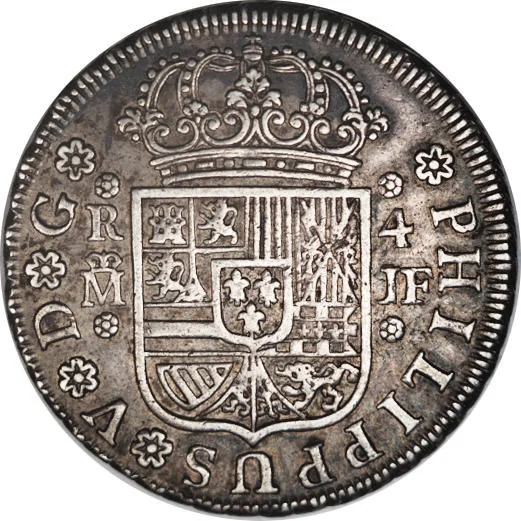
Obverse
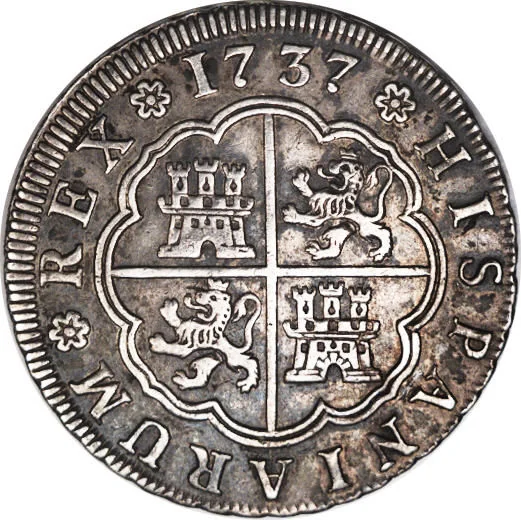
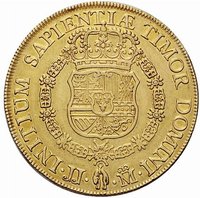
Reverse
Description:
Castile and León's coat of arms in an octolobe.
Inscription:
❀ 1737 ❀ HISPANIARUM ❀ REX
Script: Latin
Edge
Categories
| Symbols> Coat of Arms |
Mints
| Name | Mark |
|---|---|
| Royal Mint of Segovia | — |
| Royal Mint of Madrid | (M) |
| Royal Mint of Seville | (S) |
Mintings
| Year | Mint Mark | Mintage | Quality | Collection |
|---|---|---|---|---|
| 1728 | F | — | ||
| 1728 | MJJ | — | ||
| 1728 | SP | — | ||
| 1729 | F | — | ||
| 1729 | SP | — | ||
| 1731 | MF | 207,349 | ||
| 1732 | MJF | 58,871 | ||
| 1734 | MJF | 509,303 | ||
| 1735 | MJF | — | ||
| 1737 | MJF | 144,500 | ||
| 1738 | MJF | 238,935 | ||
| 1740 | MJF | 202,623 |
Historical background
In 1728, Spain's currency situation was a complex and troubled legacy of the late Habsburg era, characterized by severe debasement and economic stagnation. The primary circulating coin, the silver real, had been steadily reduced in precious metal content over the preceding decades to fund the Crown's endless military engagements and state expenses. This resulted in a bewildering variety of coins of differing intrinsic values, both domestic and foreign (especially French and Portuguese), circulating simultaneously. The state's chronic shortage of silver and gold bullion, exacerbated by declining inflows from the American colonies, meant the monetary system was fundamentally weak and unreliable, hampering both commerce and state finance.
The year itself was not one of major monetary reform but existed within a tense period of anticipation. King Philip V, the first Bourbon monarch, had been attempting to centralize and modernize the state following the War of Spanish Succession (1701-1714). His government recognized the monetary chaos as a critical obstacle to economic recovery and was actively studying solutions. Discussions were underway for a comprehensive recoinage and standardization, a policy that would eventually culminate in the pivotal Pragmática of 1728 (issued later in the year on October 14th), which ordered the creation of new, pure-standard silver coins minted in modern machinery.
Thus, the currency situation in 1728 represents a pivotal moment of transition. It was the final year of an old, degraded system and the dawn of a Bourbon reform effort aimed at stability. The planned recoinage sought to withdraw debased currency from circulation and replace it with trustworthy, uniformly minted coinage, hoping to restore public confidence, facilitate trade, and strengthen royal authority—a necessary foundation for the broader economic policies of the Enlightenment-era reformers who would follow.
The year itself was not one of major monetary reform but existed within a tense period of anticipation. King Philip V, the first Bourbon monarch, had been attempting to centralize and modernize the state following the War of Spanish Succession (1701-1714). His government recognized the monetary chaos as a critical obstacle to economic recovery and was actively studying solutions. Discussions were underway for a comprehensive recoinage and standardization, a policy that would eventually culminate in the pivotal Pragmática of 1728 (issued later in the year on October 14th), which ordered the creation of new, pure-standard silver coins minted in modern machinery.
Thus, the currency situation in 1728 represents a pivotal moment of transition. It was the final year of an old, degraded system and the dawn of a Bourbon reform effort aimed at stability. The planned recoinage sought to withdraw debased currency from circulation and replace it with trustworthy, uniformly minted coinage, hoping to restore public confidence, facilitate trade, and strengthen royal authority—a necessary foundation for the broader economic policies of the Enlightenment-era reformers who would follow.
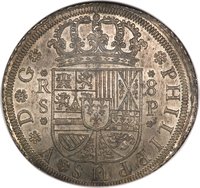
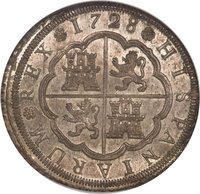

💎 Extremely Rare