

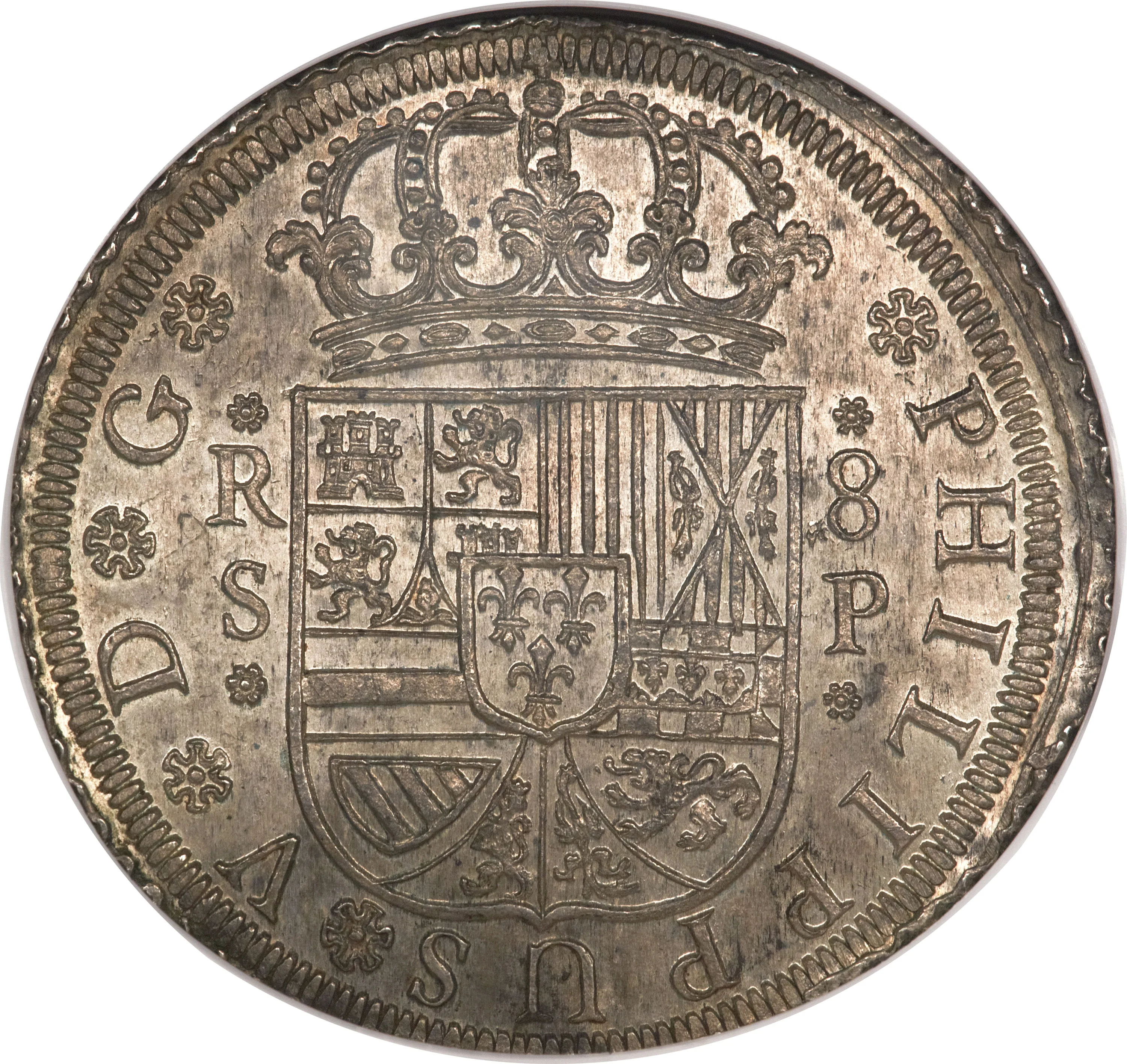

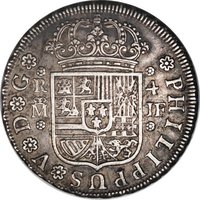
Obverse
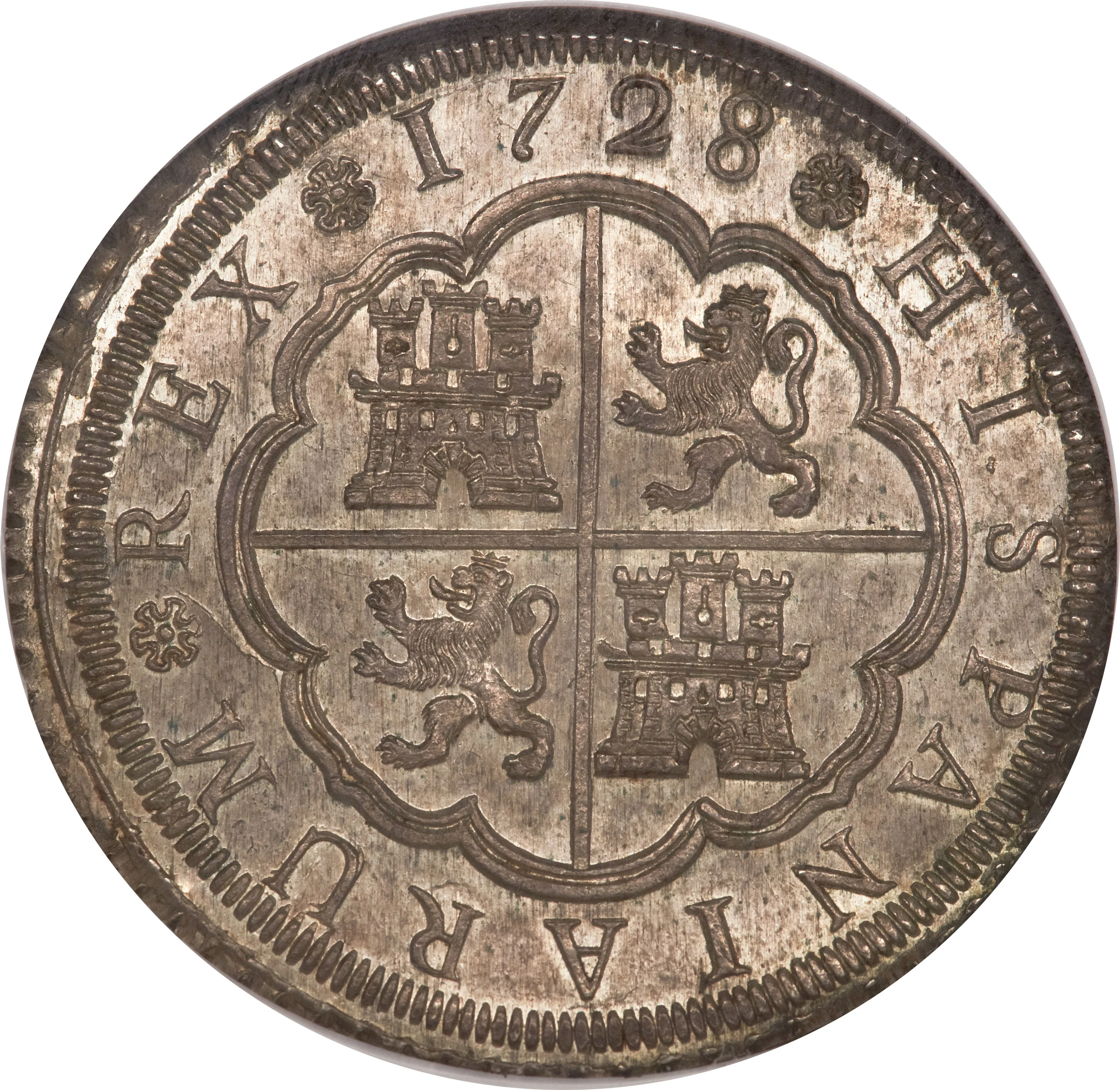
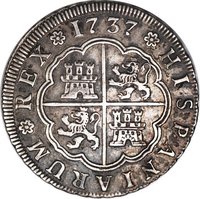
Reverse
Description:
Cross with castles and lions in an octolobe.
Inscription:
❀ HISPANIARVM ❀ REX ❀ 1728
Script: Latin
Edge
Embossed pattern
Categories
| Animal> Feline |
| Building> Castle or fortification |
| Symbols> Coat of Arms |
| Symbol> Cross |
Mints
| Name | Mark |
|---|---|
| Royal Mint of Segovia | — |
| Royal Mint of Madrid | (M) |
| Royal Mint of Seville | S |
Mintings
| Year | Mint Mark | Mintage | Quality | Collection |
|---|---|---|---|---|
| 1727 | F | — | ||
| 1728 | F | — | ||
| 1728 | MJJ | — | ||
| 1728 | SP | — | ||
| 1729 | F | — | ||
| 1729 | MJJ | — | ||
| 1729 | SP | — | ||
| 1730 | MJF | — | ||
| 1731 | MF | — | ||
| 1731 | MJF | — | ||
| 1732 | MF | — | ||
| 1732 | MJF | — | ||
| 1734 | MJF | 423,419 | ||
| 1740 | MJF | 75,369 |
Historical background
In 1727, Spain's currency situation was one of profound instability and debasement, a direct legacy of the costly wars and economic policies of the preceding Habsburg dynasty and the early Bourbon monarchs. The primary circulating coin, the silver real, had been severely degraded. The government, perpetually short of funds to finance its military ambitions and court expenses, repeatedly resorted to reducing the silver content in newly minted coins while demanding they be accepted at their old, higher face value. This practice, combined with the circulation of heavily worn older coins of better quality, created a chaotic monetary environment where the intrinsic metal value of a coin often differed wildly from its nominal value, undermining both domestic trade and foreign confidence.
The year itself fell within the early reign of King Philip V, the first Bourbon king, who was attempting to centralize and reform the Spanish state. His government recognized the monetary chaos as a critical problem. In response, a major currency reform was decreed in 1728, the planning for which was undoubtedly underway in 1727. The goal was to replace the myriad of debased and irregular coins with a new, stable national silver currency based on the real de plata antigua (old plate real) standard. This reform aimed to restore confidence by reintroducing high-purity silver coins, thereby simplifying the complex and fraudulent system and laying a foundation for economic recovery.
Consequently, 1727 represents a pivotal moment of transition. It was a year of lingering crisis, with merchants and the public grappling with an unreliable medium of exchange, which stifled commerce and contributed to inflation. Yet, it was also a year of anticipation, as the state prepared to implement a decisive top-down reform. The success of this 1728 reform was partial; while it standardized the coinage, Spain's underlying fiscal pressures—driven by its empire and European conflicts—would continue to pose long-term challenges to maintaining a sound currency throughout the 18th century.
The year itself fell within the early reign of King Philip V, the first Bourbon king, who was attempting to centralize and reform the Spanish state. His government recognized the monetary chaos as a critical problem. In response, a major currency reform was decreed in 1728, the planning for which was undoubtedly underway in 1727. The goal was to replace the myriad of debased and irregular coins with a new, stable national silver currency based on the real de plata antigua (old plate real) standard. This reform aimed to restore confidence by reintroducing high-purity silver coins, thereby simplifying the complex and fraudulent system and laying a foundation for economic recovery.
Consequently, 1727 represents a pivotal moment of transition. It was a year of lingering crisis, with merchants and the public grappling with an unreliable medium of exchange, which stifled commerce and contributed to inflation. Yet, it was also a year of anticipation, as the state prepared to implement a decisive top-down reform. The success of this 1728 reform was partial; while it standardized the coinage, Spain's underlying fiscal pressures—driven by its empire and European conflicts—would continue to pose long-term challenges to maintaining a sound currency throughout the 18th century.
✨ Legendary