

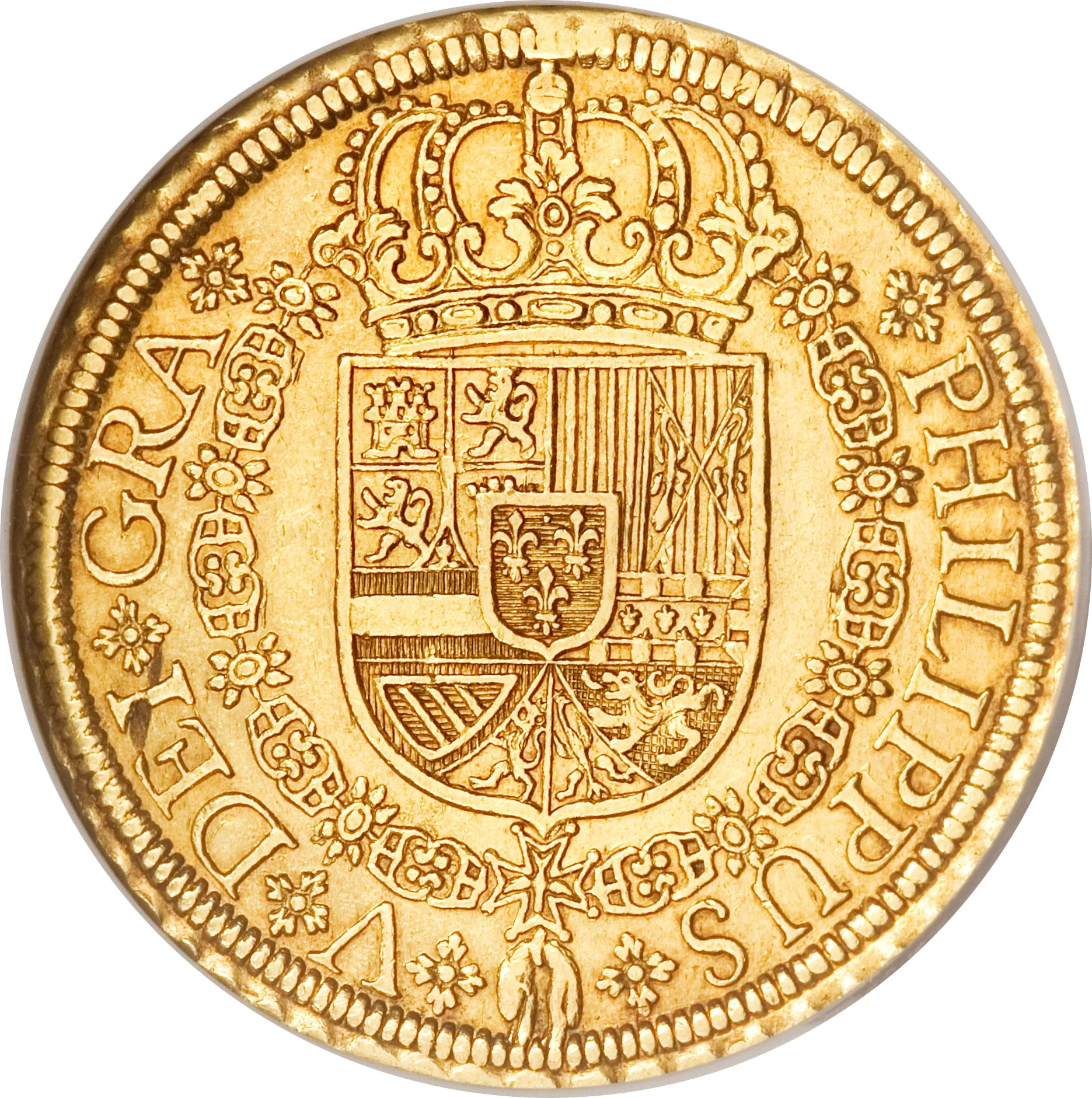
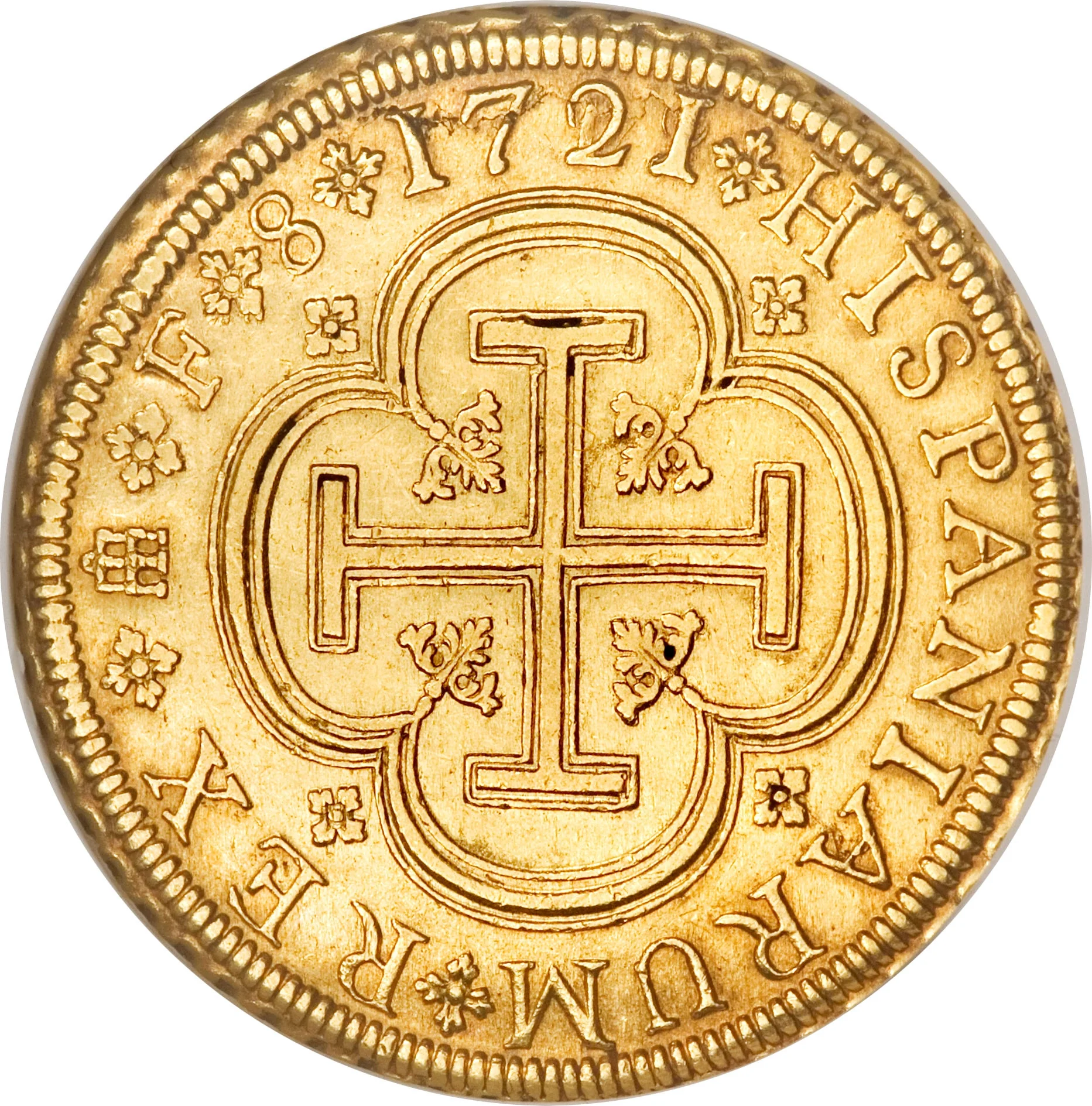
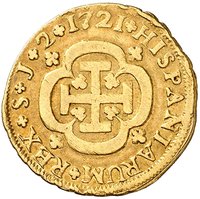
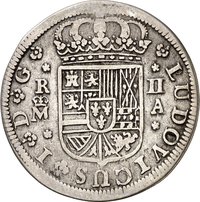
Obverse
Description:
Crowned Spanish coat of arms with the Golden Fleece.
Inscription:
✤ PHILIPPUS ✤ ✤ V ✤ DEI ✤ GRA ✤
Script: Latin
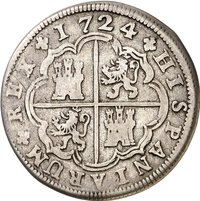
Reverse
Edge
Categories
| Symbols> Coat of Arms |
| Symbol> Cross |
Mints
| Name | Mark |
|---|---|
| Royal Mint of Segovia | — |
Mintings
| Year | Mint Mark | Mintage | Quality | Collection |
|---|---|---|---|---|
| 1721 | F | — | ||
| 1723 | F | — |
Historical background
In 1721, Spain's currency system was a complex and troubled reflection of the broader Spanish Empire's economic and political struggles. The nation was still grappling with the immense debts and financial exhaustion following the War of the Spanish Succession (1701-1714), which had concluded with the Bourbon Philip V on the throne. The royal treasury was chronically depleted, leading to repeated debasements of the coinage. The most common circulating coins, silver reales and the gold escudo, often existed alongside a bewildering variety of older, clipped, and foreign coins, creating a chaotic monetary environment where the intrinsic metal value frequently differed from the official face value.
This period saw the early efforts of the new Bourbon administration to impose order through centralization, a hallmark of their reformist agenda. In 1718, a royal decree had attempted to stabilize the system by introducing new milled coins from the Madrid mint to replace the old, hammer-struck currency, which was easily clipped and counterfeited. However, by 1721, this recoinage process was still incomplete and disruptive. The government's attempt to call in old coin and reissue it at a higher face value (a de facto devaluation) caused public distrust and economic friction, as people hoarded older, purer coins.
Consequently, the monetary situation in 1721 was one of transition and instability. While the Crown recognized the need for a uniform and reliable currency to facilitate trade and tax collection, practical implementation lagged behind policy. The circulation of adulterated coinage hampered domestic commerce and complicated Spain's international trade, as foreign merchants discounted Spanish silver due to its uncertain quality. Thus, the currency landscape remained a significant obstacle to the broader economic recovery that the Bourbon reforms sought to achieve.
This period saw the early efforts of the new Bourbon administration to impose order through centralization, a hallmark of their reformist agenda. In 1718, a royal decree had attempted to stabilize the system by introducing new milled coins from the Madrid mint to replace the old, hammer-struck currency, which was easily clipped and counterfeited. However, by 1721, this recoinage process was still incomplete and disruptive. The government's attempt to call in old coin and reissue it at a higher face value (a de facto devaluation) caused public distrust and economic friction, as people hoarded older, purer coins.
Consequently, the monetary situation in 1721 was one of transition and instability. While the Crown recognized the need for a uniform and reliable currency to facilitate trade and tax collection, practical implementation lagged behind policy. The circulation of adulterated coinage hampered domestic commerce and complicated Spain's international trade, as foreign merchants discounted Spanish silver due to its uncertain quality. Thus, the currency landscape remained a significant obstacle to the broader economic recovery that the Bourbon reforms sought to achieve.
✨ Legendary