

4 Merks – Scotland
United Kingdom
Context
Year: 1664
Country: United Kingdom 
Issuer: Scotland 
Ruler: Charles II
Currency:
(1136—1707)
Demonetized: Yes
Material
References
KM: #Click to copy to clipboard104
Numista: #25961
Value
Bullion value: $81.79
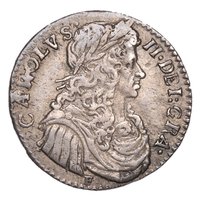
Obverse
Description:
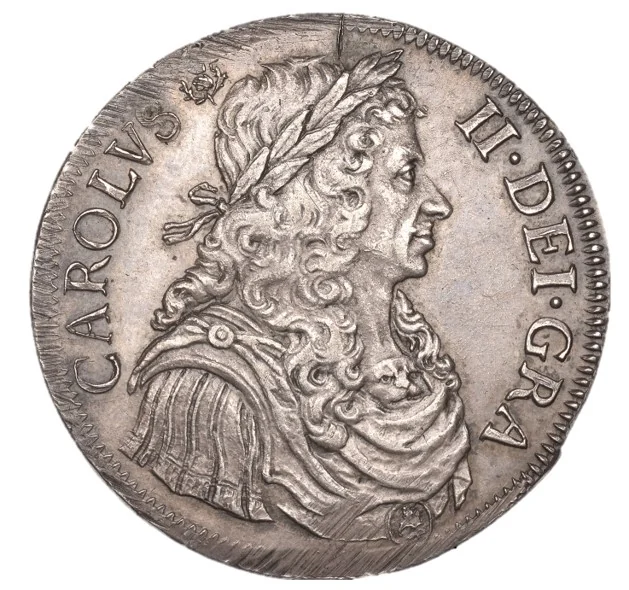
Charles II bust facing right, thistle above.
Inscription:
CAROLVS II · DEI · GRA
Script: Latin
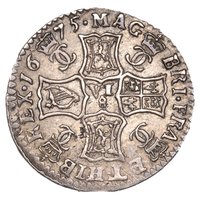
Reverse
Description:
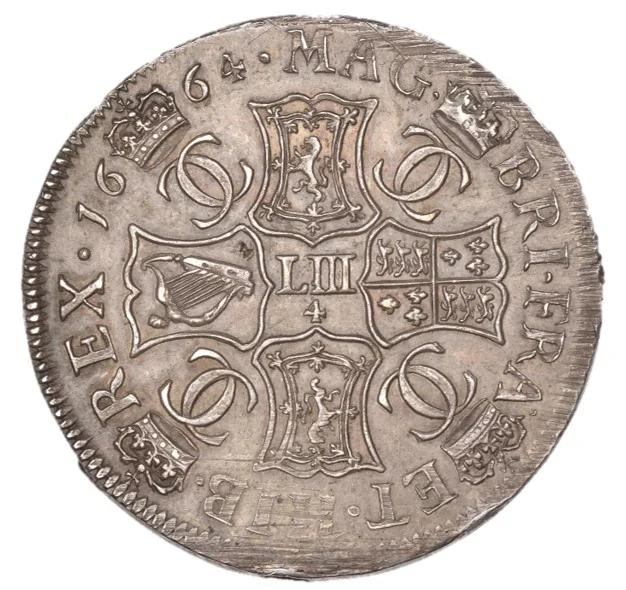
Crossed arms, conjoined Cs in each quarter, central value.
Inscription:
· MAG · BRI · FRA · ET · HIB · REX · 1664
Script: Latin
Edge
Mints
| Name | Mark |
|---|---|
| Edinburgh | — |
Mintings
| Year | Mint Mark | Mintage | Quality | Collection |
|---|---|---|---|---|
| 1664 | — | — |
Historical background
In 1664, Scotland operated under a distinct monetary system from its southern neighbour, England, though the two were linked by the regal union of the crowns. The official unit of account was the pound Scots (£Scots), which had a fixed exchange rate of 12:1 with the pound Sterling (£Sterling), meaning £12 Scots equalled £1 Sterling. This reflected Scotland’s weaker economy and trade position. The physical currency in circulation was a complex mixture of domestic and foreign coin. Scotland minted its own silver coins, such as the merk (worth 13 shillings and 4 pence Scots) and the dollar (worth 4 merks or 56 shillings Scots), but these were often scarce.
A significant problem was the widespread circulation of clipped, worn, and counterfeit foreign coins, particularly Spanish pieces of eight and French écus, which entered the country through trade. The intrinsic silver value of these foreign coins frequently exceeded their official assigned value in pounds Scots, leading to their being hoarded or melted down for bullion. This created a chronic shortage of reliable specie for everyday transactions, hampering commerce and causing public distrust in the coinage. The Scottish government under the Privy Council of King Charles II struggled to control this situation through repeated proclamations that set and adjusted exchange rates for dozens of foreign coin types.
The year 1664 itself saw no major monetary reform, but it existed within a period of persistent instability that would ultimately lead to a significant, though failed, attempt at reform in 1681. The fundamental issue was Scotland’s adverse balance of trade, which drained silver out of the country. Consequently, the economy relied heavily on a chaotic system of credit, barter, and unstable foreign coin, with the official pound Scots serving largely as a notional standard for accounting rather than a robust physical currency. This monetary fragility was a symptom of Scotland’s broader economic challenges in the late 17th century.
A significant problem was the widespread circulation of clipped, worn, and counterfeit foreign coins, particularly Spanish pieces of eight and French écus, which entered the country through trade. The intrinsic silver value of these foreign coins frequently exceeded their official assigned value in pounds Scots, leading to their being hoarded or melted down for bullion. This created a chronic shortage of reliable specie for everyday transactions, hampering commerce and causing public distrust in the coinage. The Scottish government under the Privy Council of King Charles II struggled to control this situation through repeated proclamations that set and adjusted exchange rates for dozens of foreign coin types.
The year 1664 itself saw no major monetary reform, but it existed within a period of persistent instability that would ultimately lead to a significant, though failed, attempt at reform in 1681. The fundamental issue was Scotland’s adverse balance of trade, which drained silver out of the country. Consequently, the economy relied heavily on a chaotic system of credit, barter, and unstable foreign coin, with the official pound Scots serving largely as a notional standard for accounting rather than a robust physical currency. This monetary fragility was a symptom of Scotland’s broader economic challenges in the late 17th century.
✨ Legendary