

½ Merk – Scotland
United Kingdom
Context
Year: 1675
Country: United Kingdom 
Issuer: Scotland 
Ruler: Charles II
Currency:
(1136—1707)
Demonetized: Yes
References
KM: #Click to copy to clipboard101
Numista: #89745
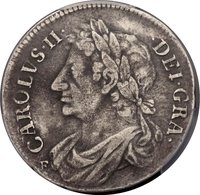
Obverse
Description:
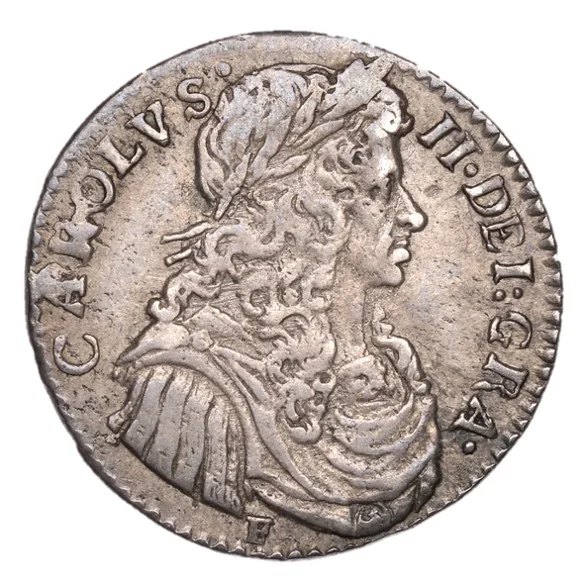
Charles II bust facing right, F below.
Inscription:
CAROLVS II · DEI · GRA ·
Script: Latin
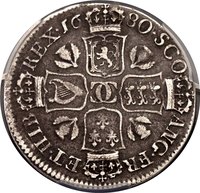
Reverse
Description:
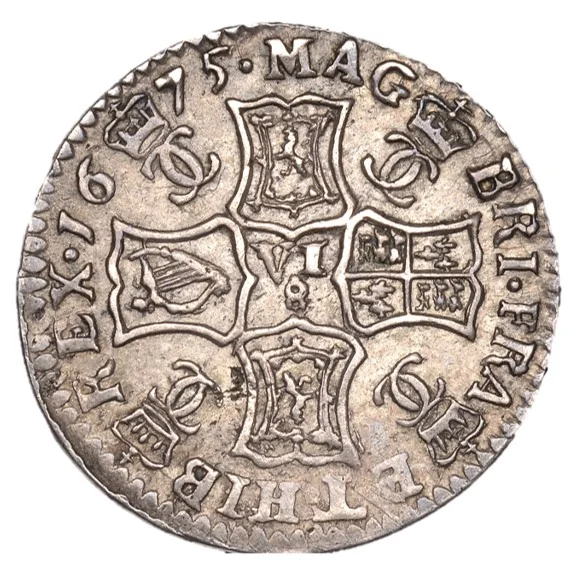
Crossed arms, conjoined Cs in each quarter, central value.
Inscription:
· MAG · BRI · FRA · ET · HIB · REX · 1675
Script: Latin
Edge
Mints
| Name | Mark |
|---|---|
| Edinburgh | — |
Mintings
| Year | Mint Mark | Mintage | Quality | Collection |
|---|---|---|---|---|
| 1675 | — | — |
Historical background
In 1675, Scotland operated under a distinct monetary system from its southern neighbour, England, though the two were linked by the Crown. The official unit of account was the pound Scots (£Scots), which had been pegged at a fixed exchange rate of £1 Sterling to £12 Scots since 1603. However, this official rate belied a complex and often chaotic reality. The physical currency in circulation was a heterogeneous mix of domestic and foreign coin, including French écus, Dutch rijksdaalders, and Spanish-American pieces of eight, alongside a limited and often debased Scottish mint output. This reliance on foreign specie made the Scottish economy vulnerable to international currency flows and exchange fluctuations.
The period was marked by a chronic shortage of high-value coinage for trade and a glut of low-denomination coins, causing significant economic difficulties. The Scottish Mint in Edinburgh under Charles II produced primarily small billon (base silver) coins like turners and bawbees, which were prone to counterfeiting and clipping. This scarcity of reliable, high-value currency hampered larger commercial transactions and interstate trade, forcing merchants to rely heavily on cumbersome foreign silver and even written credit notes. The situation was exacerbated by the fact that much of Scotland's own limited silver coinage was being drained to England in exchange for needed goods, as Sterling was universally preferred.
Consequently, the 1670s were a time of monetary instability and debate preceding more drastic actions. Proposals for currency reform, including calls for a new minting of higher denomination Scottish coins to stem the outflow, were actively discussed by the Privy Council of Scotland. These debates would eventually culminate in the ambitious, but disastrous, Scottish recoinage project of 1686, an attempt to rectify the shortages by issuing a new silver coinage at the old, unrealistic 12:1 parity. The difficulties of 1675 thus set the stage for a fiscal crisis that would severely damage the Scottish economy in the following decade.
The period was marked by a chronic shortage of high-value coinage for trade and a glut of low-denomination coins, causing significant economic difficulties. The Scottish Mint in Edinburgh under Charles II produced primarily small billon (base silver) coins like turners and bawbees, which were prone to counterfeiting and clipping. This scarcity of reliable, high-value currency hampered larger commercial transactions and interstate trade, forcing merchants to rely heavily on cumbersome foreign silver and even written credit notes. The situation was exacerbated by the fact that much of Scotland's own limited silver coinage was being drained to England in exchange for needed goods, as Sterling was universally preferred.
Consequently, the 1670s were a time of monetary instability and debate preceding more drastic actions. Proposals for currency reform, including calls for a new minting of higher denomination Scottish coins to stem the outflow, were actively discussed by the Privy Council of Scotland. These debates would eventually culminate in the ambitious, but disastrous, Scottish recoinage project of 1686, an attempt to rectify the shortages by issuing a new silver coinage at the old, unrealistic 12:1 parity. The difficulties of 1675 thus set the stage for a fiscal crisis that would severely damage the Scottish economy in the following decade.
✨ Legendary