

10 Liards – Austrian Netherlands
Belgium
Context
Year: 1791
Country: Belgium 
Issuer: Austrian Netherlands
Ruler: Leopold II
Currency:
(1744—1798)
Demonetized: Yes
Total mintage: 106,423
Material
References
KM: #Click to copy to clipboard54
Numista: #24894
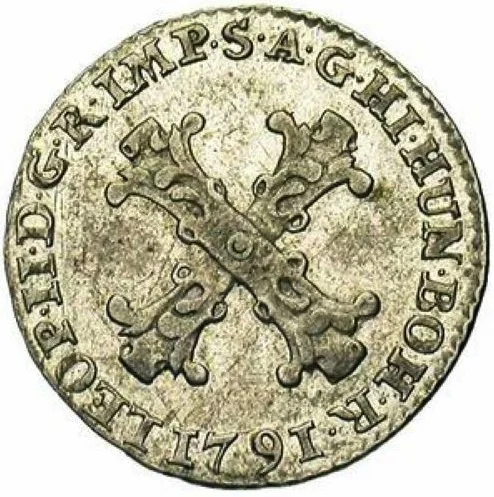
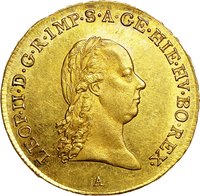
Obverse
Description:
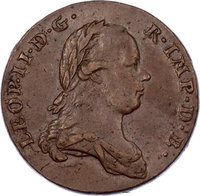
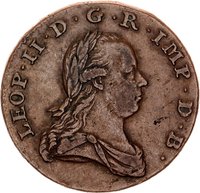
Burgundian cross with the legend: LEO II DEI GRATIA ROMANORUM IMPERATOR AUGUSTUS GERMANIAE HIEROSOLYMAE HUNGARIAE BOHEMIAE REX
Inscription:
LEOP·II·D·G·R·IMP·S·A·G·HI·HUN·BOH·R·
1791
1791
Script: Latin
Engraver: Théodore Van Berckel
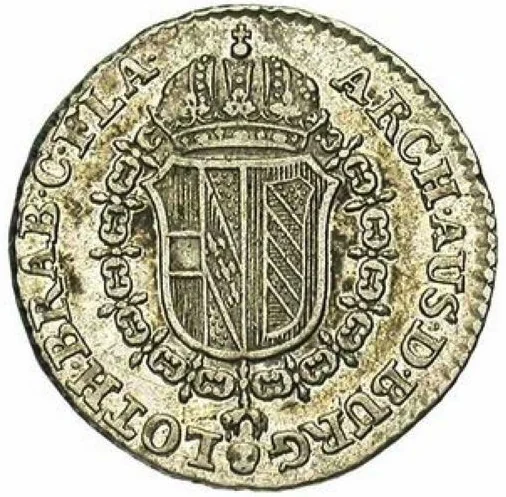
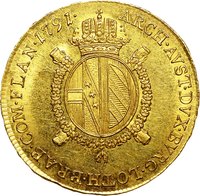
Reverse
Description:
Crowned Habsburg-Lorraine arms with the Golden Fleece chain, mint mark below. Latin legend surrounds.
Inscription:
ARCH·AUS·D·BURG LOTH·BRAB·C·FLA·
Script: Latin
Engraver: Théodore Van Berckel
Edge
Reeded
Mintings
| Year | Mint Mark | Mintage | Quality | Collection |
|---|---|---|---|---|
| 1791 | — | 106,423 |
Historical background
In 1791, the currency situation in the Austrian Netherlands (approximately modern-day Belgium and Luxembourg) was complex and unstable, reflecting the province's contested political and economic position. The region operated on a bimetallic system of silver patards and gold ducats, but its circulation was dominated by a chaotic mix of overvalued foreign coins, particularly from the neighboring Dutch Republic. The Austrian government in Vienna, distant and often inattentive to local commerce, struggled to enforce its official exchange rates, leading to widespread confusion and facilitating arbitrage by merchants and money-changers.
This monetary disorder was exacerbated by a chronic shortage of small-denomination coins for everyday transactions, which stifled local trade and irritated the populace. Furthermore, the Austrian authorities, seeking revenue, had repeatedly debased the coinage by reducing its precious metal content, a practice that eroded public trust. This financial instability mirrored and amplified the growing political discontent with Habsburg rule, as both urban merchants and rural subjects suffered from the unpredictable and unfavorable economic conditions.
Ultimately, the currency crisis of 1791 was a symptom of deeper maladies: a lack of integrated economic policy, the region's role as a buffer between major powers, and the impending shockwaves from the French Revolution. Within a few years, this instability would be overtaken by revolutionary events, as French Revolutionary forces invaded in 1792, leading to a decade of war and the eventual annexation of the territory, which imposed an entirely new monetary system.
This monetary disorder was exacerbated by a chronic shortage of small-denomination coins for everyday transactions, which stifled local trade and irritated the populace. Furthermore, the Austrian authorities, seeking revenue, had repeatedly debased the coinage by reducing its precious metal content, a practice that eroded public trust. This financial instability mirrored and amplified the growing political discontent with Habsburg rule, as both urban merchants and rural subjects suffered from the unpredictable and unfavorable economic conditions.
Ultimately, the currency crisis of 1791 was a symptom of deeper maladies: a lack of integrated economic policy, the region's role as a buffer between major powers, and the impending shockwaves from the French Revolution. Within a few years, this instability would be overtaken by revolutionary events, as French Revolutionary forces invaded in 1792, leading to a decade of war and the eventual annexation of the territory, which imposed an entirely new monetary system.
✨ Legendary