

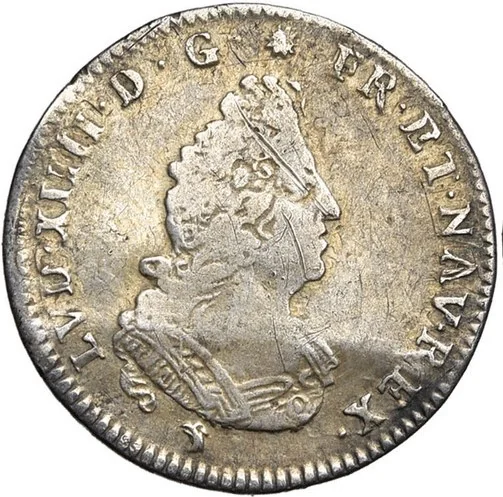
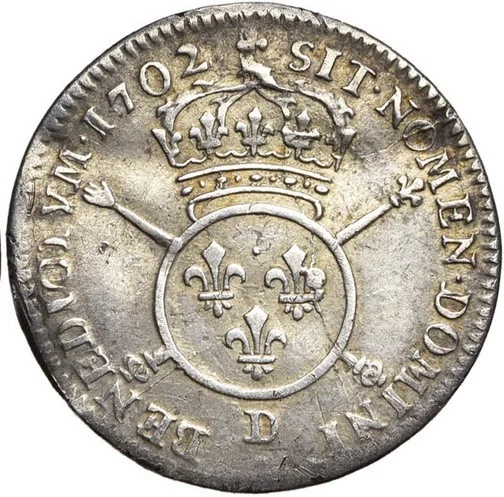
1⁄12 silver ecu – France
Add to wishlist
France
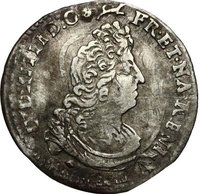
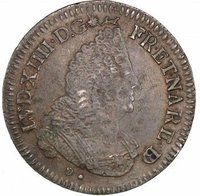
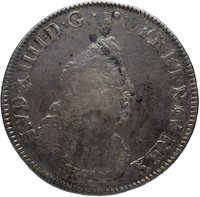
Obverse
Description:
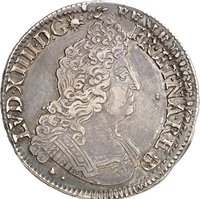
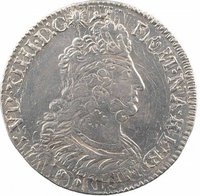
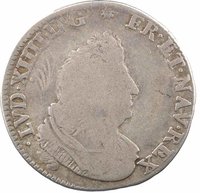
Bust of Louis XIV, cuirassed and wigged; below, distinct from the master engraver.
Inscription:
LVD • XIIII • D • G • ☀ FR • ET • NAV • REX •
Script: Latin
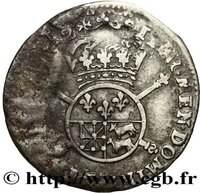
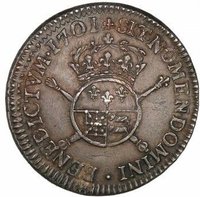
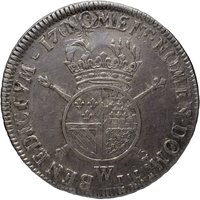
Reverse
Description:
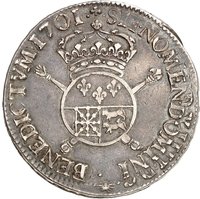
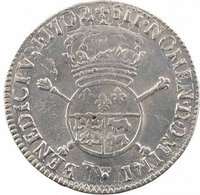
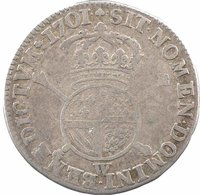
Shield of France crowned over a hand of justice and fleur-de-lis scepter; workshop mark below.
Inscription:
SIT • NOMEN • DOMINI BENEDICTVM • 1702 ♣
Script: Latin
Edge
Mints
| Name | Mark |
|---|---|
| Aix-en-Provence | & |
| Rennes | 9 |
| Monnaie de Paris | A |
| Metz | AA |
| Rouen | B |
| Caen | C |
| Lyon | D |
| Tours | E |
| Poitiers | G |
| La Rochelle | H |
| Limoges | I |
| Toulouse | M |
| Montpellier | N |
| Dijon | P |
| Troyes | S |
| Nantes | T |
| Turin | V |
| Lille | W |
| Amiens | X |
| Bourges | Y |
Mintings
Historical background
In 1701, France stood on the precipice of the War of the Spanish Succession, a conflict that would place immense strain on its financial system. The currency situation was a direct legacy of Louis XIV's costly wars and extravagant court, which had drained the royal treasury. To meet these expenses, the Sun King's finance minister, Michel Chamillart, had resorted to repeated devaluations and manipulations of the coinage. The livre tournois was the unit of account, but its value in actual silver coin was unstable, having been officially reduced several times in the preceding decades. This created a complex and often chaotic monetary environment where the face value of coins was frequently higher than their intrinsic metal content.
The system relied on three main types of money: gold coins like the louis d'or, silver coins like the écu, and vast quantities of low-quality copper liards for everyday transactions. A key problem was the practice of augmentation and diminution—the royal edicts that arbitrarily raised or lowered the official valuation of specific coins in livres. This was done to draw bullion into the mint for recoinage (a profit for the crown) or to adjust to international exchange rates, but it caused confusion, hindered trade, and eroded public trust. Merchants and foreign bankers had to consult constantly updated bulletins to know the current legal worth of the coinage in their hands.
Consequently, France suffered from a chronic shortage of sound, full-weight specie. Good coins were hoarded or exported, following Gresham's Law, leaving the economy to function on a flood of debased and clipped currency. This monetary instability acted as a hidden tax, fueling inflation and social discontent, particularly among the peasantry and wage-earners paid in depreciating coin. The stage was thus set for the financial crises that would mark the coming war, ultimately foreshadowing the systemic failures that would lead John Law to his radical, and disastrous, monetary experiments a decade later.
The system relied on three main types of money: gold coins like the louis d'or, silver coins like the écu, and vast quantities of low-quality copper liards for everyday transactions. A key problem was the practice of augmentation and diminution—the royal edicts that arbitrarily raised or lowered the official valuation of specific coins in livres. This was done to draw bullion into the mint for recoinage (a profit for the crown) or to adjust to international exchange rates, but it caused confusion, hindered trade, and eroded public trust. Merchants and foreign bankers had to consult constantly updated bulletins to know the current legal worth of the coinage in their hands.
Consequently, France suffered from a chronic shortage of sound, full-weight specie. Good coins were hoarded or exported, following Gresham's Law, leaving the economy to function on a flood of debased and clipped currency. This monetary instability acted as a hidden tax, fueling inflation and social discontent, particularly among the peasantry and wage-earners paid in depreciating coin. The stage was thus set for the financial crises that would mark the coming war, ultimately foreshadowing the systemic failures that would lead John Law to his radical, and disastrous, monetary experiments a decade later.
Series: 1701 France circulation coins

✨ Legendary