

½ Kuruș – Ottoman Empire
Turkey
Context
Year: 1691
Islamic (Hijri) Year: 1102
Country: Turkey 
Issuer: Ottoman Empire
Ruler: Ahmed II
Currency:
(1688—1844)
Demonetized: Yes
Material
References
KM: #Click to copy to clipboard107
Numista: #240526
Value
Bullion value: $26.66
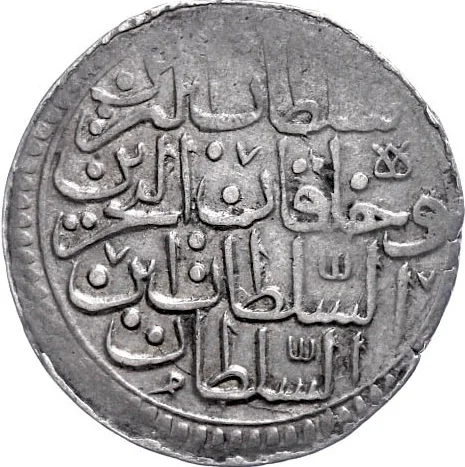
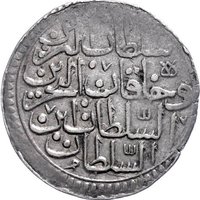
Obverse
Inscription:
سلطان البرين
وخاقان البحرين
السلطان ابن
السلطان
Sultanü'l-berreyn
ve hakanü'l-bahreyn
es-sultan ibn
es-sultan
وخاقان البحرين
السلطان ابن
السلطان
Sultanü'l-berreyn
ve hakanü'l-bahreyn
es-sultan ibn
es-sultan
Script: Arabic
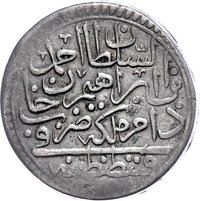
Reverse
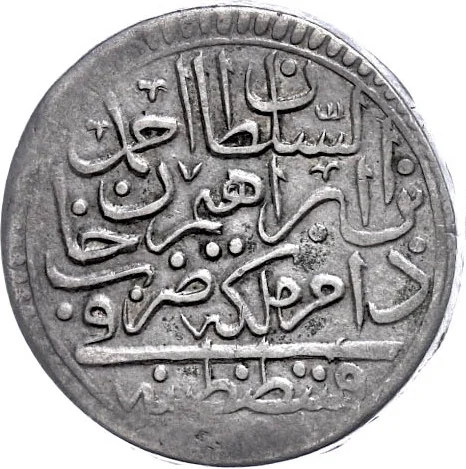
Inscription:
السلطان احمد
ابن ابراهيم خان
دام ملكه ضرب في
قسطنطنيه
١١٠٢
Es-sultan Ahmed
ibn İbrahim han
Dama mulkuhu duribe fi
Kostantiniye
1102
ابن ابراهيم خان
دام ملكه ضرب في
قسطنطنيه
١١٠٢
Es-sultan Ahmed
ibn İbrahim han
Dama mulkuhu duribe fi
Kostantiniye
1102
Script: Arabic
Edge
Mints
| Name | Mark |
|---|---|
| Constantinople | — |
Mintings
| Year | Mint Mark | Mintage | Quality | Collection |
|---|---|---|---|---|
| 1691 | — | — |
Historical background
In 1691, the Ottoman Empire was grappling with a severe and protracted currency crisis, primarily driven by the costly wars of the late 17th century. The empire was engaged in the long-running conflict with the Holy League (the Great Turkish War, 1683-1699), which followed the disastrous defeat at the gates of Vienna in 1683. The immense financial strain of maintaining large armies on multiple fronts—notably against the Habsburgs in Hungary and the Venetians in the Mediterranean—led to chronic budget deficits. The state's traditional response to such fiscal shortfalls was to debase the silver akçe, the foundational unit of account, by reducing its silver content to mint more coins from the same bullion reserves. This practice, repeated over decades, had led to a drastic devaluation; by 1691, the akçe contained only a fraction of the silver it held a century earlier, causing rampant inflation and economic instability.
The monetary system was consequently chaotic and fragmented. While the debased akçe remained crucial for small-scale transactions and accounting, its instability spurred the widespread use of larger foreign silver coins, especially the Spanish real of eight and the Dutch lion dollar (rijksdaalder), which circulated freely due to their reliable silver content. This created a dual system where domestic coinage was distrusted for major commerce. Furthermore, the gold sultani (also known as the altın), while more stable, was primarily used for state finance, large-scale trade, and hoarding, not everyday purchases. The simultaneous circulation of these vastly different coins, all with fluctuating exchange rates, created confusion in markets, hampered long-distance trade, and eroded public trust in the imperial government's financial management.
Sultan Ahmed II, who ascended to the throne in 1691, inherited this dire economic situation. His government faced the impossible task of funding a desperate war effort while the very tool of currency manipulation had reached its limits, causing more harm than good. Although some financial officials recognized the need for reform, the immediate pressures of the war precluded any systematic monetary overhaul. Thus, in 1691, the Ottoman currency system remained in a state of profound weakness, a symptom of the empire's broader military and administrative strains that would ultimately be cemented in the unfavorable terms of the Treaty of Karlowitz in 1699.
The monetary system was consequently chaotic and fragmented. While the debased akçe remained crucial for small-scale transactions and accounting, its instability spurred the widespread use of larger foreign silver coins, especially the Spanish real of eight and the Dutch lion dollar (rijksdaalder), which circulated freely due to their reliable silver content. This created a dual system where domestic coinage was distrusted for major commerce. Furthermore, the gold sultani (also known as the altın), while more stable, was primarily used for state finance, large-scale trade, and hoarding, not everyday purchases. The simultaneous circulation of these vastly different coins, all with fluctuating exchange rates, created confusion in markets, hampered long-distance trade, and eroded public trust in the imperial government's financial management.
Sultan Ahmed II, who ascended to the throne in 1691, inherited this dire economic situation. His government faced the impossible task of funding a desperate war effort while the very tool of currency manipulation had reached its limits, causing more harm than good. Although some financial officials recognized the need for reform, the immediate pressures of the war precluded any systematic monetary overhaul. Thus, in 1691, the Ottoman currency system remained in a state of profound weakness, a symptom of the empire's broader military and administrative strains that would ultimately be cemented in the unfavorable terms of the Treaty of Karlowitz in 1699.
✨ Legendary