

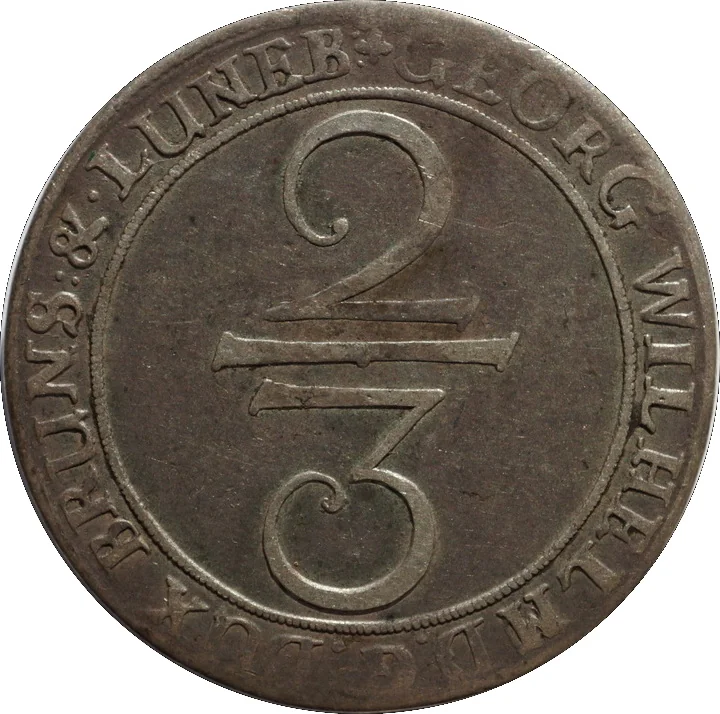
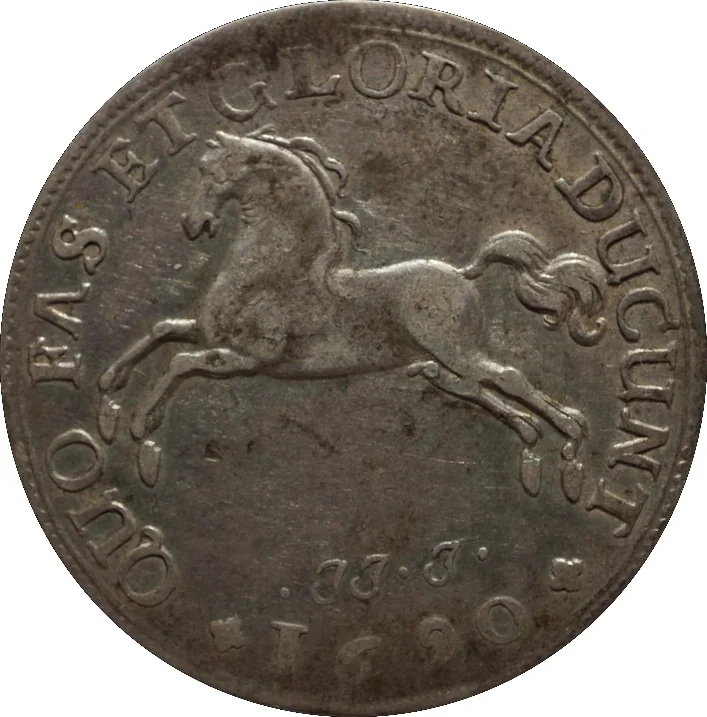
⅔ Thaler – Brunswick-Lüneburg-Celle
Germany
Context
Year: 1690
Country: Germany 
Issuer: Brunswick-Lüneburg-Celle
Ruler: George William
Currency:
Demonetized: Yes
Material
Diameter: 35 mm
Weight: 15.5 g
Silver weight: 15.50 g
Shape: Round
Composition: Silver
Standard: Silver half ounce
Magnetic: No
Alignment: Medal alignment
flip
References
KM: #Click to copy to clipboard331
Numista: #239392
Value
Bullion value: $44.06
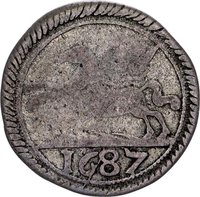
Obverse
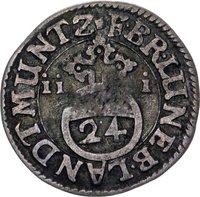
Reverse
Edge
Mints
| Name | Mark |
|---|---|
| Celle | — |
Mintings
| Year | Mint Mark | Mintage | Quality | Collection |
|---|---|---|---|---|
| 1690 | — | — |
Historical background
In 1690, the Duchy of Brunswick-Lüneburg, specifically the Principality of Celle under Duke George William, faced a complex and challenging currency situation typical of the Holy Roman Empire's fragmented monetary landscape. The region operated within a system where multiple authorities—the Emperor, the Imperial Circles, and individual territorial princes—all claimed the right to mint coinage. This resulted in a proliferation of different coins in circulation, not only local Thalers, Groschen, and Pfennigs, but also numerous foreign currencies from neighboring states, leading to chronic confusion and instability in everyday commerce.
The core problem was the widespread debasement of coinage. Faced with the immense financial pressures of ongoing wars, such as the Nine Years' War, and the need to fund court expenditures, rulers often reduced the precious metal content in coins while maintaining their face value. This practice, while providing short-term revenue, eroded public trust and sparked inflationary pressures. In Celle, as elsewhere, "bad money" (debased coinage) tended to drive "good money" (full-weight coinage) out of circulation, as people hoarded the latter, further exacerbating the scarcity of reliable currency.
Duke George William attempted to address these issues through participation in regional monetary agreements, most significantly the Zinnaische Münzvertrag of 1667 and its successor, the Leipziger Münzfuß of 1690. These treaties, negotiated among several North German states, aimed to standardize the silver content and exchange rates of key coins like the Reichsthaler to create a more stable common currency area. While the 1690 Leipzig convention set a new, slightly debased standard, its implementation in Celle was part of a continuous struggle to impose order, combat counterfeit and clipped coins, and stabilize the principality's economy amidst the centrifugal forces of the Empire's monetary anarchy.
The core problem was the widespread debasement of coinage. Faced with the immense financial pressures of ongoing wars, such as the Nine Years' War, and the need to fund court expenditures, rulers often reduced the precious metal content in coins while maintaining their face value. This practice, while providing short-term revenue, eroded public trust and sparked inflationary pressures. In Celle, as elsewhere, "bad money" (debased coinage) tended to drive "good money" (full-weight coinage) out of circulation, as people hoarded the latter, further exacerbating the scarcity of reliable currency.
Duke George William attempted to address these issues through participation in regional monetary agreements, most significantly the Zinnaische Münzvertrag of 1667 and its successor, the Leipziger Münzfuß of 1690. These treaties, negotiated among several North German states, aimed to standardize the silver content and exchange rates of key coins like the Reichsthaler to create a more stable common currency area. While the 1690 Leipzig convention set a new, slightly debased standard, its implementation in Celle was part of a continuous struggle to impose order, combat counterfeit and clipped coins, and stabilize the principality's economy amidst the centrifugal forces of the Empire's monetary anarchy.
✨ Legendary