

½ penny – United Kingdom
Add to wishlist
United Kingdom
Context
Years: 1719–1724
Issuer: United Kingdom
Ruler: George I
Currency:
(1158—1970)
Demonetization: 31 December 1869
Material
References
KM: #
Numista: #23648
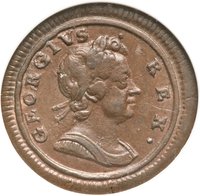
Obverse
Description:
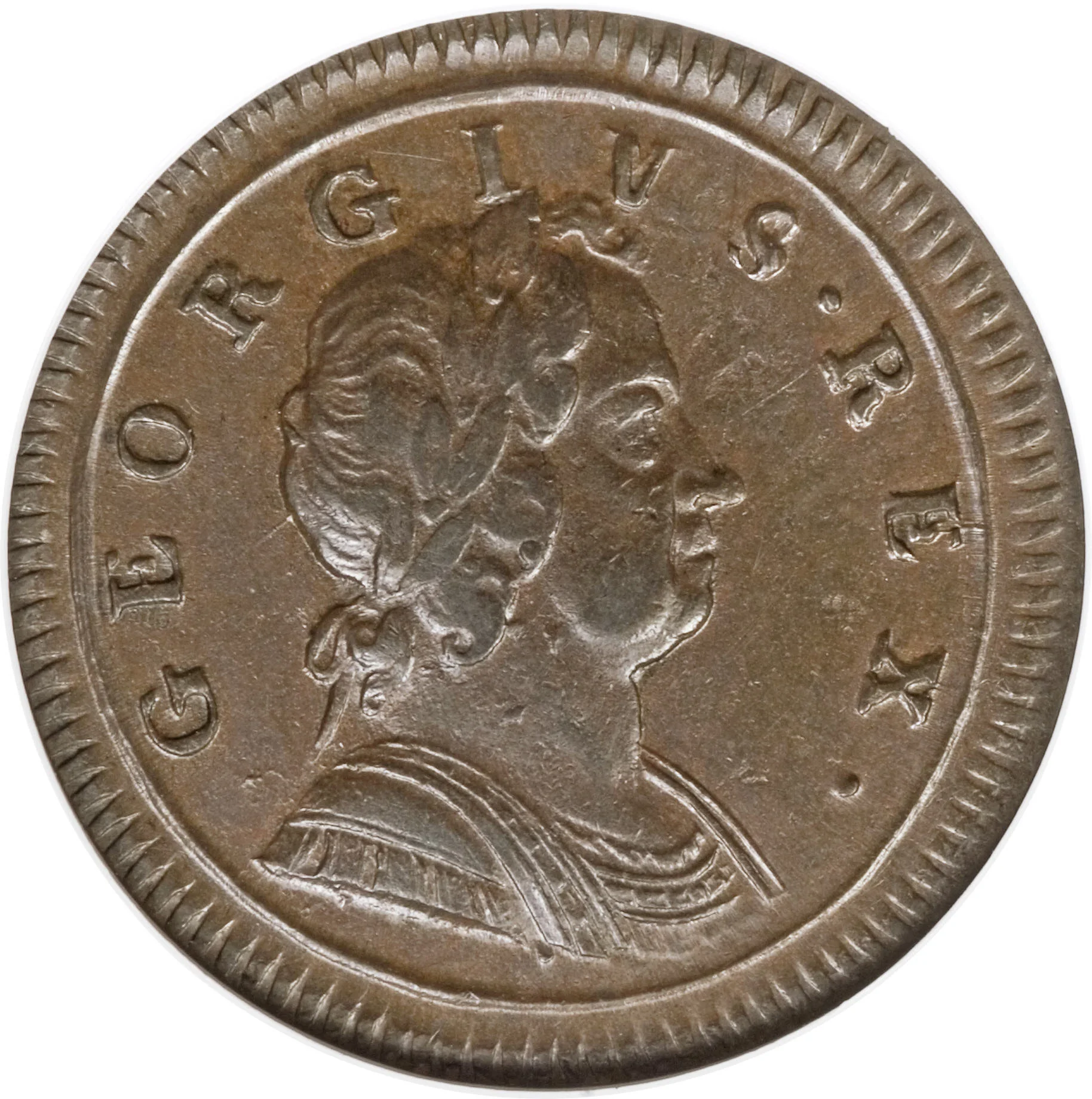
King George I facing right, laureate and cuirassed. Second issue, second obverse: plain left shoulder strap, less hair by the tie knot.
Inscription:
G E O R G I V S · R E X·
Script: Latin
Engraver: John Croker
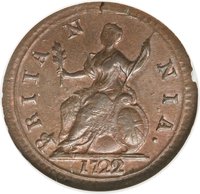
Reverse
Description:
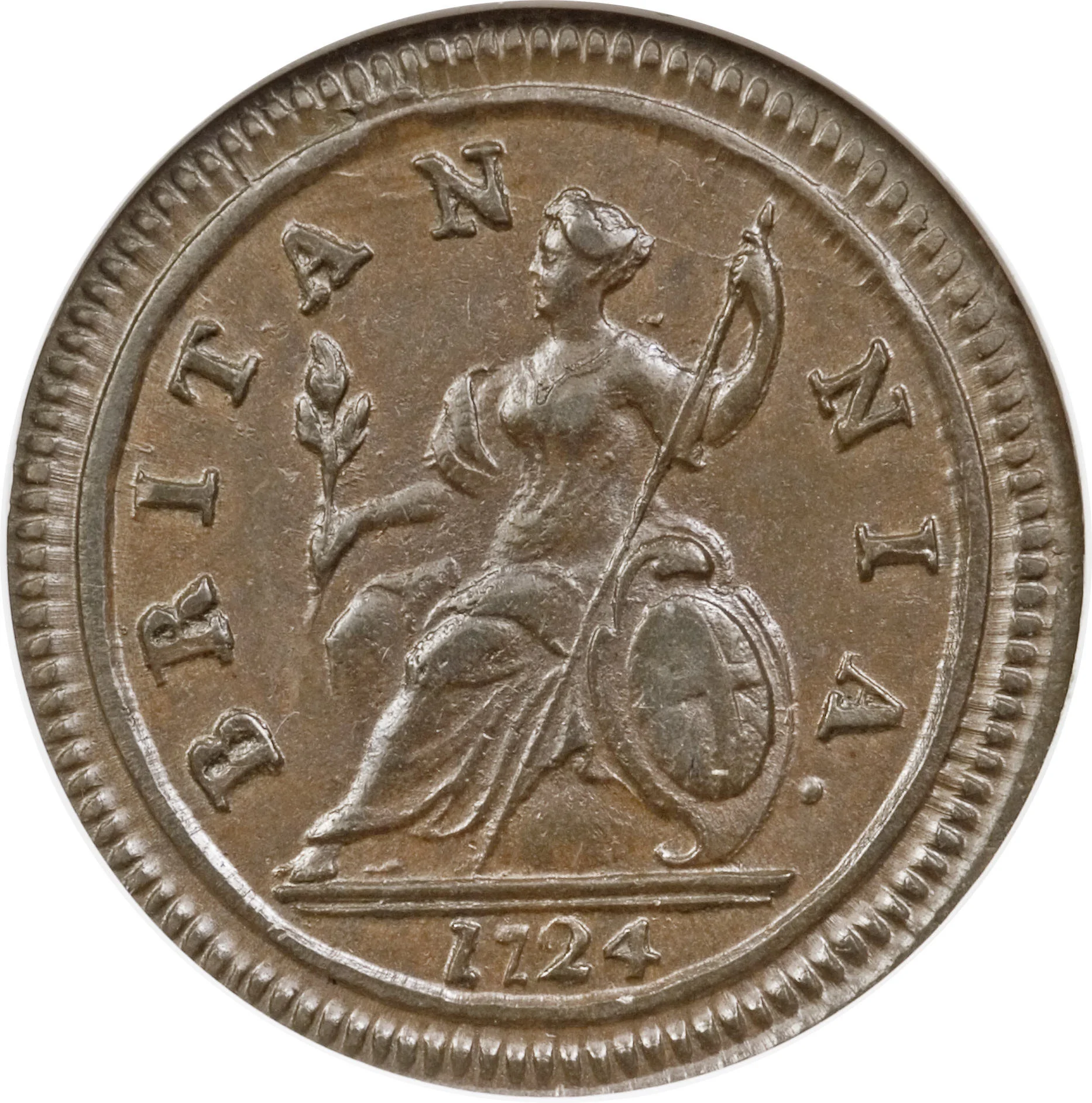
Britannia seated left, holding trident and olive branch, shield with Union flag beside her, legend around, date below.
Inscription:
BRITANNIA.
1724
1724
Script: Latin
Edge
Plain
Mints
| Name | Mark |
|---|---|
| Royal Mint (Tower of London) | — |
Mintings
| Year | Mint Mark | Mintage | Quality | Collection |
|---|---|---|---|---|
| 1719 | — | — | ||
| 1720 | — | — | ||
| 1721 | — | — | ||
| 1722 | — | — | ||
| 1723 | — | — | ||
| 1724 | — | — |
Historical background
In 1719, the United Kingdom’s currency system was in a state of fragile transition, still grappling with the consequences of the Great Recoinage of 1696. That earlier crisis had been triggered by the widespread clipping and counterfeiting of silver coins, which had drastically reduced their precious metal content and value. Sir Isaac Newton, as Warden (and later Master) of the Royal Mint, had overseen the recall and reminting of the entire silver coinage into new, milled-edge coins that were harder to debase. While this restored the physical integrity of the currency, it had a profound unintended consequence: the new, full-weight silver coins were worth more as bullion on the European continent than their face value in Britain, leading to their systematic export and melting down. By 1719, this meant that Britain was effectively on a de facto gold standard, as silver coinage remained scarce in circulation.
The period was dominated by the rise of credit instruments and the experiments of the early Financial Revolution. To facilitate commerce in the absence of sufficient specie (gold and silver coin), the public relied heavily on banknotes issued by the Bank of England (founded 1694) and by private goldsmith bankers. Furthermore, the national debt, managed by the Bank, was becoming a permanent feature of public finance. This context of financial innovation set the stage for the infamous South Sea Bubble of 1720. In 1719, the South Sea Company was actively promoting its scheme to take over the bulk of the national debt, exchanging government annuities for its own shares, a plan Parliament would authorise the following year. This speculative frenzy would soon detach financial value from reality, but in 1719, the atmosphere was one of optimistic speculation fueled by a complex and evolving monetary environment.
Therefore, the currency situation in 1719 was characterised by a critical mismatch: a sound but vanishing silver coinage, a growing reliance on gold guineas (whose value in shillings was officially fixed by the Mint but fluctuated in practice), and an expanding web of paper credit. The monetary system was bifurcated, with a physical coinage struggling to meet daily needs and a burgeoning financial sector creating abstract value. This tension between hard money and speculative paper credit defined the era, placing the UK on the precipice of one of history's most famous financial calamities.
The period was dominated by the rise of credit instruments and the experiments of the early Financial Revolution. To facilitate commerce in the absence of sufficient specie (gold and silver coin), the public relied heavily on banknotes issued by the Bank of England (founded 1694) and by private goldsmith bankers. Furthermore, the national debt, managed by the Bank, was becoming a permanent feature of public finance. This context of financial innovation set the stage for the infamous South Sea Bubble of 1720. In 1719, the South Sea Company was actively promoting its scheme to take over the bulk of the national debt, exchanging government annuities for its own shares, a plan Parliament would authorise the following year. This speculative frenzy would soon detach financial value from reality, but in 1719, the atmosphere was one of optimistic speculation fueled by a complex and evolving monetary environment.
Therefore, the currency situation in 1719 was characterised by a critical mismatch: a sound but vanishing silver coinage, a growing reliance on gold guineas (whose value in shillings was officially fixed by the Mint but fluctuated in practice), and an expanding web of paper credit. The monetary system was bifurcated, with a physical coinage struggling to meet daily needs and a burgeoning financial sector creating abstract value. This tension between hard money and speculative paper credit defined the era, placing the UK on the precipice of one of history's most famous financial calamities.
🌱 Common