

1 Shilling – United Kingdom
United Kingdom
Context

Material
References
KM: #Click to copy to clipboard558
Numista: #13088
Value
Bullion value: $15.67
Obverse
Description:
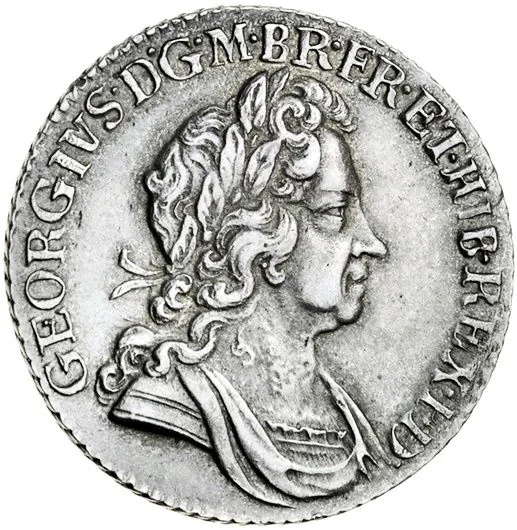
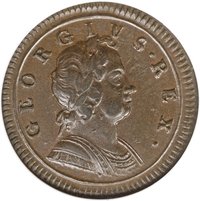
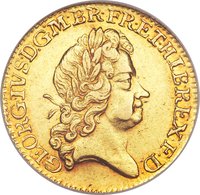
Second laureate, draped bust of George I right. Legend surrounds. Note: bow in hair.
Inscription:
GEORGIVS·D'G:M·BR·FR·ET·HIB·REX·F·D
Script: Latin
Engraver: John Croker
Reverse
Description:
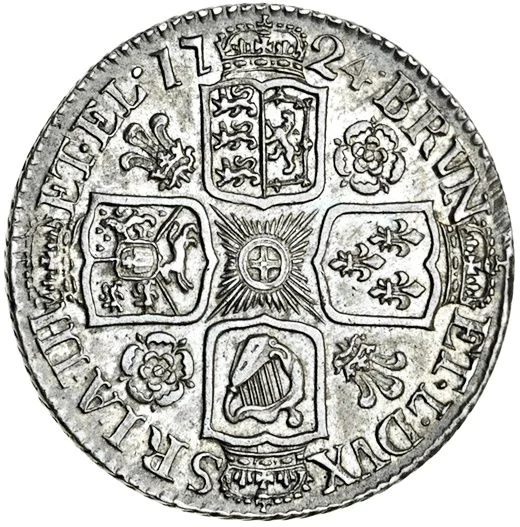
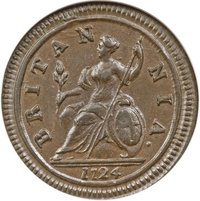
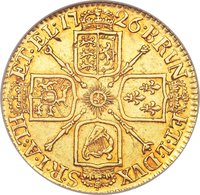
Crowned cruciform shields encircling central Garter star, date above, legend around. Varieties exist.
Inscription:
BRVN ET L DVX S R I A TH ET EL·1725·
Script: Latin
Engraver: Johann Ochs
Edge
Engrailed
Mintings
| Year | Mint Mark | Mintage | Quality | Collection |
|---|---|---|---|---|
| 1723 | — | — | ||
| 1724 | — | — | ||
| 1725 | — | — | ||
| 1726 | — | — | ||
| 1727 | — | — |
Historical background
In 1723, the United Kingdom, newly formed by the Acts of Union in 1707, operated under a complex and often chaotic bimetallic system. The official currency was based on silver shillings and pence, but the reality was a confusing mix of clipped, worn, and counterfeit coins circulating alongside foreign gold coins like Portuguese moidores and Spanish pistoles. The Great Recoinage of 1696 had attempted to solve this by issuing new, milled-edge silver coins to prevent clipping, but it had been only partially successful. A critical shortage of good silver coinage persisted, hampering everyday trade and causing public distrust, as the face value of coins often exceeded their intrinsic metal worth.
The period was marked by the rising economic dominance of gold. In 1717, Sir Isaac Newton, as Master of the Mint, had formally set the gold guinea at 21 shillings, a valuation that inadvertently overvalued gold against silver. This led to Gresham's Law in action: "bad money drives out good." Undervalued full-weight silver coins were either hoarded or melted down for export, leaving the poorer-quality silver and overvalued gold in circulation. Consequently, while gold became the preferred medium for large transactions and state finance, the lack of reliable small change for wages and market purchases remained a severe practical problem for the general populace.
This unstable monetary environment existed against a backdrop of financial innovation. The Bank of England, founded in 1694, was gaining influence, and its paper notes—though still largely confined to London and used by merchants—offered an alternative to physical specie. However, in 1723, paper currency was not yet a trusted nationwide solution. The currency situation was therefore a fragile and transitional one, caught between a failing silver standard, the de facto emergence of a gold standard, and the nascent promise of paper credit, all while the nation's expanding commerce demanded a more reliable medium of exchange.
The period was marked by the rising economic dominance of gold. In 1717, Sir Isaac Newton, as Master of the Mint, had formally set the gold guinea at 21 shillings, a valuation that inadvertently overvalued gold against silver. This led to Gresham's Law in action: "bad money drives out good." Undervalued full-weight silver coins were either hoarded or melted down for export, leaving the poorer-quality silver and overvalued gold in circulation. Consequently, while gold became the preferred medium for large transactions and state finance, the lack of reliable small change for wages and market purchases remained a severe practical problem for the general populace.
This unstable monetary environment existed against a backdrop of financial innovation. The Bank of England, founded in 1694, was gaining influence, and its paper notes—though still largely confined to London and used by merchants—offered an alternative to physical specie. However, in 1723, paper currency was not yet a trusted nationwide solution. The currency situation was therefore a fragile and transitional one, caught between a failing silver standard, the de facto emergence of a gold standard, and the nascent promise of paper credit, all while the nation's expanding commerce demanded a more reliable medium of exchange.
⭐ Somewhat Rare