

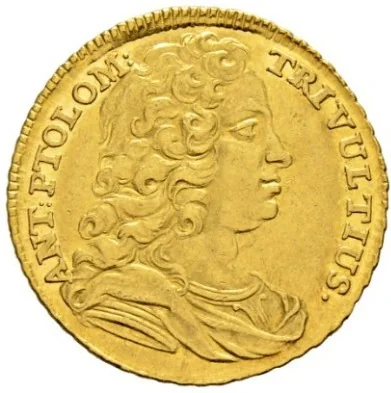
1 Ducat – Retegno
Italy

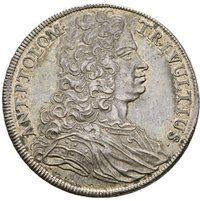
Obverse
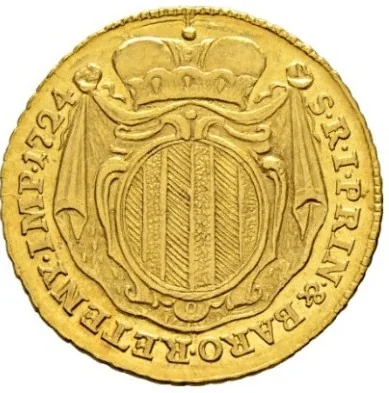
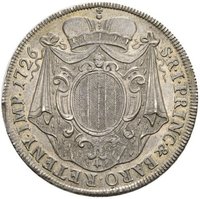
Reverse
Description:
Crowned, mantled arms with date.
Inscription:
S·R·I·PRIN·& BARO·RETENY·IMP·1724
Script: Latin
Edge
Mints
| Name | Mark |
|---|---|
| Retegno | — |
Mintings
| Year | Mint Mark | Mintage | Quality | Collection |
|---|---|---|---|---|
| 1724 | — | — | ||
| 1726 | — | — |
Historical background
In 1724, the Grand Duchy of Retegno stood at a monetary crossroads, burdened by a chaotic and debased currency system. The circulation was a jumble of old, clipped silver scudi from the previous century, low-quality copper soldi minted to fund recent border wars, and a plethora of foreign coins from neighboring trading partners. This confusion stifled commerce, as merchants and peasants alike struggled to assess real value, leading to frequent disputes and a thriving trade in coin-clipping and counterfeiting. The authority of the Mint of Retegno-Città was at a low ebb, and public trust in the coinage had eroded significantly.
Recognizing the crisis, Grand Duke Aleramo III, advised by his reformist Finance Minister, Conte di Vallombrosa, embarked on a bold monetary reform. The cornerstone was the introduction of a new silver standard, the lira reteggiana, subdivided into 20 soldi or 240 denari. Crucially, the lira was to contain a precise and guaranteed weight of fine silver, with its value proclaimed by decree and backed by the state's credit. To fund the recoinage, a temporary hearth tax was levied, and old coins were called in for reminting at a fixed, albeit slightly unfavorable, rate to the crown.
The reform of 1724 was met with initial resistance from speculators and those hoarding old coin, but it ultimately proved a foundation for stability. By providing a uniform, reliable medium of exchange, it facilitated a recovery in both internal trade and external commerce. While the success of the new lira would be tested in the coming decades by the pressures of state expenditure, the year 1724 is remembered as the moment Retegno abandoned its medieval patchwork of metal for a modern, state-managed monetary system.
Recognizing the crisis, Grand Duke Aleramo III, advised by his reformist Finance Minister, Conte di Vallombrosa, embarked on a bold monetary reform. The cornerstone was the introduction of a new silver standard, the lira reteggiana, subdivided into 20 soldi or 240 denari. Crucially, the lira was to contain a precise and guaranteed weight of fine silver, with its value proclaimed by decree and backed by the state's credit. To fund the recoinage, a temporary hearth tax was levied, and old coins were called in for reminting at a fixed, albeit slightly unfavorable, rate to the crown.
The reform of 1724 was met with initial resistance from speculators and those hoarding old coin, but it ultimately proved a foundation for stability. By providing a uniform, reliable medium of exchange, it facilitated a recovery in both internal trade and external commerce. While the success of the new lira would be tested in the coming decades by the pressures of state expenditure, the year 1724 is remembered as the moment Retegno abandoned its medieval patchwork of metal for a modern, state-managed monetary system.
✨ Legendary