

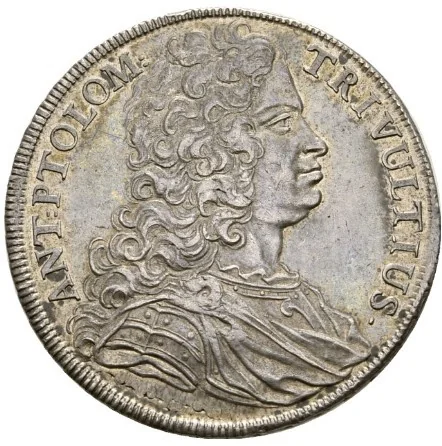
1 Tallero – Retegno
Italy
Obverse
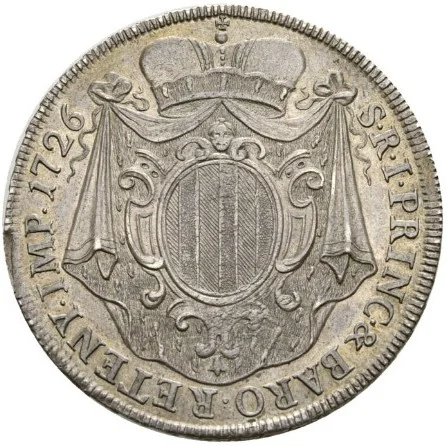
Reverse
Description:
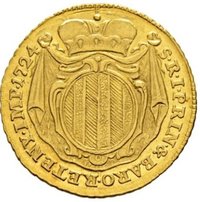
Crowned, mantled escutcheon.
Inscription:
S·R·I·PRINC & BARO·RETENY·IMP· 1726
Script: Latin
Edge
Mints
| Name | Mark |
|---|---|
| Retegno | — |
Mintings
| Year | Mint Mark | Mintage | Quality | Collection |
|---|---|---|---|---|
| 1726 | — | — |
Historical background
In 1726, the Grand Duchy of Retegno stood at a financial crossroads, its monetary system a chaotic reflection of its turbulent past. The currency in circulation was a bewildering mix of clipped and worn domestic silver scudi, alongside a plethora of foreign coins—primarily Spanish pieces of eight and French louis d’or—brought in by trade. This lack of a uniform, trusted medium of exchange stifled internal commerce and complicated tax collection, as the value of coins depended more on their weight and origin than their face value. The Royal Mint in the capital, L'Aquila, operated sporadically, its output insufficient and often suspect in purity, leading to widespread discounting and a thriving black market for money-changing.
The immediate catalyst for change was the ascension of Grand Duke Aleramo III, a reform-minded ruler influenced by Enlightenment principles. He recognized that monetary chaos was an impediment to centralizing state power and funding his ambitious infrastructural and military projects. In the spring of 1726, advised by a coterie of economists from the University of Pavia, Aleramo’s council drafted the Editto Monetario, a sweeping decree intended to sweep away the old disorder. The edict proclaimed a new, standardized silver Lira Retegnese, divisible into 20 soldi or 240 denari, and backed by a substantial, freshly acquired bullion reserve.
The transition, however, was fraught with difficulty. While the edict forbade the use of foreign coins for domestic transactions, enforcing this in port cities and border regions proved nearly impossible. Public trust was slow to build, as peasants and merchants alike were skeptical of exchanging tangible, if variable, silver for new coins they feared might be debased. Thus, 1726 was a year of tense duality: a year of official proclamations and freshly minted currency leaving the vaults, existing uneasily alongside the entrenched, shadow economy of old metal. The success of Aleramo’s reform would hinge not on the decree itself, but on the state's ability to maintain the Lira’s purity and enforce its use in the years to come.
The immediate catalyst for change was the ascension of Grand Duke Aleramo III, a reform-minded ruler influenced by Enlightenment principles. He recognized that monetary chaos was an impediment to centralizing state power and funding his ambitious infrastructural and military projects. In the spring of 1726, advised by a coterie of economists from the University of Pavia, Aleramo’s council drafted the Editto Monetario, a sweeping decree intended to sweep away the old disorder. The edict proclaimed a new, standardized silver Lira Retegnese, divisible into 20 soldi or 240 denari, and backed by a substantial, freshly acquired bullion reserve.
The transition, however, was fraught with difficulty. While the edict forbade the use of foreign coins for domestic transactions, enforcing this in port cities and border regions proved nearly impossible. Public trust was slow to build, as peasants and merchants alike were skeptical of exchanging tangible, if variable, silver for new coins they feared might be debased. Thus, 1726 was a year of tense duality: a year of official proclamations and freshly minted currency leaving the vaults, existing uneasily alongside the entrenched, shadow economy of old metal. The success of Aleramo’s reform would hinge not on the decree itself, but on the state's ability to maintain the Lira’s purity and enforce its use in the years to come.
✨ Legendary