

1 shilling, 8 pence – Jamaica
Add to wishlist
Jamaica
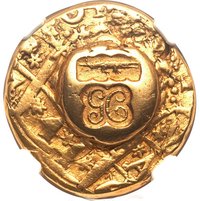
Obverse
Description:
Monogram "GR" counterstamp. Crowned shield with initial and value.
Inscription:
• FERD • VI • D • G • HISP • ET IND • R •
*P * * 2 *
*P * * 2 *
Script: Latin
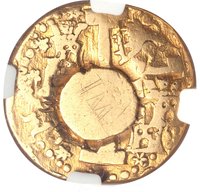
Reverse
Description:
Monogram "GR" counterstamp. Crowned hemispheres and pillars.
Inscription:
UTRA QUE VNUM
• G • 1759 • G •
G.R.
• G • 1759 • G •
G.R.
Script: Latin
Edge
Categories
| Symbol> Crown |
| Symbols> Coat of Arms |
Mints
| Name | Mark |
|---|---|
| Casa de Moneda de Guatemala | G |
Mintings
| Year | Mint Mark | Mintage | Quality | Collection |
|---|---|---|---|---|
| 1758 | G | — |
Historical background
In 1758, Jamaica was a wealthy and strategically vital British colony in the Caribbean, its economy almost entirely built upon a brutal plantation system producing sugar, rum, and other commodities through enslaved African labour. This export-driven economy created a constant demand for currency to facilitate trade, pay taxes, and conduct local business. However, the island suffered from a chronic and severe shortage of official British coinage. Sterling specie (gold and silver coins) tended to flow directly back to Britain to pay for imported goods and planters' debts, leaving the local economy perpetually starved of a reliable medium of exchange.
To fill this void, a complex and improvised monetary system had evolved. The most common unit of account was the Jamaican pound (£J), which was valued at a significant discount against British sterling (£ sterling), typically fluctuating around £J1 = 12 to 18 British shillings. The physical currency in circulation was a chaotic mixture of underweight and worn Spanish silver coins—most notably the Spanish dollar or "piece of eight"—alongside French, Portuguese, and Dutch coins. Their value was not fixed by weight but by regular proclamations from the Governor and Council, who set their official rates in Jamaican currency, leading to confusion and instability.
This unsatisfactory situation led to two key developments. First, the widespread use of "currency by proclamation" made everyday commerce cumbersome. Second, and more significantly, to fund local government expenses and infrastructure, the Jamaican Assembly had begun issuing its own paper money—treasury notes and bills of credit—which circulated as legal tender. By 1758, this paper currency was a established, if sometimes inflationary, feature of the economy, representing a bold and early example of colonial financial autonomy. Thus, the currency situation was defined by a tripartite system: an accounting in discounted Jamaican pounds, a physical circulation of heterogeneous foreign silver, and a growing reliance on locally issued paper money.
To fill this void, a complex and improvised monetary system had evolved. The most common unit of account was the Jamaican pound (£J), which was valued at a significant discount against British sterling (£ sterling), typically fluctuating around £J1 = 12 to 18 British shillings. The physical currency in circulation was a chaotic mixture of underweight and worn Spanish silver coins—most notably the Spanish dollar or "piece of eight"—alongside French, Portuguese, and Dutch coins. Their value was not fixed by weight but by regular proclamations from the Governor and Council, who set their official rates in Jamaican currency, leading to confusion and instability.
This unsatisfactory situation led to two key developments. First, the widespread use of "currency by proclamation" made everyday commerce cumbersome. Second, and more significantly, to fund local government expenses and infrastructure, the Jamaican Assembly had begun issuing its own paper money—treasury notes and bills of credit—which circulated as legal tender. By 1758, this paper currency was a established, if sometimes inflationary, feature of the economy, representing a bold and early example of colonial financial autonomy. Thus, the currency situation was defined by a tripartite system: an accounting in discounted Jamaican pounds, a physical circulation of heterogeneous foreign silver, and a growing reliance on locally issued paper money.
✨ Legendary