

100 francs – Cameroon
Add to wishlist
Cameroon
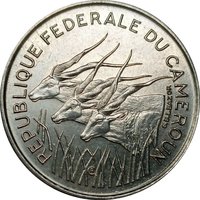
Obverse
Description:
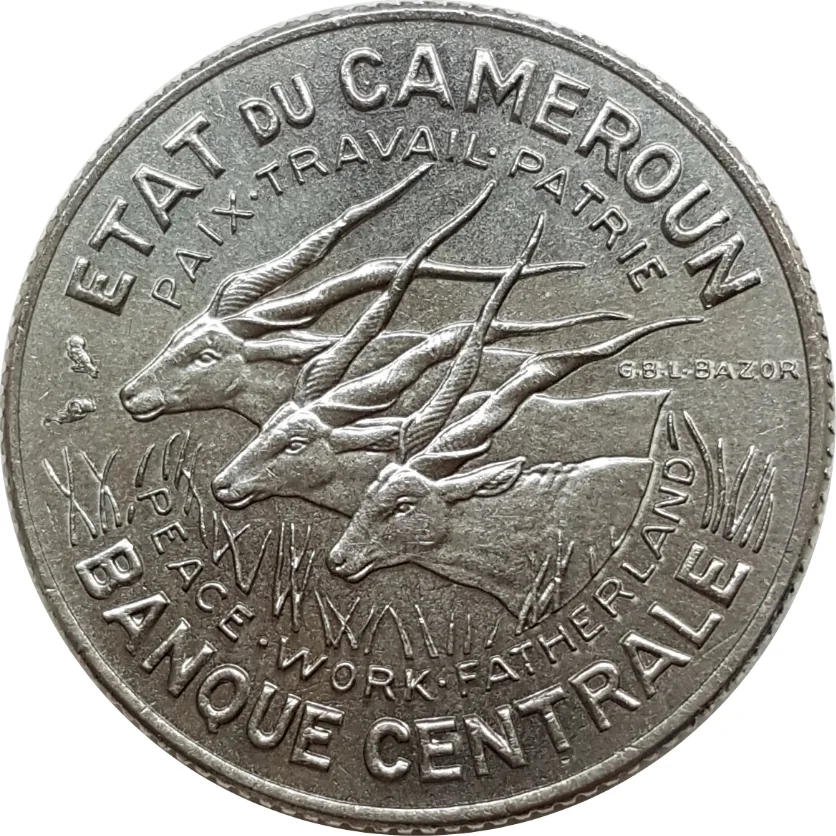
Three giant elands facing left.
Inscription:
ETAT DU CAMEROUN
PAIX · TRAVAIL · PATRIE
G.B.L.BAZOR
PEACE · WORK · FATHERLAND
BANQUE CENTRALE
PAIX · TRAVAIL · PATRIE
G.B.L.BAZOR
PEACE · WORK · FATHERLAND
BANQUE CENTRALE
Translation:
STATE OF CAMEROON
PEACE · WORK · FATHERLAND
G.B.L.BAZOR
PEACE · WORK · FATHERLAND
CENTRAL BANK
PEACE · WORK · FATHERLAND
G.B.L.BAZOR
PEACE · WORK · FATHERLAND
CENTRAL BANK
Script: Latin
Language: French
Engraver: Lucien Georges Bazor
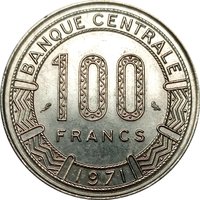
Reverse
Description:
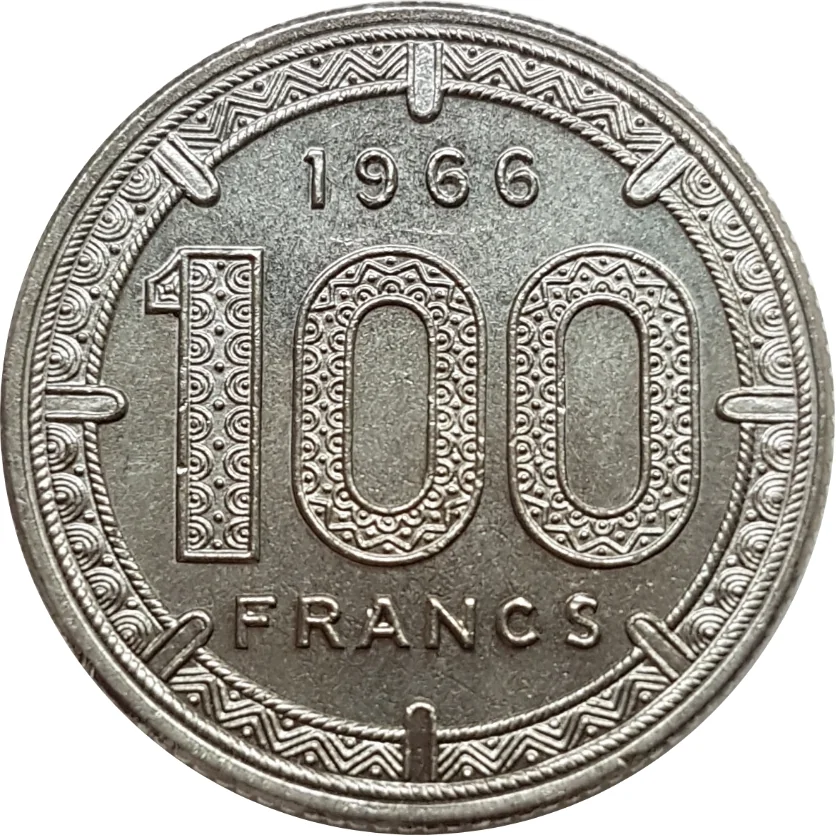
Denomination in circle.
Inscription:
1968
100
FRANCS
100
FRANCS
Script: Latin
Engraver: Lucien Georges Bazor
Edge
Reeded
Mints
| Name | Mark |
|---|---|
| Monnaie de Paris | — |
Mintings
| Year | Mint Mark | Mintage | Quality | Collection |
|---|---|---|---|---|
| 1966 | — | 4,000,000 | ||
| 1967 | — | 4,000,000 | ||
| 1968 | — | 5,000,000 |
Historical background
In 1966, Cameroon’s currency situation was defined by its recent political unification and its ongoing membership in the Franc Zone (Franc de la Coopération Financière en Afrique). The country had emerged from a complex colonial history, with the former French-administered territory gaining independence in 1960 and the southern part of the former British-administered territory federating with it in 1961. This created a bilingual nation with two distinct monetary legacies: the Franc CFA was used in the Francophone east, while the British West African pound (and later the Nigerian pound) circulated in the Anglophone west.
To cement economic integration and national unity, the government enacted a crucial monetary reform in 1966. The Central Bank of Equatorial Africa and Cameroon (BCAEC) issued a new, single currency for the entire federation: the CFA franc (BEAC). This replaced the Nigerian pound in the Anglophone regions at a fixed conversion rate, effectively ending the dual-currency system. The reform was a significant political act, designed to streamline administration, facilitate trade between the regions, and assert centralized economic control from the capital, Yaoundé.
Consequently, by the end of 1966, Cameroon was fully integrated into the Franc Zone framework, with its currency pegged to the French franc and guaranteed by the French Treasury. This arrangement provided monetary stability and low inflation, but it also meant Cameroon ceded a degree of monetary sovereignty to France. The decision set the course for the country's monetary policy for decades, anchoring its economy to France while eliminating the practical complexities of its dual-currency past.
To cement economic integration and national unity, the government enacted a crucial monetary reform in 1966. The Central Bank of Equatorial Africa and Cameroon (BCAEC) issued a new, single currency for the entire federation: the CFA franc (BEAC). This replaced the Nigerian pound in the Anglophone regions at a fixed conversion rate, effectively ending the dual-currency system. The reform was a significant political act, designed to streamline administration, facilitate trade between the regions, and assert centralized economic control from the capital, Yaoundé.
Consequently, by the end of 1966, Cameroon was fully integrated into the Franc Zone framework, with its currency pegged to the French franc and guaranteed by the French Treasury. This arrangement provided monetary stability and low inflation, but it also meant Cameroon ceded a degree of monetary sovereignty to France. The decision set the course for the country's monetary policy for decades, anchoring its economy to France while eliminating the practical complexities of its dual-currency past.
🌱 Common