

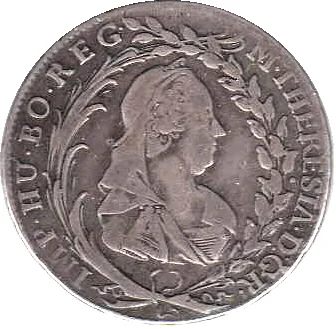
20 Kreuzer – Kingdom of Bohemia
Context
Years: 1768–1780
Country: Bohemia
Issuer: Kingdom of Bohemia
Ruler: Maria Theresa
Currency:
(1754—1857)
Subdivision: 20 Kreuzer = ⅙ Konventionsthaler = ⅓ Austrian gulden
Demonetized: Yes
Total mintage: 14,863,000
Material
References
KM: #Click to copy to clipboard800
Numista: #22117
Value
Bullion value: $16.22
Obverse
Inscription:
M THERESIA D G R IMP HU BO REG
Script: Latin
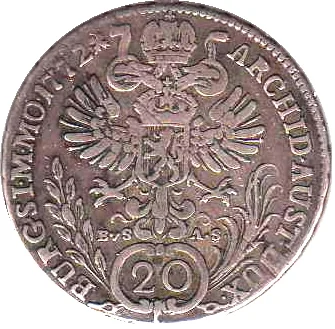
Reverse
Inscription:
ARCHID AUST DUX BURG SI M MO 1772
EvS A·S
(20)
EvS A·S
(20)
Script: Latin
Edge
Mints
| Name | Mark |
|---|---|
| Prague | — |
Mintings
| Year | Mint Mark | Mintage | Quality | Collection |
|---|---|---|---|---|
| 1768 | — | 1,120,000 | ||
| 1769 | — | 1,163,000 | ||
| 1770 | — | 1,276,000 | ||
| 1771 | — | 1,480,000 | ||
| 1772 | — | 1,249,000 | ||
| 1773 | — | 1,069,000 | ||
| 1774 | — | 1,059,000 | ||
| 1775 | — | 728,000 | ||
| 1776 | — | 1,195,000 | ||
| 1777 | — | 1,163,000 | ||
| 1778 | — | 1,458,000 | ||
| 1779 | — | 786,000 | ||
| 1780 | — | 1,117,000 |
Historical background
In 1768, the currency situation in the Kingdom of Bohemia was complex and strained, operating within the broader framework of the Habsburg Monarchy's financial system. The primary circulating coin was the Conventionsthaler, established by the monetary convention of 1753 between Austria and Bavaria. This system defined a standard, with one Conventionsthaler equal to 2 Gulden (florins) or 120 Kreuzer. However, the state's chronic fiscal deficits, exacerbated by the costly Seven Years' War (1756-1763), led to severe debasement. The government, under Empress Maria Theresa, had resorted to issuing heavily debased coinage, particularly small denominations like kreuzers, which contained less precious metal than their face value promised.
This practice created a two-tiered monetary reality. While large silver Conventionsthalers retained much of their intrinsic value and were often hoarded or used for foreign trade, the debated small coinage flooded the domestic market, causing inflation and a loss of public trust. Peasants and ordinary subjects, who were paid and conducted daily business in these inferior coins, suffered from rising prices and effectively reduced purchasing power. This "bad money" drove "good money" out of circulation, a classic example of Gresham's Law, further disrupting local Bohemian commerce and creating widespread economic discontent.
The year 1768 itself fell within a period of attempted stabilization, but fundamental problems persisted. The state's need for revenue conflicted directly with the necessity for a sound currency. While Maria Theresa's ministers, like Count Friedrich Wilhelm von Haugwitz, pursued broader administrative and financial reforms, the temptation to generate seigniorage (profit from minting coins) remained a persistent pressure. Thus, the Bohemian currency landscape was one of official standards undermined by fiscal necessity, leading to internal economic strain and a divergence between the nominal value of money and its actual worth in silver.
This practice created a two-tiered monetary reality. While large silver Conventionsthalers retained much of their intrinsic value and were often hoarded or used for foreign trade, the debated small coinage flooded the domestic market, causing inflation and a loss of public trust. Peasants and ordinary subjects, who were paid and conducted daily business in these inferior coins, suffered from rising prices and effectively reduced purchasing power. This "bad money" drove "good money" out of circulation, a classic example of Gresham's Law, further disrupting local Bohemian commerce and creating widespread economic discontent.
The year 1768 itself fell within a period of attempted stabilization, but fundamental problems persisted. The state's need for revenue conflicted directly with the necessity for a sound currency. While Maria Theresa's ministers, like Count Friedrich Wilhelm von Haugwitz, pursued broader administrative and financial reforms, the temptation to generate seigniorage (profit from minting coins) remained a persistent pressure. Thus, the Bohemian currency landscape was one of official standards undermined by fiscal necessity, leading to internal economic strain and a divergence between the nominal value of money and its actual worth in silver.
⭐ Rare