

1 speciedaler – Denmark
Add to wishlist
Denmark
Context
Material
References
KM: #
Numista: #214327
Value
Bullion value: $64.31
Obverse
Description:
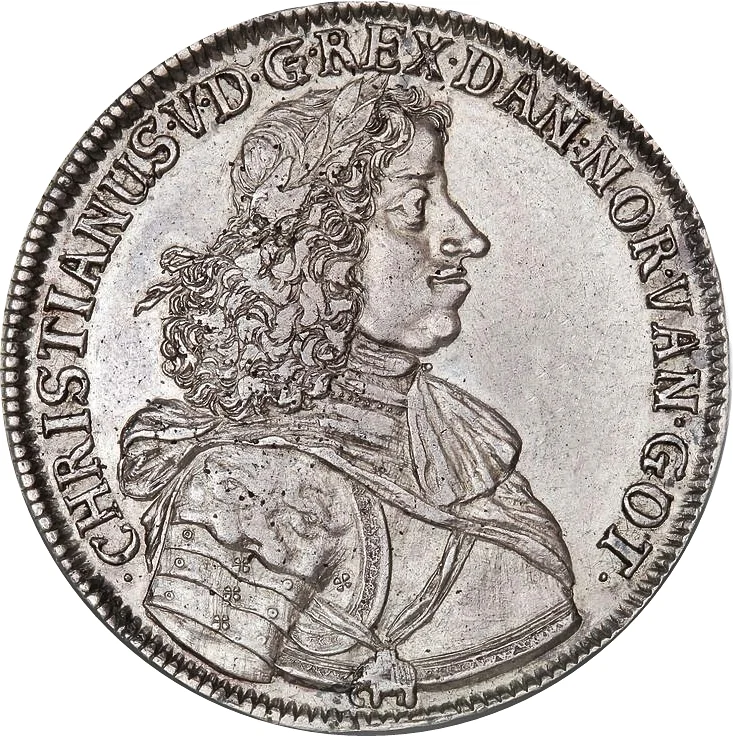
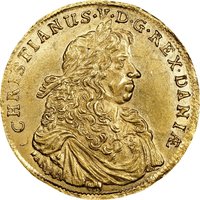
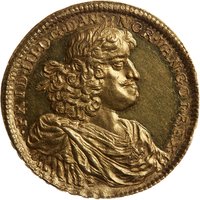
Bust of King Christian V facing right, with long hair, ornate armor featuring a lion shoulder, and the Order of the Elephant collar.
Inscription:
CHRISTIANUS · V · D · G · REX · DAN · NOR · VAN · GOT ·
Script: Latin
Reverse
Description:
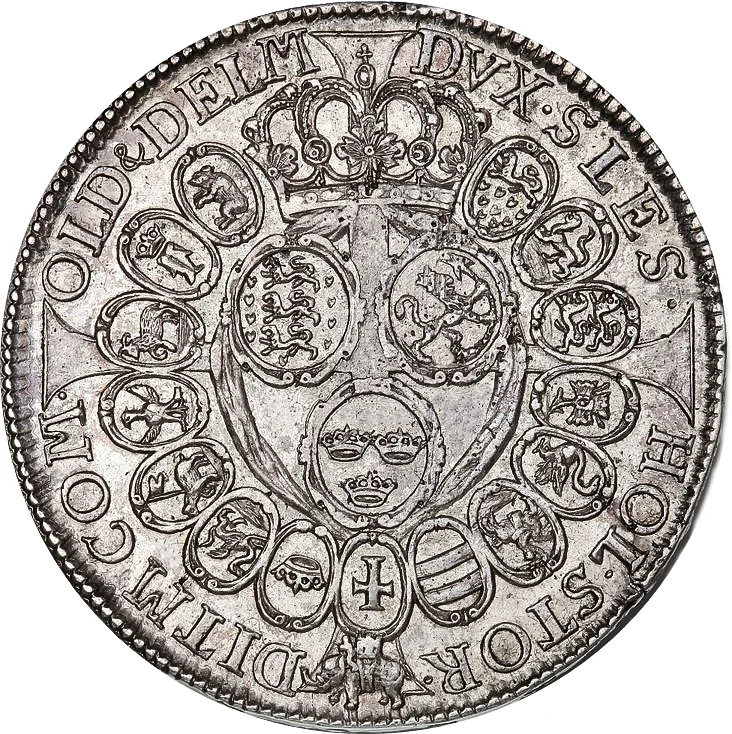
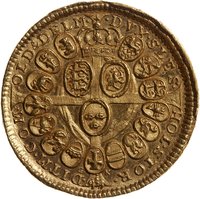
Sweden, Norway, and Denmark's coats of arms on central shields, topped by the Danish crown with the Dannebrog cross and Order of the Elephant behind. Surrounding these are 15 smaller shields representing historic realms, duchies, counties, and territories.
Inscription:
DVX · SLES · HOL · STOR · DITM · COM · OLD & DELM
Script: Latin
Edge
Plain or embossed lettering.
Legend:
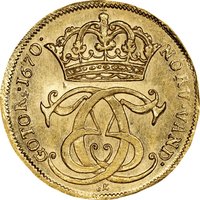
PIETATE - ET - JUSTITIA - ANNO - MDCLXX
Mints
| Name | Mark |
|---|---|
| Copenhagen | — |
Mintings
| Year | Mint Mark | Mintage | Quality | Collection |
|---|---|---|---|---|
| 1670 | — | — |
Historical background
In 1670, Denmark operated under a silver standard, with the primary currency being the rigsdaler (rix-dollar), subdivided into marks and skilling. However, the monetary system was in a state of significant strain and complexity. Decades of war and economic pressure had led to repeated debasements, where the state reduced the silver content in coins to generate short-term revenue. This resulted in a circulation of coins of varying intrinsic values, including older, purer coins and newer, weaker ones, creating confusion and undermining public trust in the currency.
The situation was further complicated by the widespread use of foreign coins, particularly German and Dutch, in everyday commerce. To manage this chaotic system, authorities regularly issued kuranter (exchange rate ordinances) that fixed the official value of both domestic and foreign coins in relation to the rigsdaler. These rates often differed from the market value based on metal content, leading to arbitrage and the hoarding or export of full-weight coins. Consequently, the economy suffered from a chronic shortage of "good money," as Gresham's Law ("bad money drives out good") took hold.
King Christian V, who had ascended to the throne in 1670, inherited these monetary troubles. His reign would soon see attempts at reform, culminating in the Currency Regulation of 1671. This reform aimed to simplify the system by introducing new, standardized coins and setting fixed exchange rates, seeking to restore stability and state control over the mint. Thus, the currency situation in 1670 was one of disorder and transition, setting the stage for a concerted, though not immediately fully successful, effort to create a more unified and reliable monetary system for the Danish state.
The situation was further complicated by the widespread use of foreign coins, particularly German and Dutch, in everyday commerce. To manage this chaotic system, authorities regularly issued kuranter (exchange rate ordinances) that fixed the official value of both domestic and foreign coins in relation to the rigsdaler. These rates often differed from the market value based on metal content, leading to arbitrage and the hoarding or export of full-weight coins. Consequently, the economy suffered from a chronic shortage of "good money," as Gresham's Law ("bad money drives out good") took hold.
King Christian V, who had ascended to the throne in 1670, inherited these monetary troubles. His reign would soon see attempts at reform, culminating in the Currency Regulation of 1671. This reform aimed to simplify the system by introducing new, standardized coins and setting fixed exchange rates, seeking to restore stability and state control over the mint. Thus, the currency situation in 1670 was one of disorder and transition, setting the stage for a concerted, though not immediately fully successful, effort to create a more unified and reliable monetary system for the Danish state.
✨ Legendary