

1 Abbasi – Iran
Circulating commemorative coins
Commemoration: Nader Afshar Coronation
Iran
Context

Material
Diameter: 25 mm
Weight: 5.32 g
Silver weight: 5.32 g
Shape: Irregular round
Composition: Silver
Magnetic: No
Technique: Hammered
Alignment: Coin alignment
flip
References
KM: #Click to copy to clipboard362.4
Numista: #212310
Value
Bullion value: $15.46
Obverse
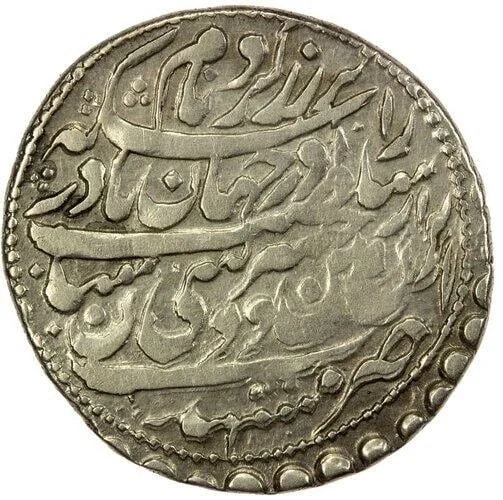
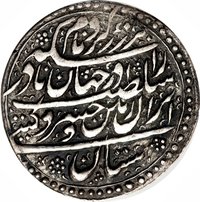
Description:
Name and titles of the ruler.
Inscription:
سکه بر زر کرد نام سلطنت را در جهان
نادر ایران زمین و خسرو گیتی ستان
ضرب مشهد
نادر ایران زمین و خسرو گیتی ستان
ضرب مشهد
Script: Persian
Reverse
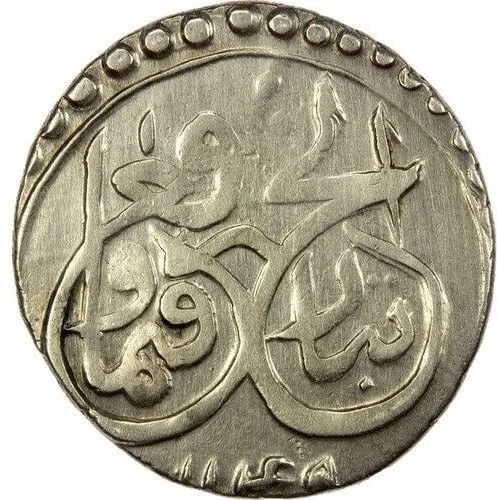
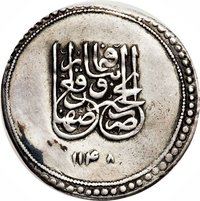
Description:
Toughra style: the Arabic legend's abjad chronogram yields AH 1148 (accession year).
Inscription:
الخیر فیما وقع
بتاریخ ۱۱۴۹
بتاریخ ۱۱۴۹
Script: Persian
Edge
Plain
Mints
| Name | Mark |
|---|---|
| Mashhad Muqaddas | مشهد |
Mintings
| Year | Mint Mark | Mintage | Quality | Collection |
|---|---|---|---|---|
| 1735 | — | — | ||
| 1736 | — | — | ||
| 1737 | — | — |
Historical background
In 1735, Iran was under the rule of Nader Shah Afshar, a brilliant military leader who had recently ascended the throne after ending the Safavid dynasty's rule. The currency situation was one of profound instability and transition, directly reflecting the tumultuous state of the empire. The Safavid monetary system, based on the silver abbasi and copper pul, had been severely degraded by decades of internal rebellion, Afghan invasion, and Ottoman and Russian occupations. Coinage was often debased, and the widespread practice of clipping precious metal from coins further eroded public trust in the currency, leading to significant fluctuations in value and hampering trade.
Nader Shah, primarily focused on his vast military campaigns, approached currency as a tool to finance his army. His immediate solution was to seize and melt the immense treasures he plundered from his invasions, most notably the legendary loot from the 1739 sack of Delhi. This influx of precious metals, particularly silver and gold, was used to mint new coins in large volumes to pay his soldiers and fund the state. These coins, often bearing his name and titles, were struck at mints across the reconquered empire and were generally of high purity, providing a temporary stabilization.
However, this was not a sustainable monetary reform. The economy remained fundamentally extractive, geared toward feeding Nader's war machine rather than fostering long-term stability or domestic production. The heavy taxation required to maintain his campaigns, combined with the eventual end of plunder, would soon lead to renewed financial strain. By the mid-1740s, the currency would again face debasement, setting the stage for the economic difficulties that contributed to the empire's fragmentation following Nader Shah's assassination in 1747. Thus, in 1735, the currency was in a state of precarious recovery, entirely dependent on the fortunes of war and the will of a single conqueror.
Nader Shah, primarily focused on his vast military campaigns, approached currency as a tool to finance his army. His immediate solution was to seize and melt the immense treasures he plundered from his invasions, most notably the legendary loot from the 1739 sack of Delhi. This influx of precious metals, particularly silver and gold, was used to mint new coins in large volumes to pay his soldiers and fund the state. These coins, often bearing his name and titles, were struck at mints across the reconquered empire and were generally of high purity, providing a temporary stabilization.
However, this was not a sustainable monetary reform. The economy remained fundamentally extractive, geared toward feeding Nader's war machine rather than fostering long-term stability or domestic production. The heavy taxation required to maintain his campaigns, combined with the eventual end of plunder, would soon lead to renewed financial strain. By the mid-1740s, the currency would again face debasement, setting the stage for the economic difficulties that contributed to the empire's fragmentation following Nader Shah's assassination in 1747. Thus, in 1735, the currency was in a state of precarious recovery, entirely dependent on the fortunes of war and the will of a single conqueror.
✨ Legendary