

1 barillo – Philippines
Add to wishlist
Philippines
Context
Year: 1766
Issuer: Philippines
Ruler: Charles III
Currency:
(1700—1857)
Subdivision: 1 barillo = 1⁄12 Real
Demonetized: Yes
References
KM: #
Numista: #21132
Obverse
Description:
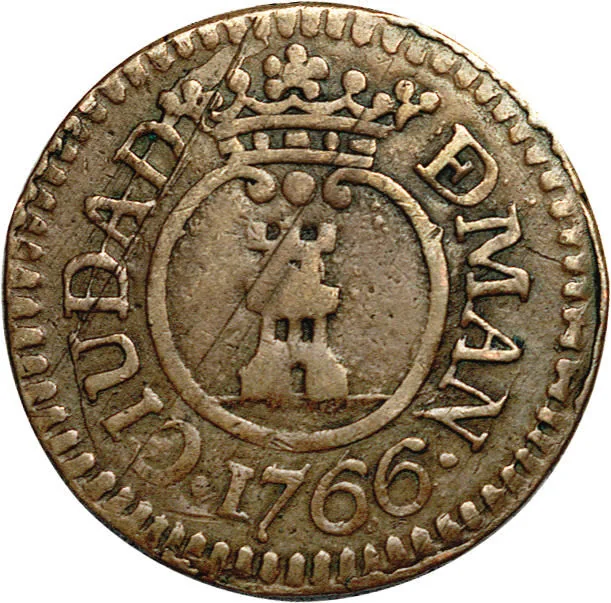
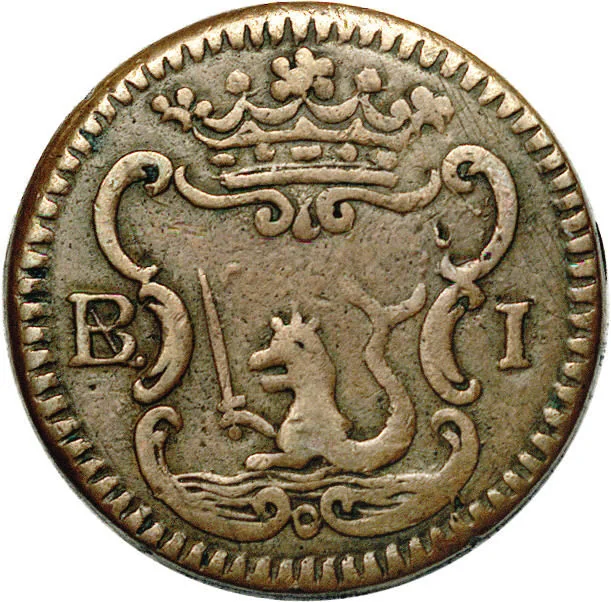
Crowned castle in a circle, beaded rim.
Inscription:
CIUDAD DE MAN
· 1766 ·
· 1766 ·
Script: Latin
Reverse
Edge
Categories
| Building> Castle or fortification |
| Symbols> Coat of Arms |
Mints
| Name | Mark |
|---|---|
| Manila | — |
Mintings
| Year | Mint Mark | Mintage | Quality | Collection |
|---|---|---|---|---|
| 1766 | — | — |
Historical background
In 1766, the currency situation in the Philippine Islands was complex and strained, operating under a dual system imposed by its colonial ruler, Spain. The official medium of exchange was the Spanish silver peso or "real de a ocho," a sturdy coin minted in the Americas that facilitated the vital Manila-Acapulco Galleon Trade. However, a severe and chronic shortage of these coins plagued local circulation, as much of the silver was either hoarded, exported to China for luxury goods, or used for large-scale trade. This scarcity crippled everyday transactions and the domestic economy.
To alleviate the shortage, alternative forms of money proliferated. The most common were "barrillas" – crude copper or lead coins first minted locally in 1728 under a royal license. By 1766, these low-denomination coins were essential for daily market purchases but were often overproduced and debased, leading to inflation and public distrust. Furthermore, a wide variety of irregular coins from Spanish America, Asia, and even cut pieces of silver (known as "chop marks") circulated, creating a chaotic monetary environment where valuation was inconsistent and cumbersome.
This problematic currency landscape existed within a broader context of administrative neglect and economic constraint. The colonial government in Manila had limited authority to implement comprehensive monetary reforms without approval from the Spanish Crown, which was often slow and preoccupied with affairs elsewhere in its empire. Consequently, the year 1766 fell within a prolonged period of monetary instability that would eventually prompt more decisive, though still problematic, reforms in the following decades, including the establishment of the first official mint in Manila in 1857. The currency situation of the time thus reflected the colony's fragmented economy, caught between global silver flows and local subsistence needs.
To alleviate the shortage, alternative forms of money proliferated. The most common were "barrillas" – crude copper or lead coins first minted locally in 1728 under a royal license. By 1766, these low-denomination coins were essential for daily market purchases but were often overproduced and debased, leading to inflation and public distrust. Furthermore, a wide variety of irregular coins from Spanish America, Asia, and even cut pieces of silver (known as "chop marks") circulated, creating a chaotic monetary environment where valuation was inconsistent and cumbersome.
This problematic currency landscape existed within a broader context of administrative neglect and economic constraint. The colonial government in Manila had limited authority to implement comprehensive monetary reforms without approval from the Spanish Crown, which was often slow and preoccupied with affairs elsewhere in its empire. Consequently, the year 1766 fell within a prolonged period of monetary instability that would eventually prompt more decisive, though still problematic, reforms in the following decades, including the establishment of the first official mint in Manila in 1857. The currency situation of the time thus reflected the colony's fragmented economy, caught between global silver flows and local subsistence needs.
💎 Extremely Rare