

20 Liards – Austrian Netherlands
Belgium
Context
Years: 1750–1754
Country: Belgium 
Issuer: Austrian Netherlands
Ruler: Maria Theresa
Currency:
(1744—1798)
Demonetized: Yes
Total mintage: 792,347
Material
References
KM: #Click to copy to clipboard13
Numista: #20602
Obverse
Description:
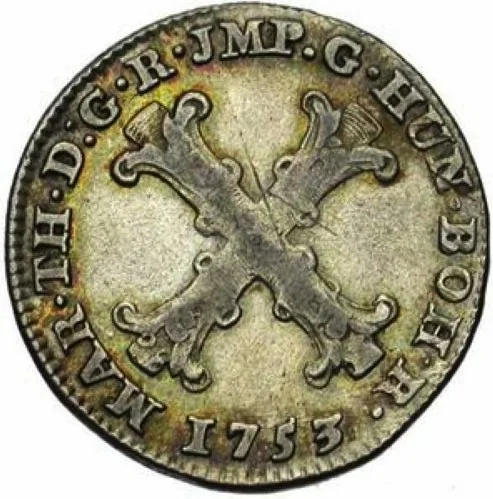
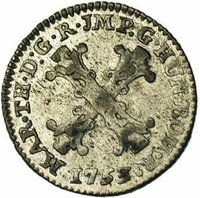
Burgundian cross, surrounding legend, date beneath.
Inscription:
MAR · TH · D : G · R · IMP . G · HUN · BOH · R
1753·
1753·
Script: Latin
Reverse
Description:
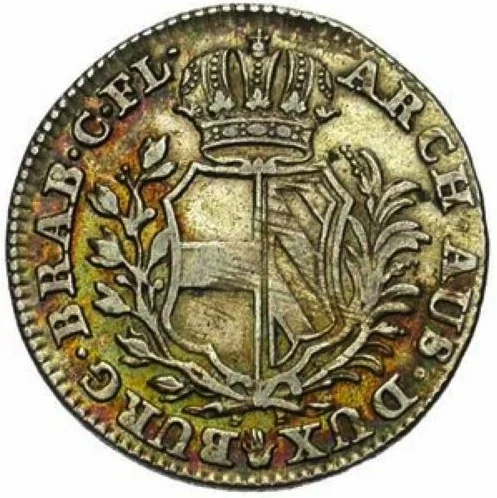
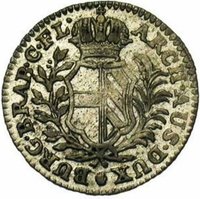
Austrian and Burgundian arms in wreath, mint mark beneath.
Inscription:
ARCH · AUS · DUX BURG · BRAB · C · FL ·
Script: Latin
Edge
Dotted
Mintings
| Year | Mint Mark | Mintage | Quality | Collection |
|---|---|---|---|---|
| 1750 | — | 420,914 | ||
| 1751 | — | — | ||
| 1752 | — | — | ||
| 1753 | — | 323,937 | ||
| 1754 | — | 47,496 |
Historical background
In the mid-18th century, the Austrian Netherlands (approximately modern-day Belgium and Luxembourg) grappled with a complex and debilitating currency crisis. The region was not a monetary sovereign; it operated within a fragmented system where numerous foreign coins, particularly French louis d'or, Dutch guilders, and local imitation issues, circulated simultaneously. The core problem was the chronic undervaluation of full-weight silver coins relative to their gold counterparts and to neighboring states. This led to Gresham's Law in action: "good" full-bodied coins were either hoarded or exported for profit, while "bad" underweight or debased coins flooded the domestic market, causing commercial confusion and eroding public trust.
The Habsburg government in Vienna, under Empress Maria Theresa, recognized that this monetary chaos stifled trade and reduced fiscal efficiency. Their primary objective was to assert control and standardize the currency to facilitate tax collection and economic integration within the broader Habsburg lands. In 1749, authorities embarked on a major reform, culminating in the Imperial Coinage Ordinance of 1750. This edict aimed to create a new, unified monetary standard based on the Brabant guilder, effectively tying the region's currency to the silver standard of the Holy Roman Empire.
The 1750 reform, however, proved only a partial success. While it provided a clearer legal framework and introduced new, high-quality silver konventionsthalers and fractional coins, it failed to completely solve the underlying structural issues. The prescribed exchange rates between gold and silver often still misaligned with market realities, and the pull of powerful neighboring economies like France and the Dutch Republic continued to disrupt circulation. Consequently, monetary instability persisted, reflecting the broader challenges of governing a prosperous but economically intertwined province within a vast and diverse continental empire.
The Habsburg government in Vienna, under Empress Maria Theresa, recognized that this monetary chaos stifled trade and reduced fiscal efficiency. Their primary objective was to assert control and standardize the currency to facilitate tax collection and economic integration within the broader Habsburg lands. In 1749, authorities embarked on a major reform, culminating in the Imperial Coinage Ordinance of 1750. This edict aimed to create a new, unified monetary standard based on the Brabant guilder, effectively tying the region's currency to the silver standard of the Holy Roman Empire.
The 1750 reform, however, proved only a partial success. While it provided a clearer legal framework and introduced new, high-quality silver konventionsthalers and fractional coins, it failed to completely solve the underlying structural issues. The prescribed exchange rates between gold and silver often still misaligned with market realities, and the pull of powerful neighboring economies like France and the Dutch Republic continued to disrupt circulation. Consequently, monetary instability persisted, reflecting the broader challenges of governing a prosperous but economically intertwined province within a vast and diverse continental empire.
💎 Very Rare