

2 schilling (Walther von der Vogelweide) – Austria
Add to wishlist
Circulating commemorative coins
Commemoration: 700th Anniversary of the Death of Walther von der Vogelweide
Austria
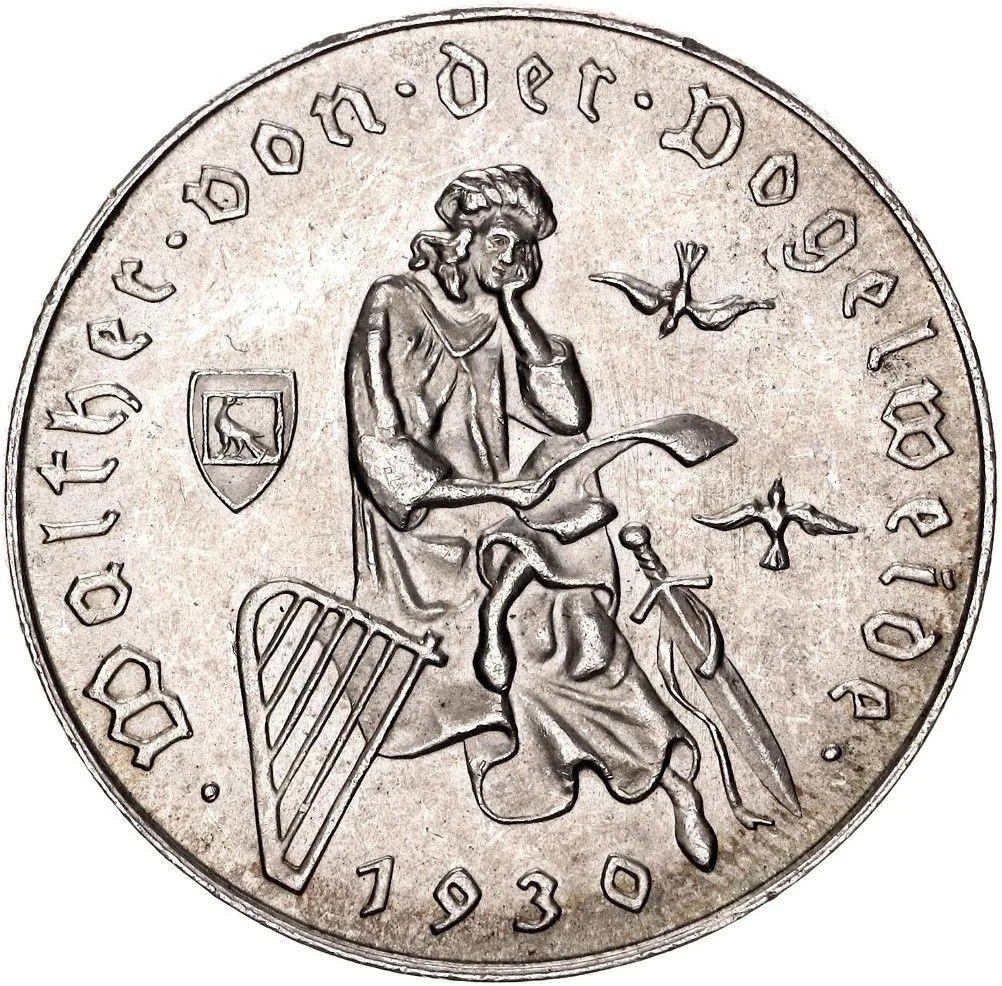
Obverse
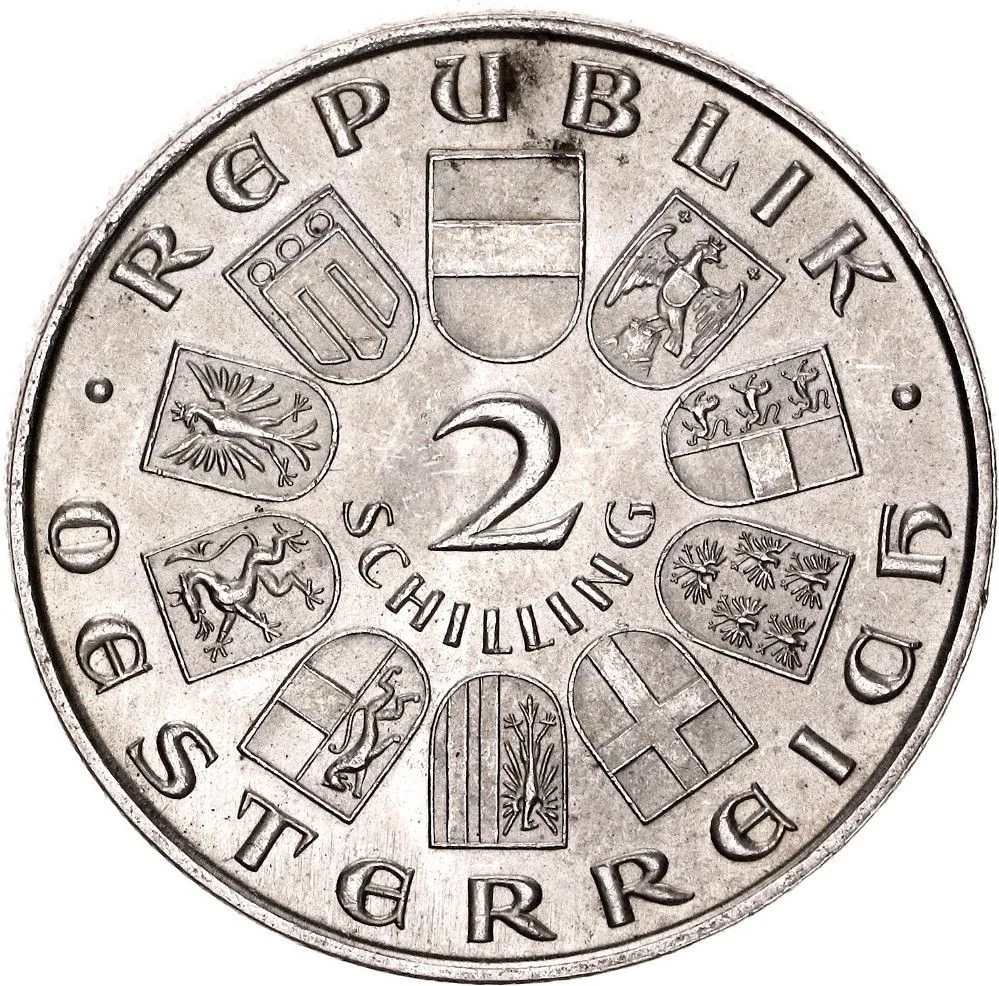
Reverse
Description:
Walther von der Vogelweide seated with doves, a harp at lower left. Date below.
Inscription:
WALTHER VON DER VOGELWEIDE
1930
1930
Script: Latin (Fraktur blackletter)
Engraver: Edwin Grienauer
Edge
Categories
| Art> Music |
| Event> Death anniversary |
| Animal> Bird |
| Art> Literature |
| Person> Artist |
| Symbols> Coat of Arms |
Mints
| Name | Mark |
|---|---|
| Münze Österreich | — |
Mintings
| Year | Mint Mark | Mintage | Quality | Collection |
|---|---|---|---|---|
| 1930 | — | 500,000 | ||
| 1930 | — | — | Proof |
Historical background
In 1930, Austria was in the grip of a severe and worsening financial crisis, a direct consequence of the post-World War I settlement and the global economic downturn. The nation, reduced to a small rump state by the dissolution of the Austro-Hungarian Empire, struggled with a weak industrial base, high unemployment, and a massive burden of public debt. Its currency, the Austrian Schilling (established in 1924 to replace the utterly devalued Krone), was fundamentally unstable, propped up by foreign loans orchestrated by the League of Nations. The country's largest bank, the Creditanstalt, was dangerously overextended, holding the debts of many failing industries and representing a systemic risk to the entire financial system.
The situation was exacerbated by the political paralysis of the era. Austria was deeply divided between the conservative Christian Socials and the socialist Social Democrats, leading to frequent political deadlock that prevented decisive action on economic reform. This political fragility eroded international confidence, making it difficult to secure the fresh credit needed to stabilize state finances. Furthermore, the collapse of global trade following the 1929 Wall Street Crash hit Austria's export-dependent economy particularly hard, causing a sharp decline in revenue and increasing the budget deficit, which further pressured the currency.
Thus, by the end of 1930, Austria's currency situation was a precarious house of cards. The Schilling's stability was entirely dependent on foreign goodwill and short-term capital flows, while the domestic economy contracted and political tensions rose. The looming insolvency of the Creditanstalt—which would erupt into a full-blown crisis in May 1931—was already visible, threatening to trigger a catastrophic banking collapse that would not only destroy the currency but also send shockwaves through the financial systems of all Central Europe.
The situation was exacerbated by the political paralysis of the era. Austria was deeply divided between the conservative Christian Socials and the socialist Social Democrats, leading to frequent political deadlock that prevented decisive action on economic reform. This political fragility eroded international confidence, making it difficult to secure the fresh credit needed to stabilize state finances. Furthermore, the collapse of global trade following the 1929 Wall Street Crash hit Austria's export-dependent economy particularly hard, causing a sharp decline in revenue and increasing the budget deficit, which further pressured the currency.
Thus, by the end of 1930, Austria's currency situation was a precarious house of cards. The Schilling's stability was entirely dependent on foreign goodwill and short-term capital flows, while the domestic economy contracted and political tensions rose. The looming insolvency of the Creditanstalt—which would erupt into a full-blown crisis in May 1931—was already visible, threatening to trigger a catastrophic banking collapse that would not only destroy the currency but also send shockwaves through the financial systems of all Central Europe.
🌱 Common