

1 Dardenna – Monaco
Monaco

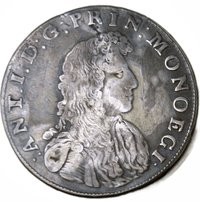
Obverse
Description:
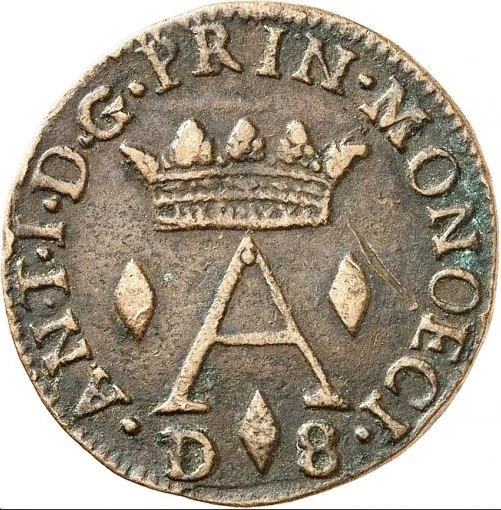
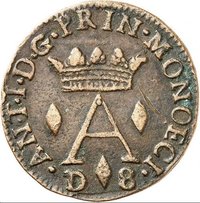
Large A with crown over three fuses.
Inscription:
ANT. I. D.G. PRIN. MONOECI
D.8.
D.8.
Script: Latin
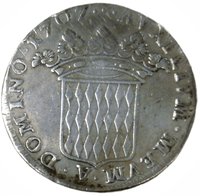
Reverse
Description:
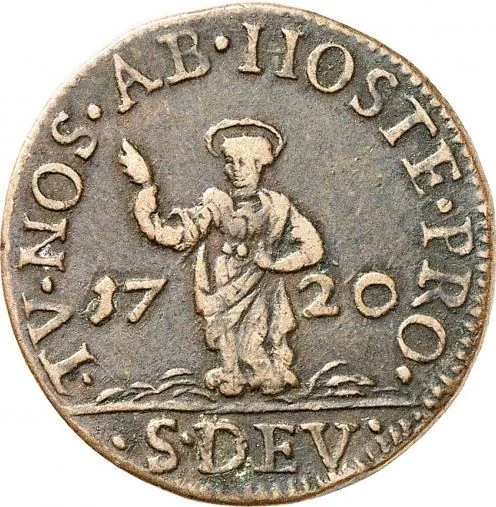
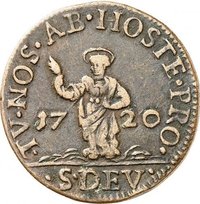
Saint Devote raises an arm, parting the vintage.
Inscription:
TV. NOS. AB. HOSTE. PRO. 17 20
S. DEV
S. DEV
Script: Latin
Edge
Plain
Categories
| Person> Religious figure |
| Symbols> Monogram |
Mints
| Name | Mark |
|---|---|
| Monaco | — |
Mintings
| Year | Mint Mark | Mintage | Quality | Collection |
|---|---|---|---|---|
| 1720 | — | — |
Historical background
In 1720, Monaco, though a sovereign principality, was deeply entangled in the economic catastrophe unfolding in neighbouring France: the Mississippi Bubble. The bubble was the result of the ambitious and ultimately disastrous financial schemes of Scottish economist John Law, who had been granted control of French finances. His system involved the merger of the Banque Royale (which issued paper money) with the Mississippi Company, which held a monopoly on trade with French Louisiana. The resulting speculative frenzy saw share prices and paper currency values skyrocket before collapsing utterly, leaving France in a state of financial ruin and its currency, the livre tournois, virtually worthless.
As Monaco’s economy was inextricably linked to France, using the livre as its de facto currency, the principality was directly swept into the crisis. The sudden, catastrophic devaluation of paper money and the collapse of credit caused severe economic dislocation within its borders. Trade was disrupted, savings were wiped out, and a profound loss of confidence in financial institutions and paper currency took hold among Monégasques and the resident merchant community, mirroring the panic and hardship seen in Paris and other French cities.
Consequently, Prince Antoine I, ruling from 1701 to 1731, faced a dire monetary crisis. His immediate challenge was to restore stability and confidence by distancing Monaco from the toxic French paper system. The pragmatic response was a return to the security of specie—coinage with intrinsic value. In 1720, the Prince authorized the minting of Monaco’s own silver currency, the 10-livre coin, a tangible and trusted medium of exchange intended to facilitate local commerce and reassert monetary sovereignty amidst the surrounding financial chaos. This issue stands as a direct numismatic testament to Monaco’s struggle to insulate itself from one of history’s most famous financial crashes.
As Monaco’s economy was inextricably linked to France, using the livre as its de facto currency, the principality was directly swept into the crisis. The sudden, catastrophic devaluation of paper money and the collapse of credit caused severe economic dislocation within its borders. Trade was disrupted, savings were wiped out, and a profound loss of confidence in financial institutions and paper currency took hold among Monégasques and the resident merchant community, mirroring the panic and hardship seen in Paris and other French cities.
Consequently, Prince Antoine I, ruling from 1701 to 1731, faced a dire monetary crisis. His immediate challenge was to restore stability and confidence by distancing Monaco from the toxic French paper system. The pragmatic response was a return to the security of specie—coinage with intrinsic value. In 1720, the Prince authorized the minting of Monaco’s own silver currency, the 10-livre coin, a tangible and trusted medium of exchange intended to facilitate local commerce and reassert monetary sovereignty amidst the surrounding financial chaos. This issue stands as a direct numismatic testament to Monaco’s struggle to insulate itself from one of history’s most famous financial crashes.
✨ Legendary