

1 Ecu – Monaco
Monaco

Material
Diameter: 42 mm
Weight: 27 g
Silver weight: 27.00 g
Shape: Irregular round
Composition: Silver
Magnetic: No
Technique: Hammered
References
KM: #Click to copy to clipboard23
Numista: #200929
Value
Bullion value: $77.84
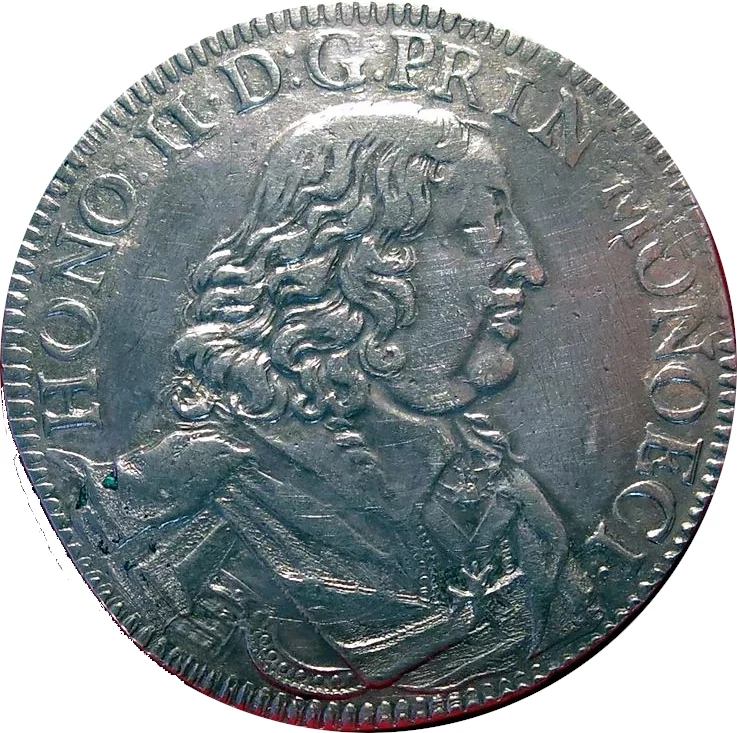
Obverse
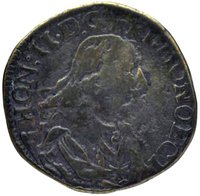
Description:
Bust of Honoré II, right-facing.
Inscription:
HONO: II. D: G: PRIN. MONOECI.
Script: Latin
Engraver: Jean Solignac
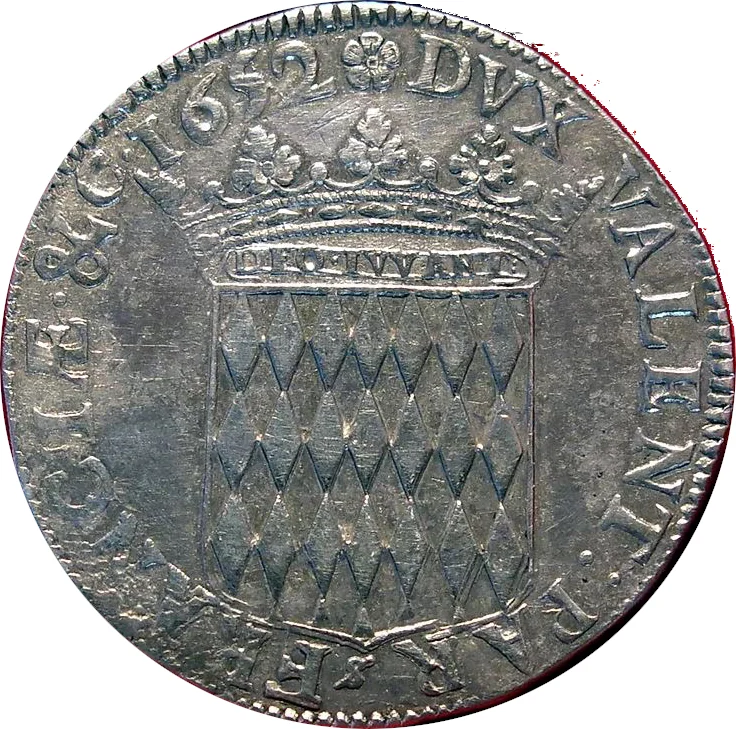
Reverse
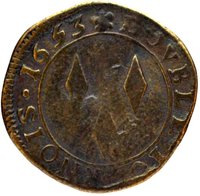
Description:
Crowned arms with seven diamonds.
Inscription:
DEO. IVVANTE
DVX. VALENT: PAR FRANCIAE. & C. 1652
DVX. VALENT: PAR FRANCIAE. & C. 1652
Script: Latin
Engraver: Jean Solignac
Edge
Plain
Mints
| Name | Mark |
|---|---|
| Monaco | — |
Mintings
| Year | Mint Mark | Mintage | Quality | Collection |
|---|---|---|---|---|
| 1652 | — | — | ||
| 1653 | — | — |
Historical background
In 1652, Monaco was navigating a complex monetary landscape shaped by its precarious position between larger powers. The Principality, under the rule of Honoré II (who had taken the title of Prince in 1612), did not mint its own independent currency. Instead, its economy relied heavily on the circulation of foreign coinage, primarily French livres, Spanish reales, and Italian currencies like the Genoese lira and Piedmontese scudo. This reflected Monaco's political and economic ties: while formally a protectorate of Spain since 1524, its geographic and cultural proximity to France and the Italian states created a constant influx of multiple coinages.
The situation was inherently unstable due to the frequent debasement and fluctuating values of these foreign coins. Honoré II, who had actively sought closer ties with France (culminating in the 1641 Treaty of Péronne, which replaced Spanish protection with French), would have been acutely aware of the economic disruptions caused by the monetary policies of his powerful neighbors. The period was one of financial experimentation in Europe, with France itself under Louis XIV's minister, Cardinal Mazarin, grappling with currency manipulation to fund its involvement in the ongoing Franco-Spanish War (1635–1659).
Consequently, monetary transactions in mid-17th century Monaco were likely conducted through a practical, day-to-day assessment of coin weights and metallic content, with merchants and officials relying on published tariffs that assigned values to the myriad of coins in circulation. The absence of a sovereign Monegasque coinage at this time underscores the principality's limited economic autonomy, as it was forced to adapt to the volatile monetary currents of the region, a challenge for both its commerce and the prince's own finances.
The situation was inherently unstable due to the frequent debasement and fluctuating values of these foreign coins. Honoré II, who had actively sought closer ties with France (culminating in the 1641 Treaty of Péronne, which replaced Spanish protection with French), would have been acutely aware of the economic disruptions caused by the monetary policies of his powerful neighbors. The period was one of financial experimentation in Europe, with France itself under Louis XIV's minister, Cardinal Mazarin, grappling with currency manipulation to fund its involvement in the ongoing Franco-Spanish War (1635–1659).
Consequently, monetary transactions in mid-17th century Monaco were likely conducted through a practical, day-to-day assessment of coin weights and metallic content, with merchants and officials relying on published tariffs that assigned values to the myriad of coins in circulation. The absence of a sovereign Monegasque coinage at this time underscores the principality's limited economic autonomy, as it was forced to adapt to the volatile monetary currents of the region, a challenge for both its commerce and the prince's own finances.
✨ Legendary