

2 Deniers – Monaco
Monaco

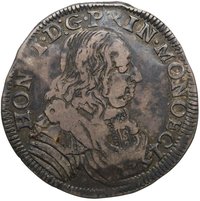
Obverse
Description:
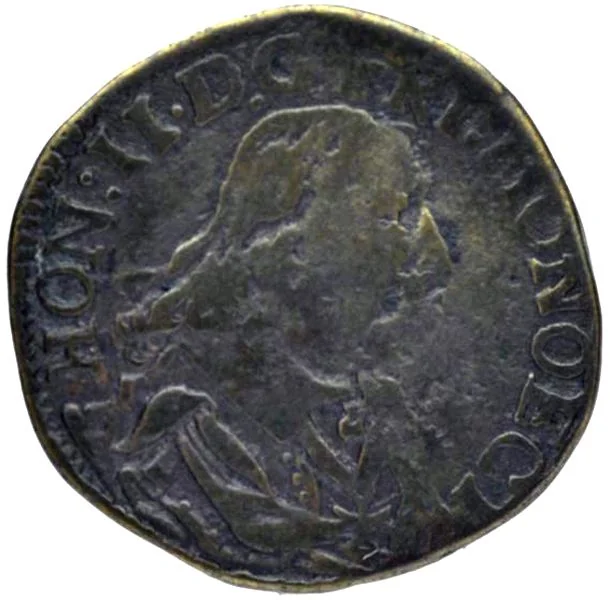
Circular legend with greneti, right-facing draped bust wearing the Holy Spirit cordon of Prince Honoré II.
Inscription:
HON. II. D.G. PR. MONOECI.
Script: Latin
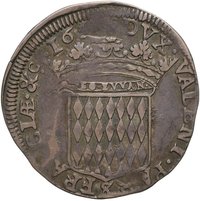
Reverse
Description:
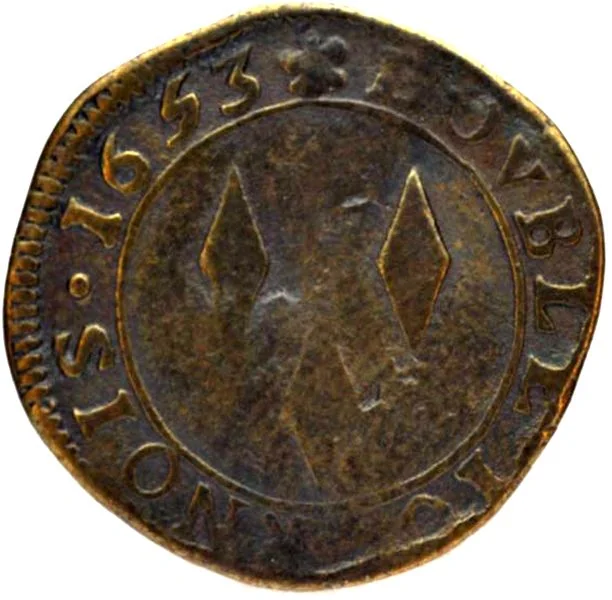
Circular greneti border, three rockets in center.
Inscription:
DOVBLE TOVRNOIS . 1653
Script: Latin
Edge
Plain
Mints
| Name | Mark |
|---|---|
| Monaco | — |
Mintings
| Year | Mint Mark | Mintage | Quality | Collection |
|---|---|---|---|---|
| 1653 | — | — |
Historical background
In 1653, Monaco was navigating a complex monetary landscape shaped by its precarious position between greater European powers. The Principality, under the rule of Honoré II (who had taken the title of Prince in 1612), did not mint its own independent coinage. Instead, its economy relied heavily on the circulation of foreign currencies, primarily those of its powerful neighbors, France and Spain. This dependency was a direct reflection of Monaco's political tightrope; while the Grimaldi family sought to maintain sovereignty, they were deeply entangled in the spheres of influence of both the French crown and the Spanish Habsburgs, with Spanish protection being particularly strong at this time.
The most common currencies in daily use were likely Spanish silver reales and French écus, livres, and sous. The coexistence of these multiple coinage systems, each with fluctuating values and metal contents, created a challenging environment for trade and taxation. Honoré II, who had cultivated closer ties with France (including a landmark treaty in 1641 to replace Spanish protection with French), would have been keenly aware that control over currency was a key symbol of sovereignty. However, the economic reality was one of adaptation and pragmatism, with merchants and officials constantly evaluating and exchanging a heterogeneous mix of coins.
This period fell within the broader era of the "Price Revolution" in Europe, where inflows of precious metals from the Americas contributed to inflation and monetary instability. For a small, trade-dependent state like Monaco, these macro-economic waves were felt acutely. The lack of a national mint meant the Principality had little direct control over its money supply, leaving its economy vulnerable to the monetary policies and debasements of others. Thus, the currency situation in 1653 was less a defined system and more a fluid, often chaotic, marketplace of competing foreign coins, mirroring Monaco's struggle to assert its autonomy within a continent of giants.
The most common currencies in daily use were likely Spanish silver reales and French écus, livres, and sous. The coexistence of these multiple coinage systems, each with fluctuating values and metal contents, created a challenging environment for trade and taxation. Honoré II, who had cultivated closer ties with France (including a landmark treaty in 1641 to replace Spanish protection with French), would have been keenly aware that control over currency was a key symbol of sovereignty. However, the economic reality was one of adaptation and pragmatism, with merchants and officials constantly evaluating and exchanging a heterogeneous mix of coins.
This period fell within the broader era of the "Price Revolution" in Europe, where inflows of precious metals from the Americas contributed to inflation and monetary instability. For a small, trade-dependent state like Monaco, these macro-economic waves were felt acutely. The lack of a national mint meant the Principality had little direct control over its money supply, leaving its economy vulnerable to the monetary policies and debasements of others. Thus, the currency situation in 1653 was less a defined system and more a fluid, often chaotic, marketplace of competing foreign coins, mirroring Monaco's struggle to assert its autonomy within a continent of giants.
✨ Legendary