

10 cents – Netherlands
Add to wishlist
Netherlands
Context
Years: 1904–1906
Issuer: Netherlands
Ruler: Wilhelmina
Currency:
(1817—2001)
Demonetized: Yes
Total mintage: 9,000,000
Material
References
KM: #
Numista: #12306
Value
Exchange value: 0.10 NLG
Bullion value: $2.27
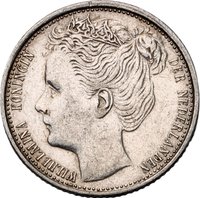
Obverse
Description:
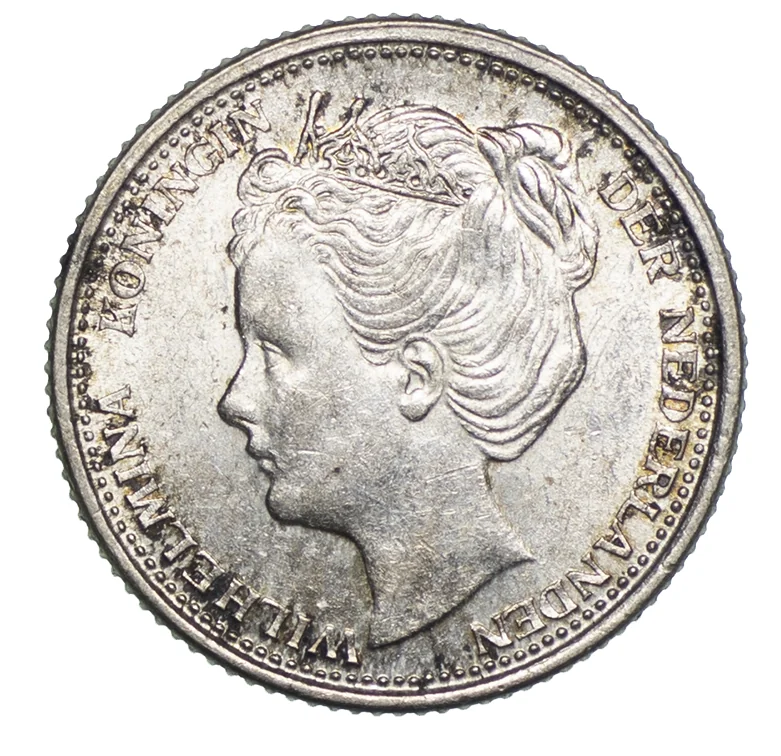
Queen Wilhelmina in profile left, wearing a diadem.
Inscription:
WILHELMINA KONINGIN DER NEDERLANDEN
Translation:
Wilhelmina Queen of the Netherlands
Script: Latin
Language: Dutch
Engraver: Johannes Cornelis Wienecke
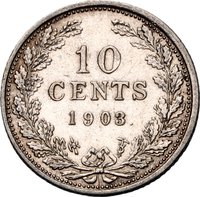
Reverse
Description:
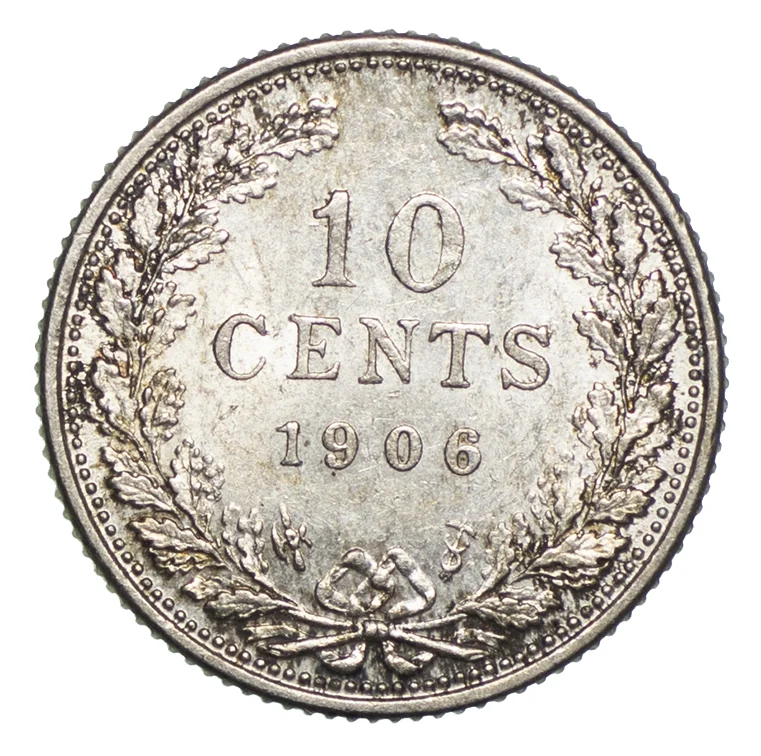
Value and date encircled
Inscription:
10
CENTS
1904
CENTS
1904
Script: Latin
Engraver: Johannes Cornelis Wienecke
Edge
Reeded
Mints
| Name | Mark |
|---|---|
| Royal Dutch Mint | — |
Mintings
| Year | Mint Mark | Mintage | Quality | Collection |
|---|---|---|---|---|
| 1904 | — | 3,000,000 | ||
| 1905 | — | 2,000,000 | ||
| 1906 | — | 4,000,000 |
Historical background
In 1904, the Netherlands operated under the well-established gold standard, with the Dutch guilder (gulden) as its national currency. The country's monetary system was defined by the Bank Act of 1863, which granted De Nederlandsche Bank (DNB) a monopoly on note issuance and firmly pegged the guilder to gold. This provided a period of remarkable monetary stability and international credibility, facilitating the Netherlands' extensive trade and colonial enterprises. The value of the guilder was fixed, and banknotes were freely convertible into gold coin upon demand, creating a predictable financial environment.
Despite this overarching stability, the period was not without its monetary debates and pressures. Like much of Europe, the Netherlands experienced a general trend towards the increased use of banknotes over gold and silver coin in everyday circulation, a process known as "the victory of paper." Furthermore, the global economic landscape was dominated by the gold-backed British pound sterling, which served as the primary reserve and trade currency. This meant that while the guilder was stable, international commerce and finance in the Dutch East Indies and elsewhere often flowed through sterling, subtly underscoring the guilder's secondary role in the global system.
Looking ahead, the stability of 1904 would soon be tested. The outbreak of World War I a decade later would force the Netherlands, as a neutral power, to suspend gold convertibility in 1914 to protect its bullion reserves. This pivotal moment ended the classic gold standard era and ushered in a period of monetary management and uncertainty, making the pre-war years, including 1904, representative of the closing chapter of a long period of metallic monetary certainty in Dutch history.
Despite this overarching stability, the period was not without its monetary debates and pressures. Like much of Europe, the Netherlands experienced a general trend towards the increased use of banknotes over gold and silver coin in everyday circulation, a process known as "the victory of paper." Furthermore, the global economic landscape was dominated by the gold-backed British pound sterling, which served as the primary reserve and trade currency. This meant that while the guilder was stable, international commerce and finance in the Dutch East Indies and elsewhere often flowed through sterling, subtly underscoring the guilder's secondary role in the global system.
Looking ahead, the stability of 1904 would soon be tested. The outbreak of World War I a decade later would force the Netherlands, as a neutral power, to suspend gold convertibility in 1914 to protect its bullion reserves. This pivotal moment ended the classic gold standard era and ushered in a period of monetary management and uncertainty, making the pre-war years, including 1904, representative of the closing chapter of a long period of metallic monetary certainty in Dutch history.
🌱 Common