


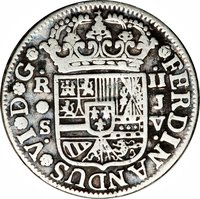
Obverse
Description:
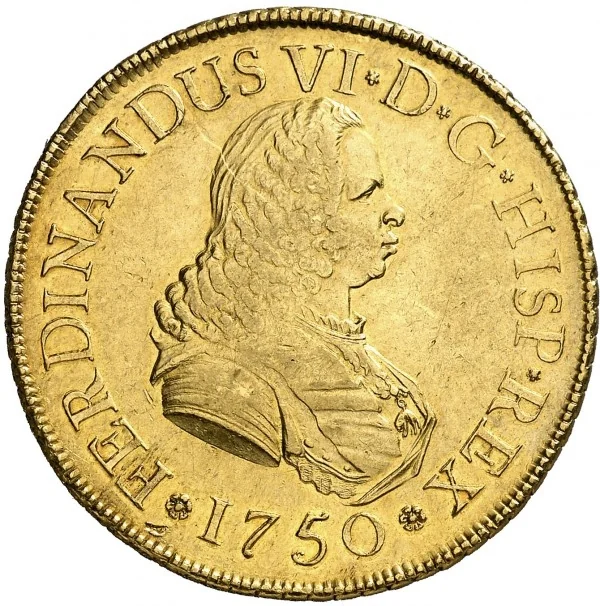
Armored bust of Ferdinand VI, right-facing.
Inscription:
FERDINANDUS VI ✿ D ✿ G ✿ HISP ✿ REX
✿ 1750 ✿
✿ 1750 ✿
Script: Latin
Engraver: Tomás Francisco Prieto Martin
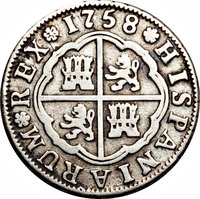
Reverse
Description:
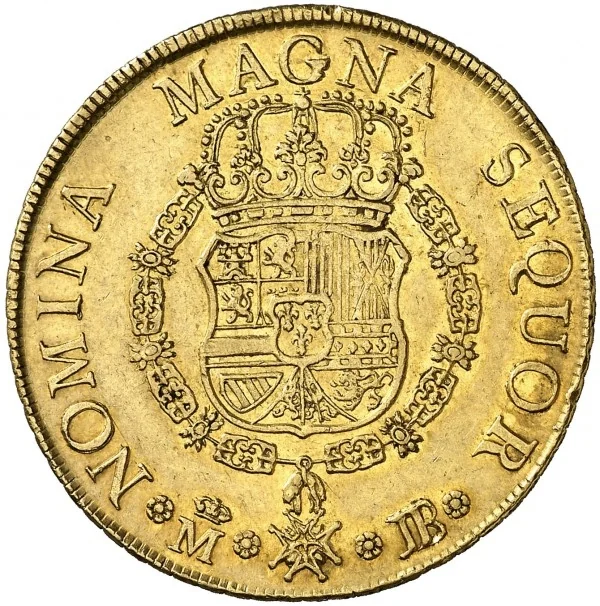
Crowned Spanish coat of arms with the Golden Fleece.
Inscription:
NOMINA MAGNA SEQUOR
✿ M ✿ ✿ JB ✿
✿ M ✿ ✿ JB ✿
Script: Latin
Engraver: Tomás Francisco Prieto Martin
Edge
Categories
| Symbols> Coat of Arms |
Mints
| Name | Mark |
|---|---|
| Royal Mint of Madrid | (M) |
Mintings
| Year | Mint Mark | Mintage | Quality | Collection |
|---|---|---|---|---|
| 1750 | MJB | — |
Historical background
In 1750, Spain operated under a complex and strained monetary system, a legacy of its vast global empire. The primary unit was the real, with the famous piece of eight (real de a ocho) being worth 8 reales and the gold escudo valued at 16 reales. However, the system was plagued by severe problems of scarcity and debasement. Centuries of financing European wars and a chronic trade deficit had drained silver and gold from the peninsula, leading to a critical shortage of physical coinage, especially small-denomination money needed for daily transactions. This scarcity crippled domestic commerce and fostered widespread use of inferior, locally minted tokens and foreign coins.
The monetary chaos was exacerbated by the policies of the Bourbon monarchy, particularly King Philip V (r. 1700-1746), who had engaged in repeated devaluations and manipulations to fund the War of Spanish Succession and subsequent conflicts. While his successor, Ferdinand VI (r. 1746-1759), under whom Spain enjoyed a period of peace and fiscal reform in 1750, sought stability, the damage was deep-rooted. The circulation consisted of a confusing mix of old and new coins of varying intrinsic values, alongside Portuguese, French, and Spanish-American currencies, making trade cumbersome and prone to fraud.
Furthermore, the situation highlighted a central paradox of the Spanish Empire: while vast quantities of silver flowed from mines in Mexico and Peru to the colonial port of Cadiz, much of it was immediately shipped out to pay foreign creditors and for manufactured imports, bypassing the Spanish economy. Thus, in 1750, Spain was a nation symbolically rich in precious metals yet practically starved of sound currency, a weakness that hindered internal economic development even as the crown sought to centralize and reform its administration during the broader Bourbon Reforms.
The monetary chaos was exacerbated by the policies of the Bourbon monarchy, particularly King Philip V (r. 1700-1746), who had engaged in repeated devaluations and manipulations to fund the War of Spanish Succession and subsequent conflicts. While his successor, Ferdinand VI (r. 1746-1759), under whom Spain enjoyed a period of peace and fiscal reform in 1750, sought stability, the damage was deep-rooted. The circulation consisted of a confusing mix of old and new coins of varying intrinsic values, alongside Portuguese, French, and Spanish-American currencies, making trade cumbersome and prone to fraud.
Furthermore, the situation highlighted a central paradox of the Spanish Empire: while vast quantities of silver flowed from mines in Mexico and Peru to the colonial port of Cadiz, much of it was immediately shipped out to pay foreign creditors and for manufactured imports, bypassing the Spanish economy. Thus, in 1750, Spain was a nation symbolically rich in precious metals yet practically starved of sound currency, a weakness that hindered internal economic development even as the crown sought to centralize and reform its administration during the broader Bourbon Reforms.
✨ Legendary