

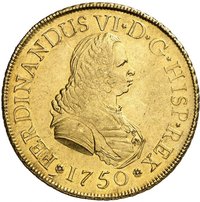
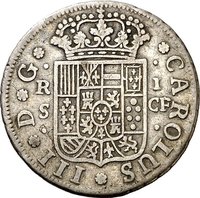
Obverse
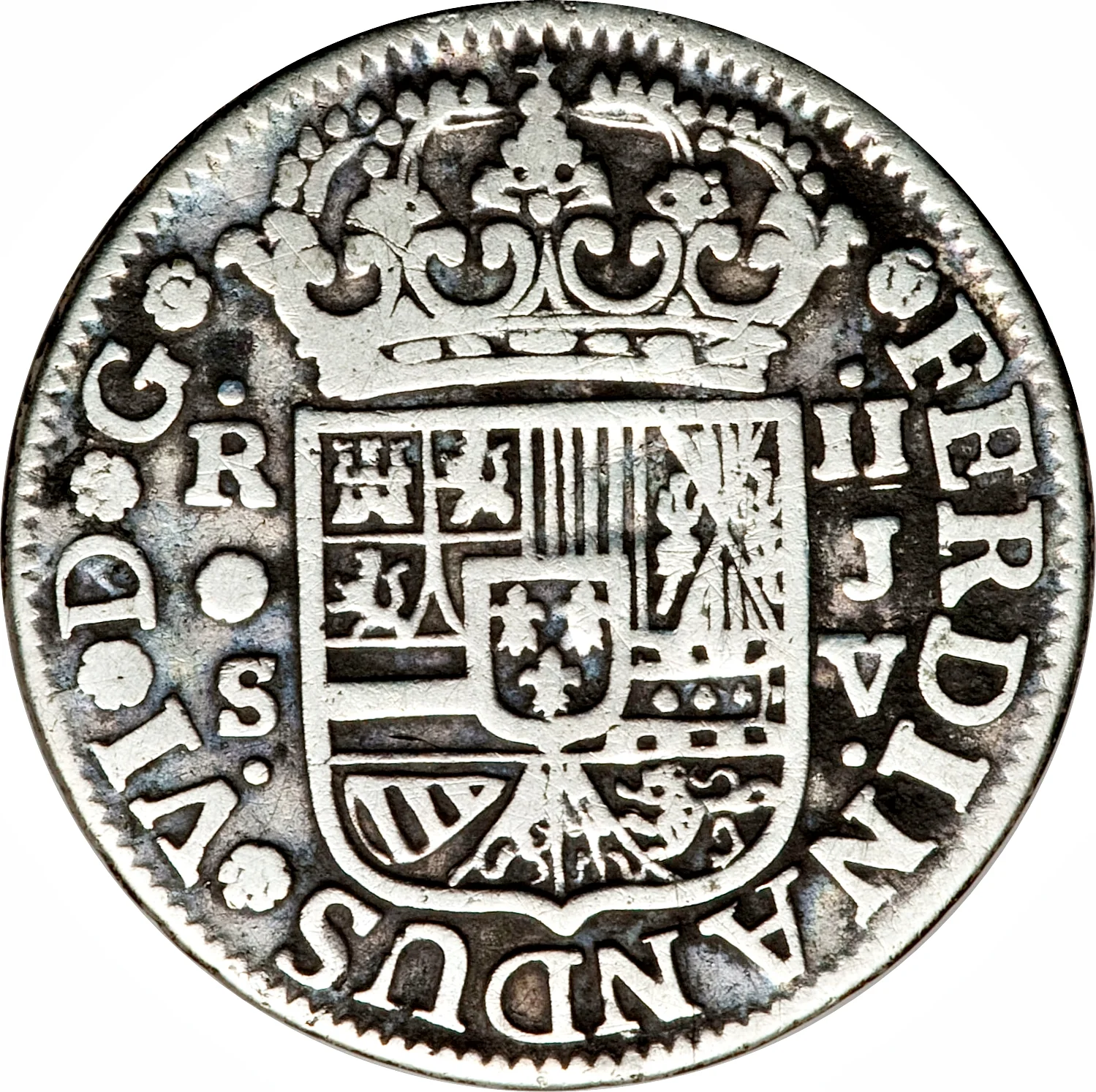
Description:
Royal arms of Spain.
Inscription:
✿ FERDINANDUS ✿ VI ✿ D ✿ G ✿
· ·
R II
✿
S J V
· ·
· ·
R II
✿
S J V
· ·
Script: Latin
Engraver: Tomás Francisco Prieto Martin
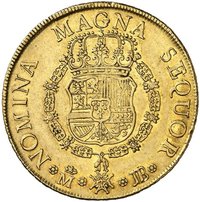
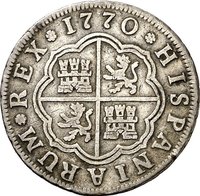
Reverse
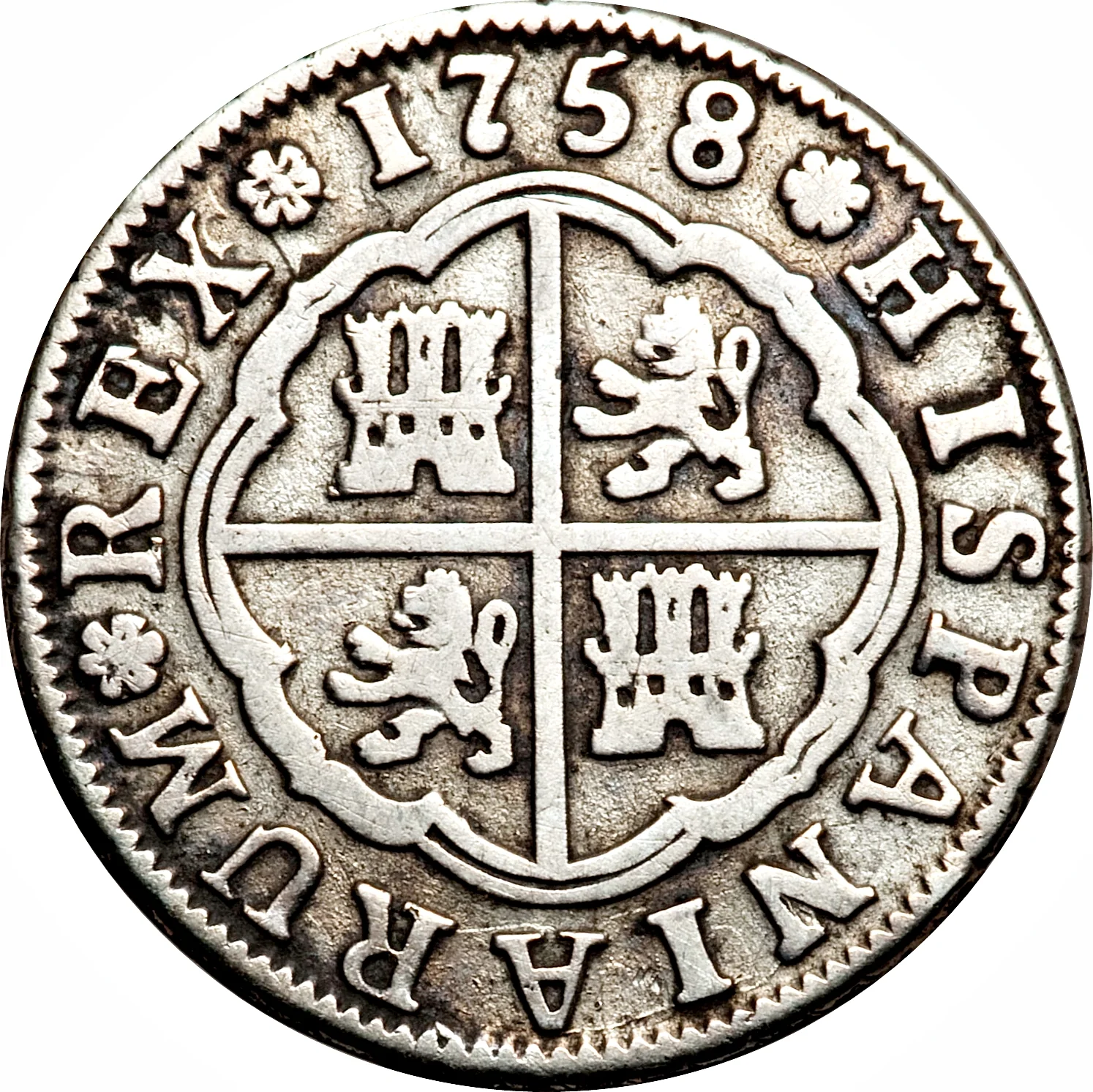
Description:
Castile and León's coat of arms in an octolobe.
Inscription:
✿ 1758 ✿ HISPANIARUM ✿ REX
Script: Latin
Engraver: Tomás Francisco Prieto Martin
Edge
Reeded
Categories
| Symbols> Coat of Arms |
Mints
| Name | Mark |
|---|---|
| Royal Mint of Madrid | (M) |
| Royal Mint of Seville | (S) |
Mintings
| Year | Mint Mark | Mintage | Quality | Collection |
|---|---|---|---|---|
| 1754 | MJB | — | ||
| 1754 | SPJ | — | ||
| 1757 | MJB | — | ||
| 1757 | SJV | — | ||
| 1758 | MJB | — | ||
| 1758 | SJV | — | ||
| 1759 | SJV | — | ||
| 1759 | MJ | — | ||
| 1759 | MJB | — |
Historical background
In 1754, Spain operated under a complex and strained monetary system, a legacy of its vast global empire. The primary unit was the real, with the famous piece of eight (8 reales) serving as a cornerstone for both domestic and international trade, notably in the Americas and Asia. However, the system was not uniform. Alongside silver coins from Spanish mints, a multitude of foreign coins—particularly Portuguese, French, and Italian—circulated widely due to trade, each with fluctuating local values. This created a chaotic environment where exchange rates varied from city to city, complicating commerce and tax collection.
The period was marked by a chronic shortage of circulating coinage, especially low-denomination copper maravedís essential for everyday transactions. This scarcity was a symptom of deeper issues: decades of expensive European wars had drained silver from the royal treasury, leading to repeated debasements of copper currency to fund state expenses. Consequently, public trust in the value of copper coinage was low, and prices were unstable. The economy suffered from this lack of a reliable and sufficient medium of exchange, which stifled internal trade and economic growth.
King Ferdinand VI, whose reign (1746-1759) was a period of relative peace and fiscal recovery, was aware of these monetary disorders. The government had begun efforts to reform the system, centralizing minting operations and attempting to curb the influx of foreign coin. The year 1754 falls within a crucial preparatory phase, where assessments were being made for more substantial reforms that would later culminate under his successor, Charles III. These future efforts aimed to unify the currency, restore confidence, and reassert royal control over the monetary supply, which was seen as essential for the crown's authority and the kingdom's economic health.
The period was marked by a chronic shortage of circulating coinage, especially low-denomination copper maravedís essential for everyday transactions. This scarcity was a symptom of deeper issues: decades of expensive European wars had drained silver from the royal treasury, leading to repeated debasements of copper currency to fund state expenses. Consequently, public trust in the value of copper coinage was low, and prices were unstable. The economy suffered from this lack of a reliable and sufficient medium of exchange, which stifled internal trade and economic growth.
King Ferdinand VI, whose reign (1746-1759) was a period of relative peace and fiscal recovery, was aware of these monetary disorders. The government had begun efforts to reform the system, centralizing minting operations and attempting to curb the influx of foreign coin. The year 1754 falls within a crucial preparatory phase, where assessments were being made for more substantial reforms that would later culminate under his successor, Charles III. These future efforts aimed to unify the currency, restore confidence, and reassert royal control over the monetary supply, which was seen as essential for the crown's authority and the kingdom's economic health.
⭐ Somewhat Rare