

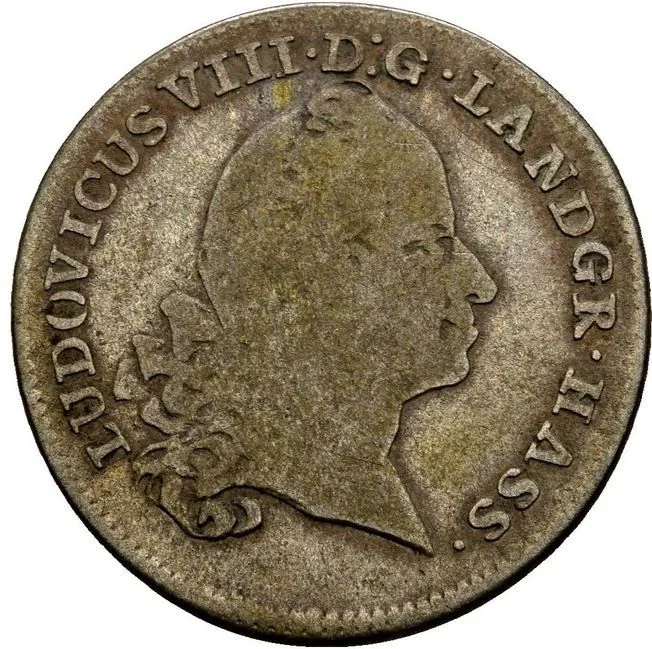
10 Kreuzers – Landgraviate of Hesse-Darmstadt
Context
Years: 1763–1765
Issuer: Landgraviate of Hesse-Darmstadt
Ruler: Louis VIII
Currency:
(1568—1805)
Demonetized: Yes
References
KM: #Click to copy to clipboard211
Numista: #194472
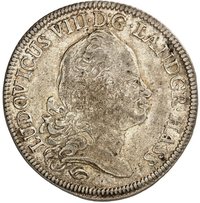
Obverse
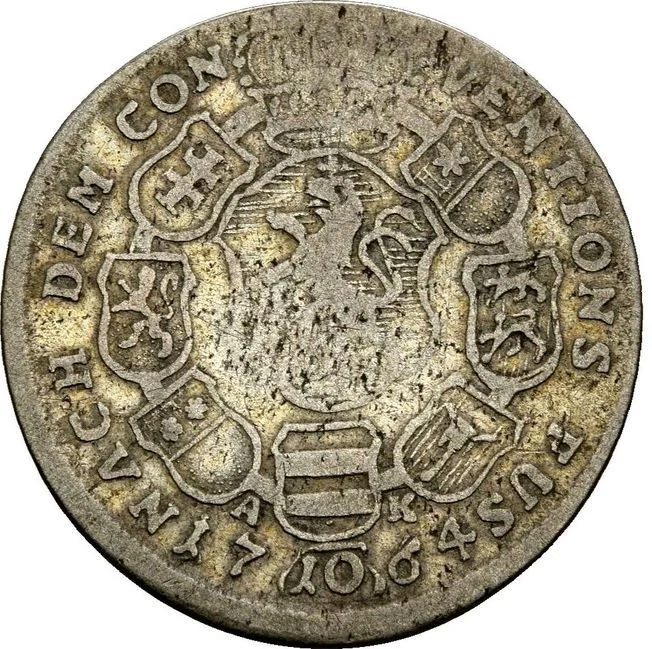
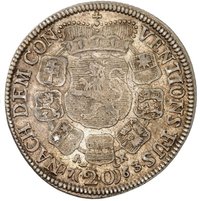
Reverse
Description:
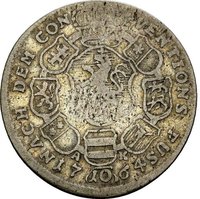
Lion on central shield, surrounded by seven smaller shields, topped by a crown.
Inscription:
NACH DEM CON / VENTIONS FUS
AK
AK
Script: Latin
Edge
Mints
| Name | Mark |
|---|---|
| Darmstadt | — |
Mintings
| Year | Mint Mark | Mintage | Quality | Collection |
|---|---|---|---|---|
| — | — | — | ||
| 1763 | — | — | ||
| 1764 | — | — | ||
| 1765 | — | — |
Historical background
In 1763, the Landgraviate of Hesse-Darmstadt, like much of the Holy Roman Empire, was emerging from the immense financial strain of the Seven Years' War (1756-1763). The conflict had drained the state's coffers, forcing the ruling Landgrave Ludwig IX to resort to heavy borrowing and the debasement of coinage to fund military expenditures. This resulted in a proliferation of low-value, small-denomination coins (Scheidemünzen) within the territory, while higher-value, full-weight silver talers were often hoarded or exported, leading to a severe shortage of "good money" for larger transactions and trade.
The currency landscape was further complicated by the region's political fragmentation. Hesse-Darmstadt existed within a complex web of monetary systems, as neighboring states like Hesse-Kassel, the Free City of Frankfurt, and the Electoral Palatinate all issued their own coinage. This created chronic confusion for merchants and citizens, who had to navigate fluctuating exchange rates and the uncertain value of numerous circulating coins. The problem was exacerbated by the widespread circulation of counterfeit and clipped coins, which eroded public trust in the monetary system.
Consequently, the post-war year of 1763 was a pivotal moment of monetary crisis and reckoning. The pressing need for fiscal stabilization and economic recovery demanded currency reform. While a comprehensive solution would take time, the immediate situation was characterized by a debased and chaotic circulating medium, a crippling public debt, and the urgent administrative challenge of restoring monetary order to facilitate trade and rebuild the landgraviate's shattered economy.
The currency landscape was further complicated by the region's political fragmentation. Hesse-Darmstadt existed within a complex web of monetary systems, as neighboring states like Hesse-Kassel, the Free City of Frankfurt, and the Electoral Palatinate all issued their own coinage. This created chronic confusion for merchants and citizens, who had to navigate fluctuating exchange rates and the uncertain value of numerous circulating coins. The problem was exacerbated by the widespread circulation of counterfeit and clipped coins, which eroded public trust in the monetary system.
Consequently, the post-war year of 1763 was a pivotal moment of monetary crisis and reckoning. The pressing need for fiscal stabilization and economic recovery demanded currency reform. While a comprehensive solution would take time, the immediate situation was characterized by a debased and chaotic circulating medium, a crippling public debt, and the urgent administrative challenge of restoring monetary order to facilitate trade and rebuild the landgraviate's shattered economy.
✨ Legendary