

5 Ducats – Hungary
Hungary

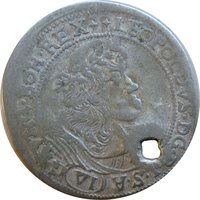
Obverse
Description:
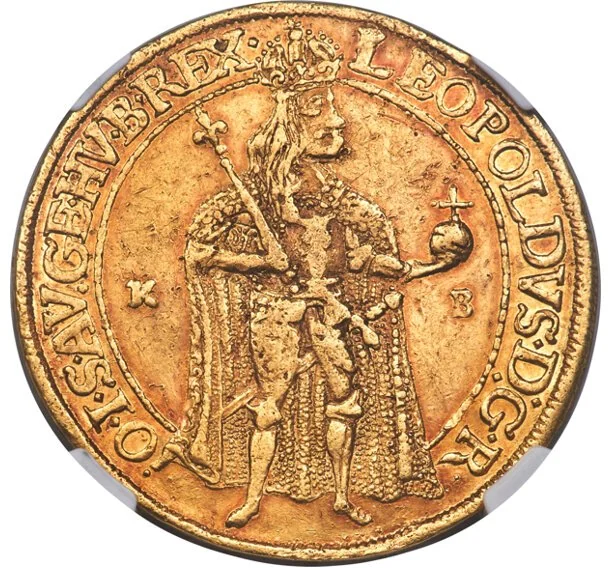
Monarch facing right, holding scepter and orb, breaking inner pearl circle. K B mintmark.
Inscription:
LEOPOLDVS · D · G · R O · I · S · AV · GE · HV · B · REX ·
Script: Latin
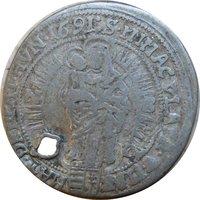
Reverse
Description:
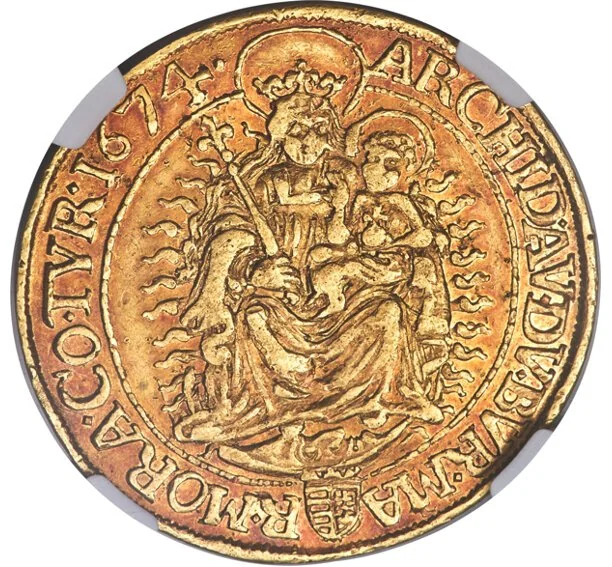
Crowned Madonna with scepter and child on a crescent moon, above the Hungarian coat of arms.
Inscription:
ARCHID · AV · DV · BVR · MA R · MORA · CO · TYR · 1674
K B
K B
Script: Latin
Edge
Plain
Mints
| Name | Mark |
|---|---|
| Kremnica | KB |
Mintings
| Year | Mint Mark | Mintage | Quality | Collection |
|---|---|---|---|---|
| 1669 | K | — | ||
| 1674 | K | — |
Historical background
In 1669, Hungary’s currency situation was chaotic and deeply unstable, a direct legacy of the ongoing wars and political fragmentation of the 17th century. The Kingdom of Hungary was divided into three parts: the Ottoman-occupied center, the Principality of Transylvania in the east, and the Habsburg-ruled "Royal Hungary" in the north and west. Each region operated with different monetary systems. The Habsburgs, ruling from Vienna, primarily minted and circulated large silver thalers (Tallér) and smaller silver denars for the Royal Hungarian territory, but chronic state bankruptcy and the immense costs of the ongoing wars against the Ottomans led to severe debasement. The silver content of coins was repeatedly reduced to fund military campaigns, eroding public trust and the currency's real value.
This period saw a flood of underweight and adulterated coins, alongside a proliferation of older, better-quality coins being hoarded or melted down (Gresham’s Law in action). Furthermore, a vast array of foreign coins circulated, including Turkish akçe and piasters in occupied territories, as well as Dutch thalers and various German state coins traded in the west. This created a complex and inefficient marketplace where exchange rates fluctuated wildly, and merchants faced significant losses. The Habsburg monetary authorities struggled to impose order, but their own fiscal desperation prevented any consistent, sound monetary policy.
Consequently, the economy in 1669 was characterized by high transaction costs, price inflation for goods, and widespread uncertainty. The monetary disorder mirrored the broader devastation of the country from continuous warfare, hindering trade and economic recovery. It was a system in crisis, awaiting the stability that would only begin to emerge after the expulsion of the Ottomans at the end of the century and subsequent Habsburg reforms.
This period saw a flood of underweight and adulterated coins, alongside a proliferation of older, better-quality coins being hoarded or melted down (Gresham’s Law in action). Furthermore, a vast array of foreign coins circulated, including Turkish akçe and piasters in occupied territories, as well as Dutch thalers and various German state coins traded in the west. This created a complex and inefficient marketplace where exchange rates fluctuated wildly, and merchants faced significant losses. The Habsburg monetary authorities struggled to impose order, but their own fiscal desperation prevented any consistent, sound monetary policy.
Consequently, the economy in 1669 was characterized by high transaction costs, price inflation for goods, and widespread uncertainty. The monetary disorder mirrored the broader devastation of the country from continuous warfare, hindering trade and economic recovery. It was a system in crisis, awaiting the stability that would only begin to emerge after the expulsion of the Ottomans at the end of the century and subsequent Habsburg reforms.
✨ Legendary