

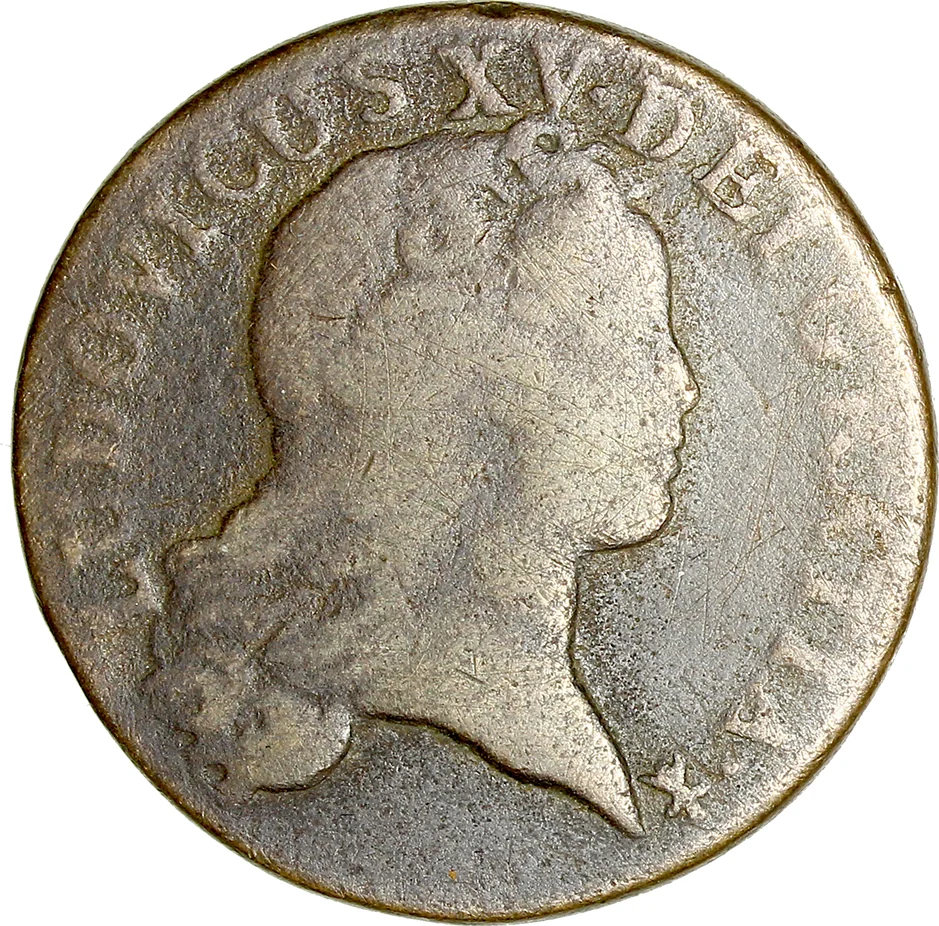
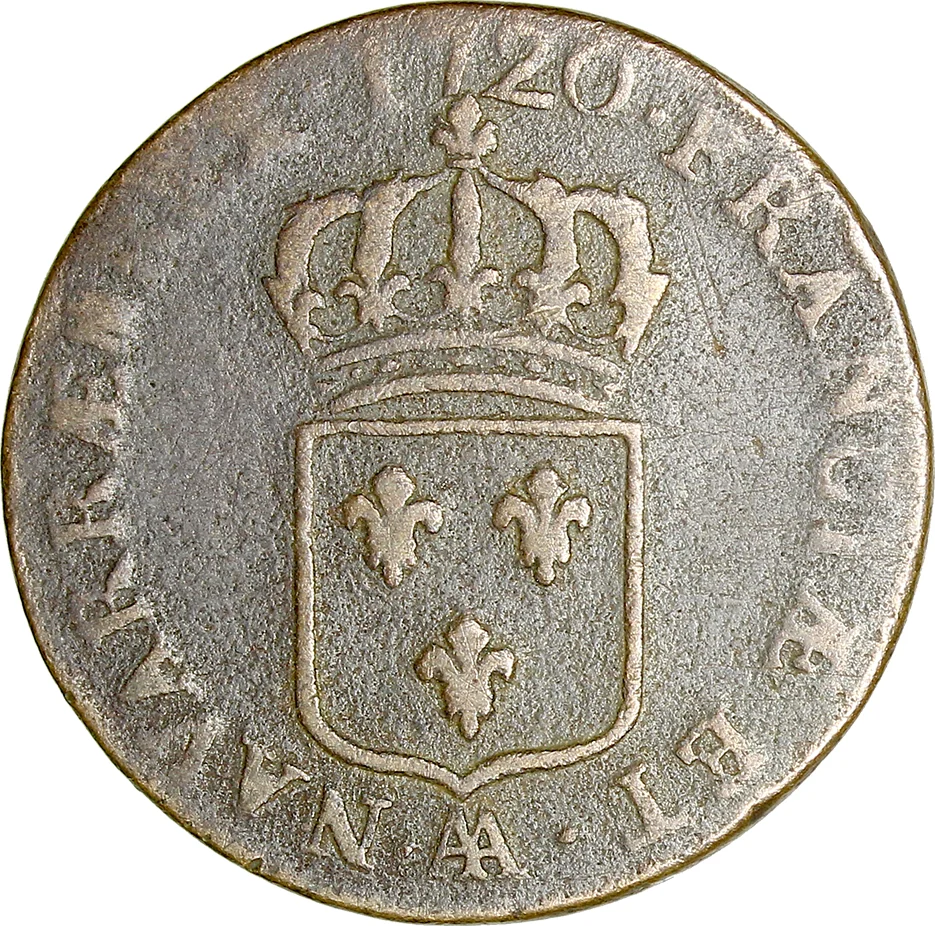
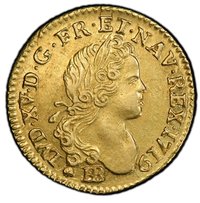
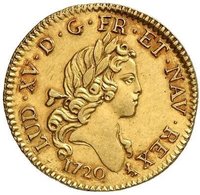
Obverse
Description:
Young Louis XV, bare-headed with curls cascading behind his neck.
Inscription:
LUDOVICUS XV DEI GRATIA
Script: Latin
Engraver: Norbert Roettiers
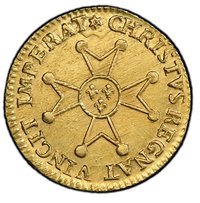
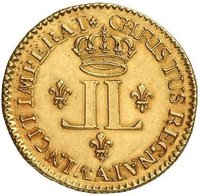
Reverse
Description:
The French shield crowned.
Inscription:
FRANCIÆ · ET · NAVARRÆ · REX ·1720 ·
AA
AA
Script: Latin
Engraver: Norbert Roettiers
Edge
Plain
Categories
| Symbols> Coat of Arms |
| Person> Monarch |
| Symbol> Wreath |
| Symbol> Fleur-de-lis |
Mints
| Name | Mark |
|---|---|
| Monnaie de Paris | A |
| Metz | AA |
| Rouen | B |
| Strasbourg | BB |
| La Rochelle | H |
| Perpignan | Q |
| Reims | S |
Mintings
Historical background
In 1719, France was in the midst of the audacious economic experiment known as the Mississippi Bubble, masterminded by Scottish financier John Law. Having gained the confidence of the Regent, Philippe d’Orléans, who governed for the young Louis XV, Law had consolidated the kingdom’s crushing war debts into his Mississippi Company. To stimulate the economy and manage the royal debt, he established a national bank that issued paper money, a novel and controversial concept in a society accustomed to metal coinage. The system initially brought prosperity, as the bank’s notes were theoretically convertible into gold and silver, and confidence in Law’s schemes ran high.
The currency situation grew increasingly frenzied and unstable throughout the year. The wild speculation in shares of the Mississippi Company, fueled by tales of vast wealth in French Louisiana, created a massive demand for banknotes to buy stock. Law’s Banque Royale, now a state institution, responded by printing increasing volumes of paper money without sufficient metallic backing. This led to a dangerous inflation of the money supply, while the promised mineral riches from the colonies failed to materialize. Despite attempts to prop up the system by decreeing the forced acceptance of paper and devaluing gold and silver coins, public confidence began to waver as smart investors started to covertly exchange their paper for tangible assets.
By the closing months of 1719, the façade was crumbling. The currency was becoming severely depreciated, and the first signs of a panic emerged as people sought to convert banknotes back into specie, only to find the bank’s reserves inadequate. The situation set the stage for the catastrophic collapse that would unfold in 1720, a collapse that would discredit paper money in France for decades, ruin thousands of investors, and leave the royal debt more burdensome than ever. Thus, 1719 represents the peak of a speculative mania built on fiduciary currency, a pivotal year of illusory wealth preceding a profound financial and political crisis.
The currency situation grew increasingly frenzied and unstable throughout the year. The wild speculation in shares of the Mississippi Company, fueled by tales of vast wealth in French Louisiana, created a massive demand for banknotes to buy stock. Law’s Banque Royale, now a state institution, responded by printing increasing volumes of paper money without sufficient metallic backing. This led to a dangerous inflation of the money supply, while the promised mineral riches from the colonies failed to materialize. Despite attempts to prop up the system by decreeing the forced acceptance of paper and devaluing gold and silver coins, public confidence began to waver as smart investors started to covertly exchange their paper for tangible assets.
By the closing months of 1719, the façade was crumbling. The currency was becoming severely depreciated, and the first signs of a panic emerged as people sought to convert banknotes back into specie, only to find the bank’s reserves inadequate. The situation set the stage for the catastrophic collapse that would unfold in 1720, a collapse that would discredit paper money in France for decades, ruin thousands of investors, and leave the royal debt more burdensome than ever. Thus, 1719 represents the peak of a speculative mania built on fiduciary currency, a pivotal year of illusory wealth preceding a profound financial and political crisis.
🌟 Limited