

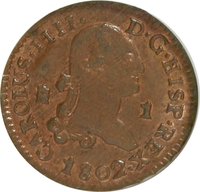
Obverse
Description:
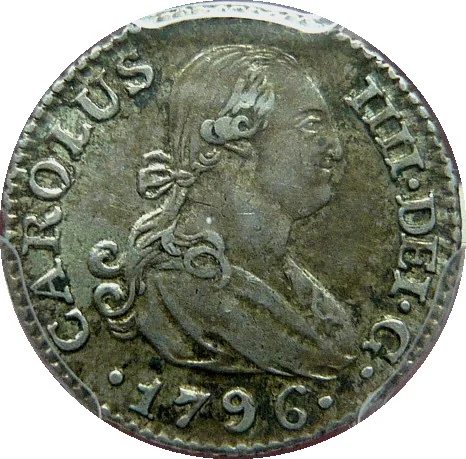
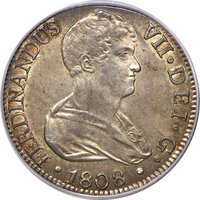
King Charles IV right-facing draped bust.
Inscription:
CAROLUS IIII · DEI · G ·
· 1796 ·
· 1796 ·
Script: Latin
Engraver: Pedro González de Sepúlveda
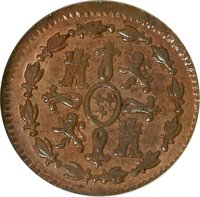
Reverse
Description:
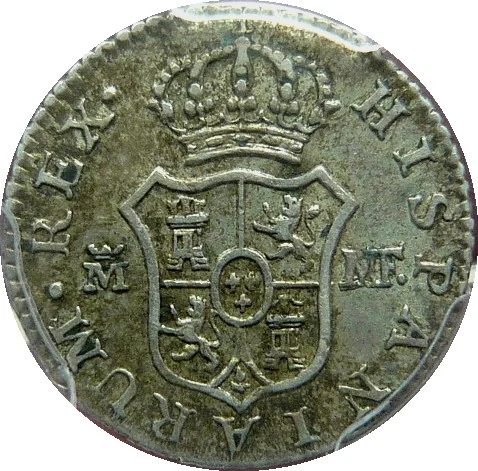
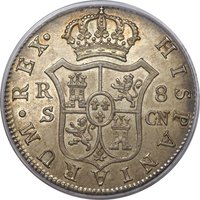
Royal arms of Spain.
Inscription:
HISPANIARUM · REX ·
M MF.
M MF.
Script: Latin
Engraver: Pedro González de Sepúlveda
Edge
Decorated
Categories
| Symbols> Coat of Arms |
Mints
| Name | Mark |
|---|---|
| Royal Mint of Madrid | (M) |
| Royal Mint of Seville | S |
Mintings
| Year | Mint Mark | Mintage | Quality | Collection |
|---|---|---|---|---|
| 1789 | MMF | — | ||
| 1790 | MMF | — | ||
| 1791 | MMF | — | ||
| 1793 | MMF | — | ||
| 1793 | SCN | — | ||
| 1795 | MMF | — | ||
| 1796 | MMF | — | ||
| 1797 | MMF | — | ||
| 1798 | MMF | — | ||
| 1799 | MMF | — | ||
| 1799 | MFA | — | ||
| 1800 | MFA | — | ||
| 1802 | MFA | — | ||
| 1802 | SCN | — | ||
| 1803 | MFA | — | ||
| 1804 | MFA | — | ||
| 1805 | SCN | — | ||
| 1807 | SCN | — | ||
| 1808 | MAI | — | ||
| 1808 | MFA | — |
Historical background
In 1789, Spain's currency system was a complex and fragile relic of its imperial past, grappling with severe structural problems. The backbone was the real de vellón, a billon coin (copper with a small silver content) used for everyday transactions, while larger sums were accounted for in escudos (gold) and reales de plata (silver). However, a century of economic decline, costly wars, and inefficient taxation had led successive Bourbon monarchs to repeatedly debase the coinage. By 1789, the currency was effectively on a copper standard, with the intrinsic metal value of coins often falling below their face value, causing inflation and a loss of public confidence.
This monetary instability was exacerbated by a chaotic circulation of countless older coins from different reigns and regions, all with varying metallic values. The state's chronic budget deficits, worsened by support for the American Revolution, forced the Crown to rely heavily on short-term debt (vales reales) issued by the Banco de San Carlos. These promissory notes began to circulate as paper money but quickly traded at a steep discount to their nominal value, further complicating the monetary landscape. The system was inherently unstable, as the government lacked the silver reserves to back its obligations, creating a looming crisis of sovereign credit.
The situation placed Spain in a vulnerable position on the eve of the French Revolution. While Charles III's ministers had attempted reforms, the fundamental issues remained unresolved: an inadequate tax base, reliance on American silver shipments that were becoming less reliable, and a monetary mass increasingly divorced from real value. The outbreak of revolution in France in 1789 would soon trigger massive spending on warfare, leading to catastrophic inflation in the 1790s. Thus, the currency situation of 1789 represented the calm before the storm, a weakened system poised for the severe financial collapse that would dominate the reign of Charles IV.
This monetary instability was exacerbated by a chaotic circulation of countless older coins from different reigns and regions, all with varying metallic values. The state's chronic budget deficits, worsened by support for the American Revolution, forced the Crown to rely heavily on short-term debt (vales reales) issued by the Banco de San Carlos. These promissory notes began to circulate as paper money but quickly traded at a steep discount to their nominal value, further complicating the monetary landscape. The system was inherently unstable, as the government lacked the silver reserves to back its obligations, creating a looming crisis of sovereign credit.
The situation placed Spain in a vulnerable position on the eve of the French Revolution. While Charles III's ministers had attempted reforms, the fundamental issues remained unresolved: an inadequate tax base, reliance on American silver shipments that were becoming less reliable, and a monetary mass increasingly divorced from real value. The outbreak of revolution in France in 1789 would soon trigger massive spending on warfare, leading to catastrophic inflation in the 1790s. Thus, the currency situation of 1789 represented the calm before the storm, a weakened system poised for the severe financial collapse that would dominate the reign of Charles IV.
⭐ Rare