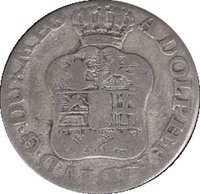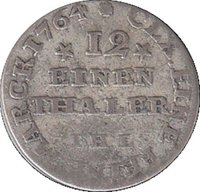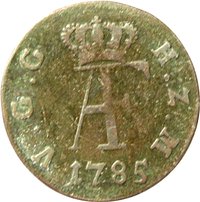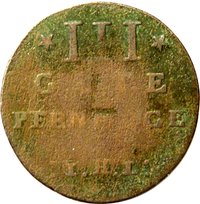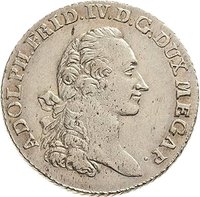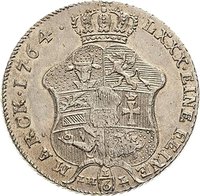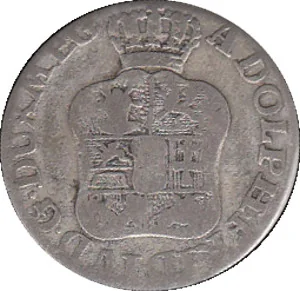
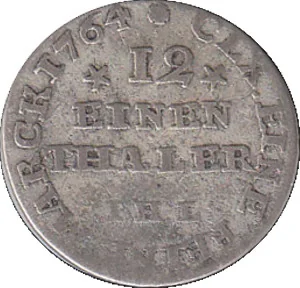
In 1764, the currency situation in the Duchy of Mecklenburg-Strelitz was characterized by significant complexity and instability, common across the fragmented German states of the Holy Roman Empire. The duchy did not have a fully sovereign monetary system; instead, it operated within the framework of the
Mecklenburg Convention Thaler (Konventionsthaler), a currency standard adopted by both Mecklenburg duchies (Schwerin and Strelitz) in 1752/1753. This standard pegged the Thaler to the Cologne Mark of fine silver, aiming to bring order by aligning with the wider Reichsthaler system used across the Empire. However, in practice, a multitude of foreign and older domestic coins remained in circulation, leading to a confusing mix of values and constant difficulties in exchange.
The economic strain of the recent Seven Years' War (1756-1763) profoundly exacerbated monetary problems. To finance the conflict, states across Europe, including Mecklenburg-Strelitz, had engaged in debasement—reducing the precious metal content in coins while maintaining their face value. This resulted in inflation, a loss of public trust in the currency, and the hoarding of older, purer coins (Gresham's Law). By 1764, the duchy was grappling with the war's aftermath: a depreciated circulating medium, heavy debt, and the challenging task of restoring monetary integrity amidst a slow economic recovery.
Consequently, the primary focus in 1764 was on stabilization and regulatory enforcement. The ducal government sought to reaffirm the Convention Thaler standard and control the chaotic circulation by issuing mandates against the use of debased or foreign coins. However, its limited economic power and the continued circulation of neighboring states' currencies, particularly from Prussia and the Hanseatic cities, made effective control difficult. Thus, the currency situation remained a fragile patchwork of official standards, wartime legacy, and everyday monetary confusion, reflecting the duchy's broader position as a small state within a complex imperial economic landscape.