

1 Baht – Thailand
Thailand
Context
Years: 1913–1918
Issuer: Thailand 
Ruler: Phra Mongkut Klao
Currency:
(since 1897)
Demonetized: Yes
Total mintage: 34,950,000
Material
References
Y: #Click to copy to clipboard45
Numista: #12261
Value
Exchange value: 1 THB = $0.03
Bullion value: $37.61
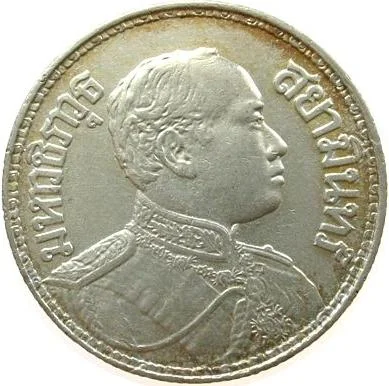
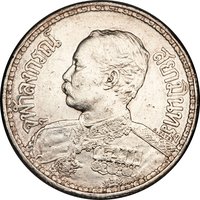
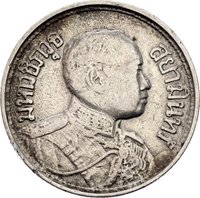
Obverse
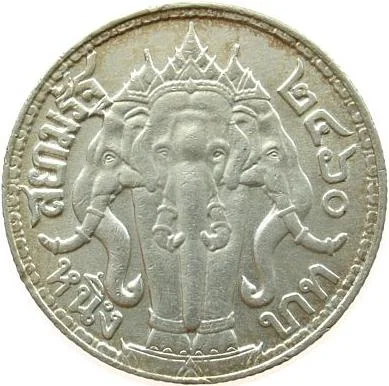
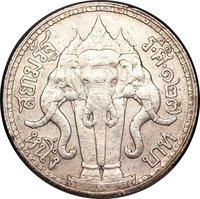
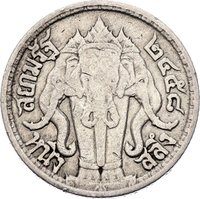
Reverse
Edge
Reeded
Mintings
| Year | Mint Mark | Mintage | Quality | Collection |
|---|---|---|---|---|
| 1913 | — | 2,690,000 | ||
| 1914 | — | — | ||
| 1915 | — | 5,000,000 | ||
| 1916 | — | 9,080,000 | ||
| 1917 | — | 14,340,000 | ||
| 1918 | — | 3,840,000 |
Historical background
In 1913, Thailand, then known as Siam, operated under a complex and transitional monetary system. The nation had not yet issued its own modern, unified coinage or banknotes. Instead, the economy relied on a mixture of physical silver, including bullet-shaped coins known as "pot duang," and a variety of foreign silver coins, primarily the Mexican Dollar and the British Indian Rupee, which circulated freely. This system was cumbersome for trade and state finance, as the value of these coins fluctuated with global silver prices, creating instability.
Recognizing the need for modernization, King Chulalongkorn (Rama V) had initiated financial reforms, which were being advanced by his successor, King Vajiravudh (Rama VI). A pivotal step was the establishment of the Baht as the national decimal currency unit in 1897, but the tangible manifestation of this was still in progress. The Currency Act of 1908 laid the legal groundwork, authorizing the creation of a new decimal coinage system where one Baht was subdivided into 100 Satang. By 1913, the Treasury Department was actively minting and introducing these new flat, machine-struck coins in bronze and silver, gradually replacing the old pod duang and foreign silver.
Thus, 1913 represents a critical juncture where Siam was actively phasing out its ancient and imported metallic currency in favor of a modern, sovereign decimal system. This reform was a cornerstone of the broader administrative and economic modernization of the absolute monarchy, aimed at strengthening central authority, facilitating taxation and trade, and aligning the kingdom with international financial standards. The full transition to a managed currency, including the later introduction of paper notes by the Treasury and eventually the Bank of Thailand, was built upon this foundational decade of change.
Recognizing the need for modernization, King Chulalongkorn (Rama V) had initiated financial reforms, which were being advanced by his successor, King Vajiravudh (Rama VI). A pivotal step was the establishment of the Baht as the national decimal currency unit in 1897, but the tangible manifestation of this was still in progress. The Currency Act of 1908 laid the legal groundwork, authorizing the creation of a new decimal coinage system where one Baht was subdivided into 100 Satang. By 1913, the Treasury Department was actively minting and introducing these new flat, machine-struck coins in bronze and silver, gradually replacing the old pod duang and foreign silver.
Thus, 1913 represents a critical juncture where Siam was actively phasing out its ancient and imported metallic currency in favor of a modern, sovereign decimal system. This reform was a cornerstone of the broader administrative and economic modernization of the absolute monarchy, aimed at strengthening central authority, facilitating taxation and trade, and aligning the kingdom with international financial standards. The full transition to a managed currency, including the later introduction of paper notes by the Treasury and eventually the Bank of Thailand, was built upon this foundational decade of change.
🌱 Fairly Common