

8 Mark – Sweden
Sweden
Context
Years: 1700–1704
Issuer: Sweden 
Ruler: Charles XII
Currency:
(1665—1715)
Demonetized: Yes
Total mintage: 18,608
Material
Weight: 31.35 g
Silver weight: 28.90 g
Shape: Round
Composition: 92.2% Silver
Standard: Silver ounce
Magnetic: No
References
KM: #Click to copy to clipboard317
Numista: #183294
Value
Bullion value: $82.68
Obverse
Description:
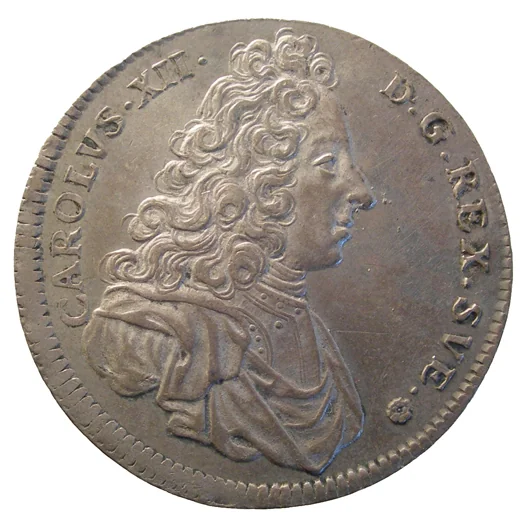
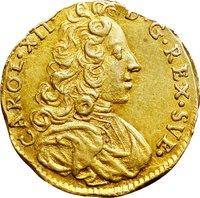
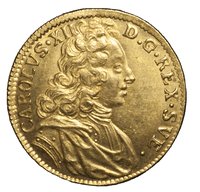
King Carl XII in profile, draped bust with heavy hair.
Inscription:
CAROLVS·XII· D.G.REX.SVE.
Script: Latin
Reverse
Description:
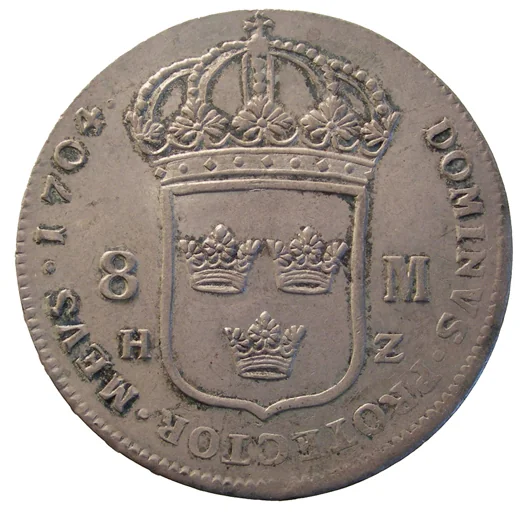
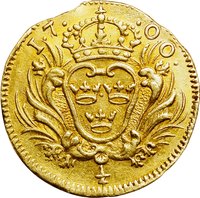
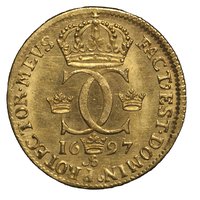
Shield with three Swedish crowns divides value and mintmark within circular legend.
Inscription:
DOMINVS·PROTECTOR·MEVS·1704·
8 M
H Z
8 M
H Z
Script: Latin
Edge
Mints
| Name | Mark |
|---|---|
| Stockholm | — |
Mintings
| Year | Mint Mark | Mintage | Quality | Collection |
|---|---|---|---|---|
| 1700 | — | 6,284 | ||
| 1701 | — | 6,490 | ||
| 1704 | — | 5,834 |
Historical background
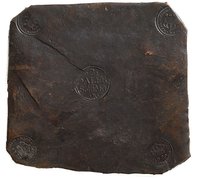
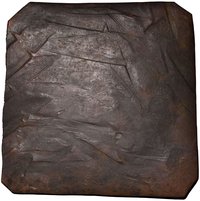
In the early 18th century, Sweden's currency system was in a state of profound crisis, a direct legacy of its era as a Great Power. To finance the lavish expenditures of King Charles XI and, more critically, the protracted Great Northern War (1700–1721) under Charles XII, the state had resorted to massive coin debasement. The Swedish Riksdaler, once a respected silver coin, was systematically reduced in precious metal content, while copper daler plates—the uniquely cumbersome "plate money"—remained a foundational part of the monetary system, their value fluctuating with the international price of copper.
This period, often called the "plate money period," was characterized by a chaotic multi-metallic system with no fixed exchange rate between its components: silver coin, copper coin, and the large copper plates. The government's relentless minting of ever-lighter silver coins to pay for the war led to rampant inflation and Gresham's Law in action, where "bad" debased money drove "good" full-valued money out of circulation. By 1709, following the defeat at Poltava, the financial situation became desperate, with the state's credit exhausted and the currency's real value collapsing.
Consequently, everyday economic life in 1700 Sweden was marked by extreme instability and complexity. Merchants and the public struggled with confusing and shifting exchange rates, widespread mistrust of the coinage, and the physical impracticality of the heavy plate money. This monetary chaos severely hampered trade, eroded public confidence in the state, and placed a heavy burden on the population, setting the stage for the sweeping financial reforms that would follow the war's conclusion.
This period, often called the "plate money period," was characterized by a chaotic multi-metallic system with no fixed exchange rate between its components: silver coin, copper coin, and the large copper plates. The government's relentless minting of ever-lighter silver coins to pay for the war led to rampant inflation and Gresham's Law in action, where "bad" debased money drove "good" full-valued money out of circulation. By 1709, following the defeat at Poltava, the financial situation became desperate, with the state's credit exhausted and the currency's real value collapsing.
Consequently, everyday economic life in 1700 Sweden was marked by extreme instability and complexity. Merchants and the public struggled with confusing and shifting exchange rates, widespread mistrust of the coinage, and the physical impracticality of the heavy plate money. This monetary chaos severely hampered trade, eroded public confidence in the state, and placed a heavy burden on the population, setting the stage for the sweeping financial reforms that would follow the war's conclusion.
✨ Legendary