

1 Ducat – Sweden
Sweden
Context
Years: 1712–1717
Issuer: Sweden 
Ruler: Charles XII
Currency:
(1665—1715)
Demonetized: Yes
Total mintage: 43,006
References
KM: #Click to copy to clipboard350
Numista: #183187
Value
Bullion value: $562.81
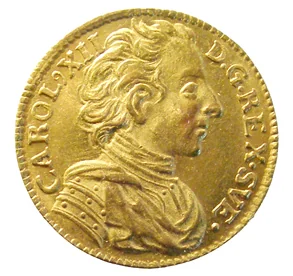
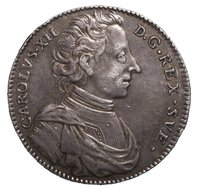
Obverse
Description:
Armored bust of Carl XI right within legend.
Inscription:
CAROL,XII D.G·REX·SVE·
Script: Latin
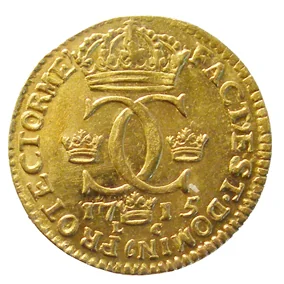
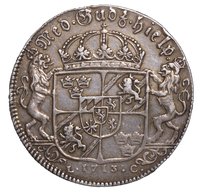
Reverse
Description:
Monogram with three Swedish crowns inside legend circle. Date and mintmark below.
Inscription:
FACT,EST·DOMIN,PROTECTORME'
17 15
17 15
Script: Latin
Edge
Mints
| Name | Mark |
|---|---|
| Stockholm | — |
Mintings
| Year | Mint Mark | Mintage | Quality | Collection |
|---|---|---|---|---|
| 1712 | — | 4,433 | ||
| 1713 | — | 4,243 | ||
| 1714 | — | 16,000 | ||
| 1715 | — | 6,863 | ||
| 1716 | — | 7,828 | ||
| 1717 | — | 3,639 |
Historical background
In 1712, Sweden was embroiled in the Great Northern War (1700-1721), a conflict that had stretched its finances to the breaking point. King Charles XII’s ambitious campaigns, particularly the disastrous defeat at Poltava in 1709, had drained the treasury. To fund the ongoing war effort, the state resorted to the drastic measure of heavily debasing the coinage. The Swedish Riksdaler was systematically reduced in silver content, while large quantities of low-quality copper and billon (base metal) coins were minted to pay soldiers and suppliers. This created a classic scenario of too much money chasing too few goods, as the war also disrupted domestic production and trade.
The monetary situation was chaotic, characterized by a severe inflation that eroded public trust. Different types of coins—older full-value riksdalers, new debased coins, and even emergency "credit coins" issued by the army—circulated simultaneously at fluctuating values. Prices for essential goods soared, causing widespread hardship among the civilian population and soldiers whose pay was in depreciated currency. The government’s attempts to legislate fixed exchange rates between old and new coins failed, as market forces and rampant speculation undermined official decrees.
This currency crisis was a symptom of Sweden’s fading imperial power. The financial manipulations of 1712 provided short-term liquidity for the war but at a devastating long-term cost. It undermined the credibility of the state, destabilized the economy, and contributed to the social and political exhaustion that would ultimately force Sweden to cede its Baltic empire in the war’s aftermath. The period stands as a stark example of how wartime fiscal desperation can trigger inflationary spirals and erode a nation’s economic foundation.
The monetary situation was chaotic, characterized by a severe inflation that eroded public trust. Different types of coins—older full-value riksdalers, new debased coins, and even emergency "credit coins" issued by the army—circulated simultaneously at fluctuating values. Prices for essential goods soared, causing widespread hardship among the civilian population and soldiers whose pay was in depreciated currency. The government’s attempts to legislate fixed exchange rates between old and new coins failed, as market forces and rampant speculation undermined official decrees.
This currency crisis was a symptom of Sweden’s fading imperial power. The financial manipulations of 1712 provided short-term liquidity for the war but at a devastating long-term cost. It undermined the credibility of the state, destabilized the economy, and contributed to the social and political exhaustion that would ultimately force Sweden to cede its Baltic empire in the war’s aftermath. The period stands as a stark example of how wartime fiscal desperation can trigger inflationary spirals and erode a nation’s economic foundation.
✨ Legendary