

Obverse
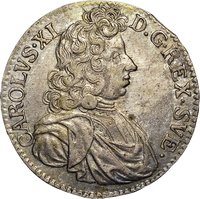
Description:
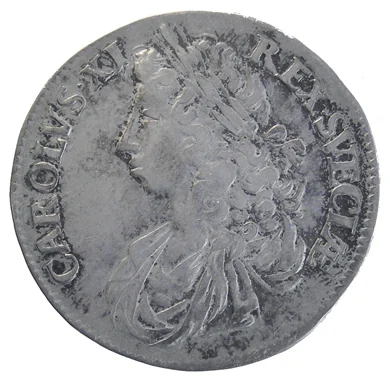
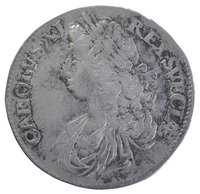
Laureate bust of Carl XI left within encircling legend.
Inscription:
CAROLVS·XI REX·SVECIÆ
Script: Latin
Reverse
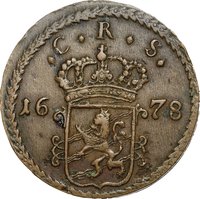
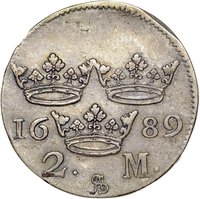
Description:
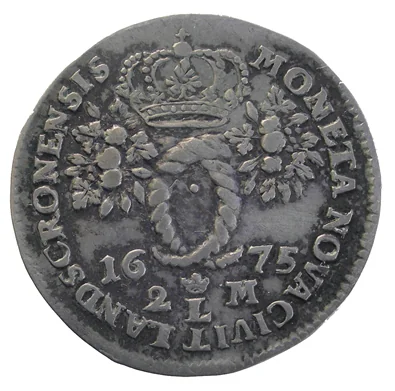
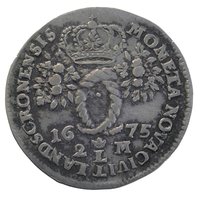
Crowned art divides date above value and mint mark within circular legend.
Inscription:
MONETA NOVA CIVIT LANDSCRONENSIS
Script: Latin
Edge
Mints
| Name | Mark |
|---|---|
| Landskrona | — |
Mintings
| Year | Mint Mark | Mintage | Quality | Collection |
|---|---|---|---|---|
| 1675 | — | — |
Historical background
In 1675, Sweden found itself in a precarious monetary situation, a direct consequence of its ambitious foreign policy. To finance its involvement in the Scanian War (1675–1679) against Denmark and other adversaries, the Swedish state, under the regency of Charles XI, resorted to the rapid debasement of its copper currency. The Swedish monetary system was uniquely bimetallic, relying heavily on bulky copper daler plates, but the war effort demanded a more expedient solution. The government therefore authorized the minting of large quantities of lower-quality copper coinage and began issuing the first Swedish banknotes, known as transportsedlar, to pay for military supplies.
This emergency issuance led to severe inflation and a collapse in public confidence. The new coins, containing less intrinsic metal value, and the largely unbacked paper notes quickly depreciated in value against the older, purer copper currency and against silver. This created a chaotic multi-tiered currency system where older coins were hoarded (following Gresham's Law), prices soared, and soldiers and suppliers were paid in a currency that merchants were reluctant to accept. The situation was exacerbated by a deliberate Danish policy of counterfeiting Swedish coins to further destabilize the economy.
The crisis of 1675 marked a critical point in Swedish financial history, exposing the dangers of wartime fiscal policy. The immediate aftermath saw widespread economic distress and a loss of faith in government-issued money. This experience would profoundly shape the future reign of Charles XI, who, after the war, embarked on the Great Reduction to reclaim crown lands and stabilize state finances, and ultimately led to the founding of the Bank of Sweden (Sveriges Riksbank) in 1668, which would later grapple with establishing a more stable monetary system.
This emergency issuance led to severe inflation and a collapse in public confidence. The new coins, containing less intrinsic metal value, and the largely unbacked paper notes quickly depreciated in value against the older, purer copper currency and against silver. This created a chaotic multi-tiered currency system where older coins were hoarded (following Gresham's Law), prices soared, and soldiers and suppliers were paid in a currency that merchants were reluctant to accept. The situation was exacerbated by a deliberate Danish policy of counterfeiting Swedish coins to further destabilize the economy.
The crisis of 1675 marked a critical point in Swedish financial history, exposing the dangers of wartime fiscal policy. The immediate aftermath saw widespread economic distress and a loss of faith in government-issued money. This experience would profoundly shape the future reign of Charles XI, who, after the war, embarked on the Great Reduction to reclaim crown lands and stabilize state finances, and ultimately led to the founding of the Bank of Sweden (Sveriges Riksbank) in 1668, which would later grapple with establishing a more stable monetary system.
Series: 1675 Sweden circulation coins

✨ Legendary