Logo Title
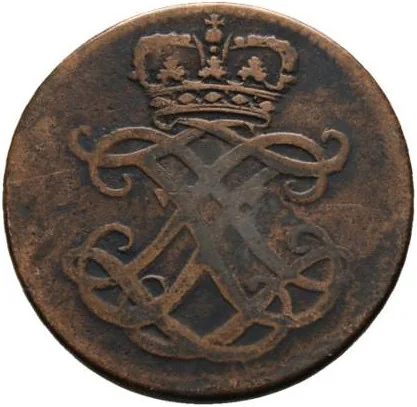
obverse
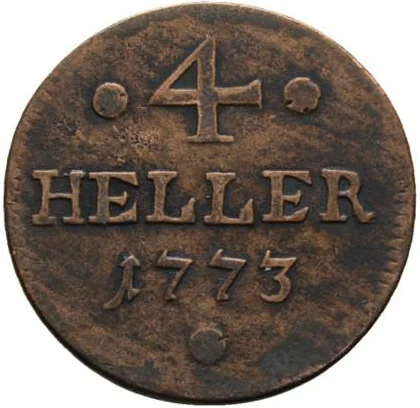
reverse
MANFRED OLDING Münzenhandlung

4 Hellers – Landgraviate of Hesse-Cassel

Context
Year: 1773
Currency:
Demonetized: Yes
Material
Shape: Round
Composition: Copper
Magnetic: No
References
KM: #Click to copy to clipboard502
Numista: #182066

Obverse

Description:
Crowned double FL monogram.
Script: Latin

Reverse

Description:
Denomination and date on three lines. Dots flank the 4 and one below the date.
Inscription:
4

HELLER

1773
Script: Latin

Edge

Mintings

YearMint MarkMintageQualityCollection
1773

Historical background

In 1773, the currency situation in the Landgraviate of Hesse-Cassel was one of relative stability and strength, a notable achievement within the politically fragmented Holy Roman Empire. This stability was largely the result of deliberate policies enacted under Landgrave Frederick II, who had ascended to the throne in 1760. Recognizing that a sound currency was essential for state credit, international trade, and the financing of his ambitious military policies, Frederick II had worked to consolidate and standardize the monetary system, moving away from the debasement and confusion that plagued many neighboring territories.

The cornerstone of this system was the Reichsthaler, a silver coin adhering to the imperial standards set by the Reichsmünzfuß (imperial minting ordinance). Hesse-Cassel minted its own Reichsthalers, which were widely accepted and trusted. These were subdivided into 32 Albuss or 24 Gutegroschen, creating a clear and functional hierarchy of coins for daily transactions. This reliability was crucial for the landgraviate’s economy, which benefited from transit trade and a growing financial sector, including the famous Militärkasse (military treasury) that would later lend money to foreign powers.

However, this official system coexisted with a complex reality of circulating foreign coins. Given Hesse-Cassel’s location on important trade routes, Dutch, French, and coins from other German states also circulated, requiring constant official valuation lists (Kurantzettel) to establish their worth against the Hessian standard. Furthermore, the landgraviate’s financial strength was underpinned by a controversial source: the leasing of Hessian troops as mercenaries, particularly to Great Britain, which would soon be employed on a massive scale during the American Revolutionary War. The substantial subsidies from these treaties, flowing into the treasury in sound foreign currency, were a key pillar supporting the integrity of Hesse-Cassel's own monetary system in 1773 and beyond.
Legendary