

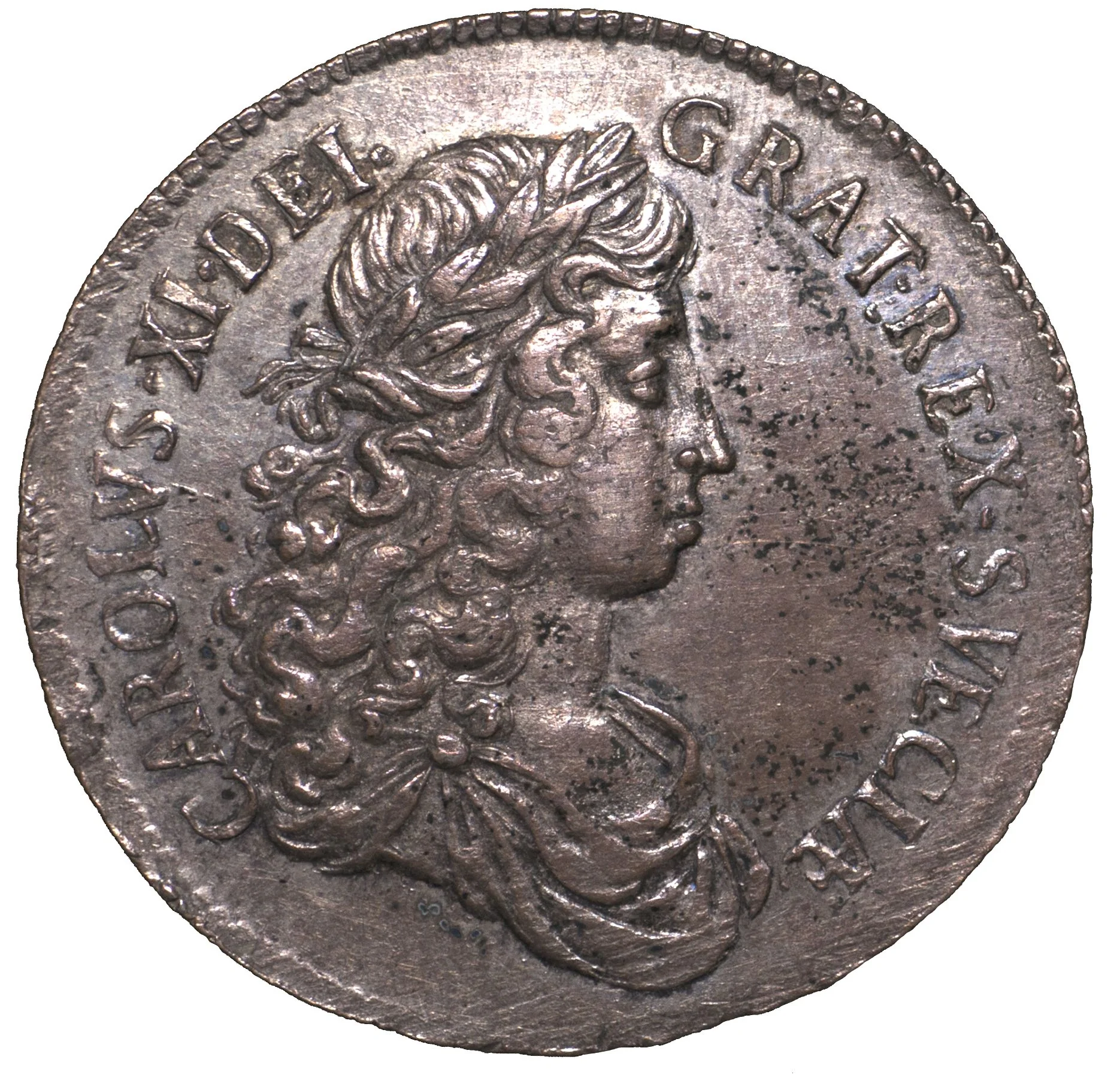
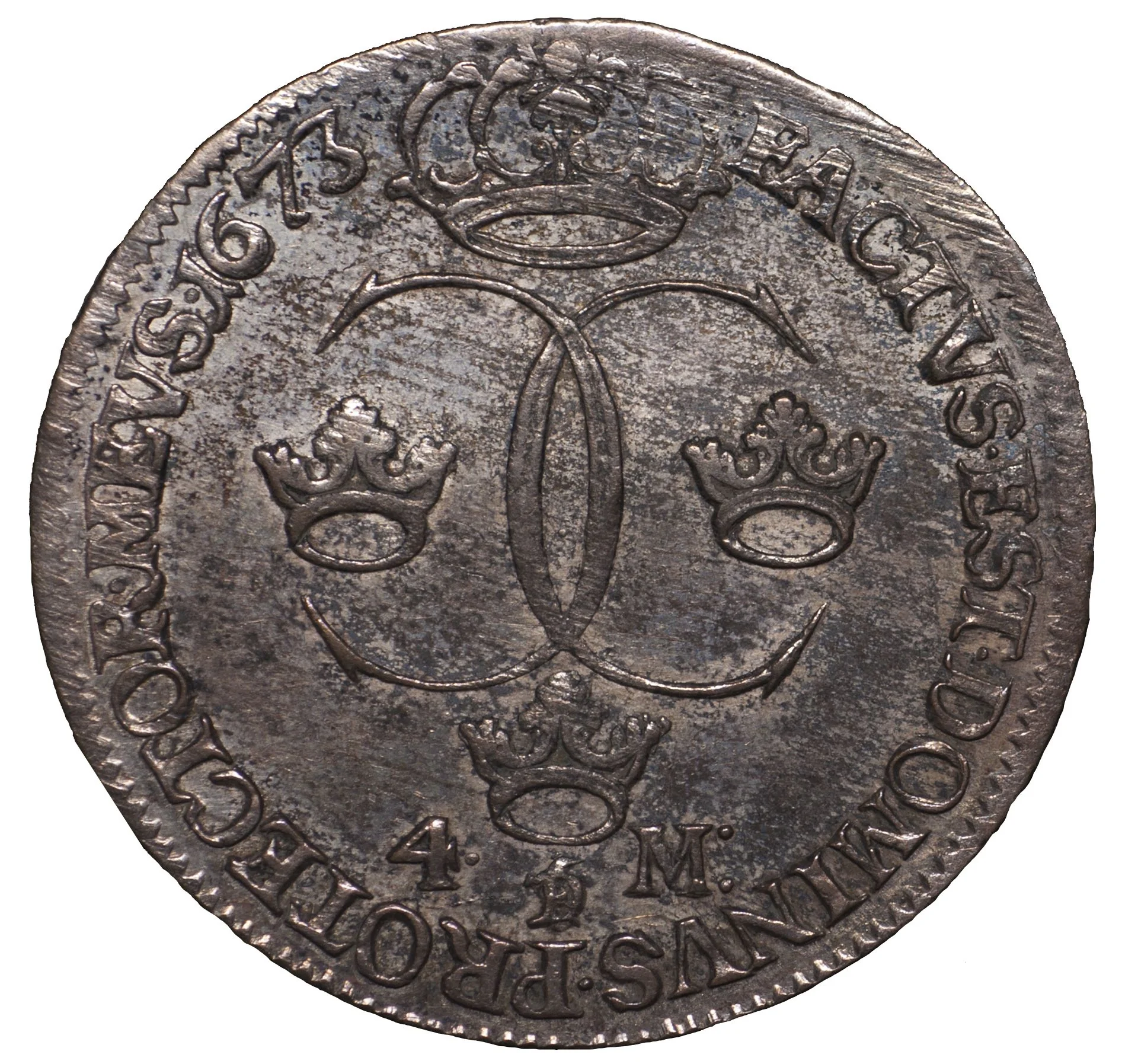
Obverse
Description:
Carl XI laureate bust right.
Inscription:
CAROLVS·XI·DEI· GRATIA:REX·SVECIÆ·
Reverse
Description:
Interlocked C's crowned, three crowns above, value encircled by legend.
Inscription:
FACTVS·EST·DOMINVS·PROTECTOR·MEVS·1673·
4 M
4 M
Edge
Mints
| Name | Mark |
|---|---|
| Stockholm | — |
Mintings
| Year | Mint Mark | Mintage | Quality | Collection |
|---|---|---|---|---|
| 1673 | — | — |
Historical background
In 1673, Sweden found itself in a precarious monetary situation, a direct consequence of the immense financial strain of its ongoing wars. The kingdom was deeply embroiled in the Scanian War (1675–1679) against Denmark-Norway and its allies, a conflict fought to retain its recently acquired southern provinces. The cost of maintaining a large army and navy was staggering, far exceeding ordinary tax revenues. To bridge this fiscal gap, the state resorted to the traditional, yet destructive, expedient of currency debasement, severely reducing the silver content of the already-circulating copper coinage to create more money from the same metal reserves.
This practice led to a classic and chaotic bimetal system. Sweden’s currency was nominally based on both silver and copper, with the famous large plåtmynt (plate money) representing high-value copper coins. However, the relentless debasement created a widening gap between the face value of coins and their intrinsic metal worth. Gresham's law took hold, where "bad money drives out good," as people hoarded older, purer coins and only used the new debased ones, fueling inflation and a severe loss of public confidence in the currency. The monetary system became fragmented, with different types of coins circulating at different, fluctuating market rates rather than their official values.
The situation in 1673 was a critical point on a path toward a financial crisis. The government, under the regency of young King Charles XI, was aware of the destabilizing effects but was trapped by immediate military necessities. The degraded coinage hampered trade, complicated army provisioning, and increased economic hardship. This experience would later become a powerful catalyst for reform. Following the war's end, the lessons of the 1670s directly informed the Great Reduction of the 1680s, where the Crown reclaimed alienated lands to secure a stable fiscal base, and ultimately led to the establishment of the Riksens Ständers Bank (the precursor to the Sveriges Riksbank) in 1668, which would eventually help stabilize the nation's finances.
This practice led to a classic and chaotic bimetal system. Sweden’s currency was nominally based on both silver and copper, with the famous large plåtmynt (plate money) representing high-value copper coins. However, the relentless debasement created a widening gap between the face value of coins and their intrinsic metal worth. Gresham's law took hold, where "bad money drives out good," as people hoarded older, purer coins and only used the new debased ones, fueling inflation and a severe loss of public confidence in the currency. The monetary system became fragmented, with different types of coins circulating at different, fluctuating market rates rather than their official values.
The situation in 1673 was a critical point on a path toward a financial crisis. The government, under the regency of young King Charles XI, was aware of the destabilizing effects but was trapped by immediate military necessities. The degraded coinage hampered trade, complicated army provisioning, and increased economic hardship. This experience would later become a powerful catalyst for reform. Following the war's end, the lessons of the 1670s directly informed the Great Reduction of the 1680s, where the Crown reclaimed alienated lands to secure a stable fiscal base, and ultimately led to the establishment of the Riksens Ständers Bank (the precursor to the Sveriges Riksbank) in 1668, which would eventually help stabilize the nation's finances.

✨ Legendary