

8 marks – Sweden
Add to wishlist
Sweden
Context
Year: 1666
Issuer: Sweden
Ruler: Charles XI
Currency:
(1598—1665)
Demonetized: Yes
Total mintage: 6,237
Material
Diameter: 45.8 mm
Weight: 31.35 g
Silver Weight:: 28.90 g
Shape: Round
Composition: 92.2% Silver
Standard: Silver ounce
Magnetic: No
References
KM: #
Numista: #181925
Value
Bullion value: $72.43
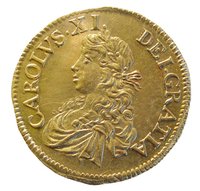
Obverse
Description:
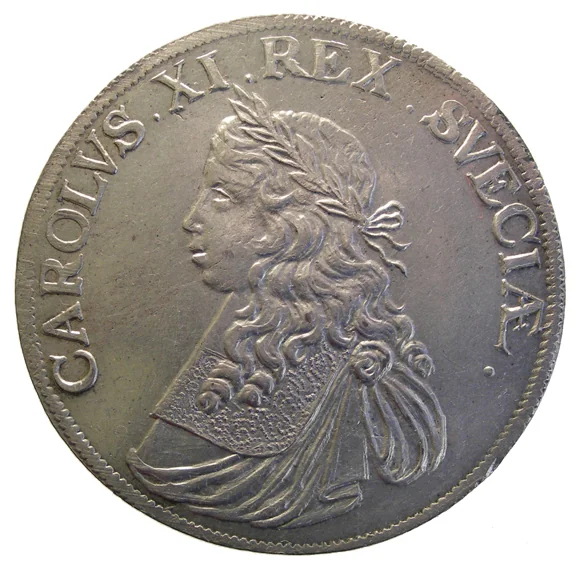
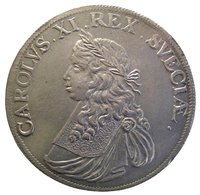
Bust of King Karl XI facing left, with long curly hair, encircled by a legend.
Inscription:
CAROLVS.XI.REX.SVECIÆ.
Script: Latin
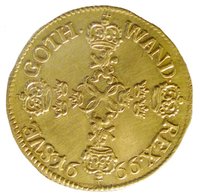
Reverse
Description:
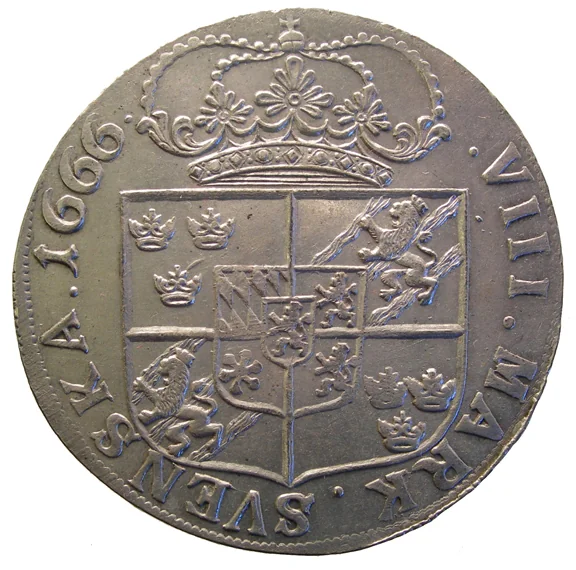
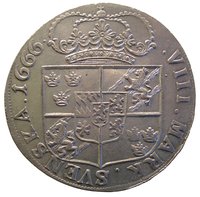
Swedish crowned shield within circular inscription.
Inscription:
.VIII.MARK.SVENSKA.1666.
Script: Latin
Edge
Mints
| Name | Mark |
|---|---|
| Stockholm | — |
Mintings
| Year | Mint Mark | Mintage | Quality | Collection |
|---|---|---|---|---|
| 1666 | — | 6,237 |
Historical background
In 1666, Sweden operated under a complex and strained monetary system, a direct legacy of its ambitions as a European great power during the Thirty Years' War. The kingdom was on a copper standard, unique in Europe, where large, cumbersome copper plates (plåtmynt) circulated alongside silver coins. This system was fundamentally tied to Sweden's domestic wealth—its vast copper mines, particularly at Falun—but it created severe practical and economic problems. The intrinsic value of the copper in the coins was meant to equal their face value, but fluctuating metal prices and the sheer weight (a 10-daler plate could weigh over 20 kilograms) made transactions absurdly impractical and hindered commerce.
The situation was exacerbated by the government's chronic need for revenue to fund its military and administrative ambitions. To meet expenses, the state repeatedly engaged in debasement, especially of the silver coinage, reducing its silver content while maintaining its nominal value. This practice, led by the Bank of the Palmstruch (the precursor to the Riksbank) founded in 1656, led to inflation and a loss of public confidence. By 1666, a dual circulation of older, purer coins and newer, debased ones created chaos, as people hoarded good money and spent bad, a classic example of Gresham's Law.
Consequently, 1666 fell within a period of intense monetary instability and experimentation. The government, under the regency of young King Charles XI, faced the urgent task of restoring order. This culminated in the major monetary reform of 1668, which established the Riksens Ständers Bank (the Estates of the Realm Bank, later the Riksbank) and began a slow move toward a more stable silver-based system. Thus, the currency situation in 1666 was one of crisis and transition, marking the painful end of the copper standard era and setting the stage for modern central banking in Sweden.
The situation was exacerbated by the government's chronic need for revenue to fund its military and administrative ambitions. To meet expenses, the state repeatedly engaged in debasement, especially of the silver coinage, reducing its silver content while maintaining its nominal value. This practice, led by the Bank of the Palmstruch (the precursor to the Riksbank) founded in 1656, led to inflation and a loss of public confidence. By 1666, a dual circulation of older, purer coins and newer, debased ones created chaos, as people hoarded good money and spent bad, a classic example of Gresham's Law.
Consequently, 1666 fell within a period of intense monetary instability and experimentation. The government, under the regency of young King Charles XI, faced the urgent task of restoring order. This culminated in the major monetary reform of 1668, which established the Riksens Ständers Bank (the Estates of the Realm Bank, later the Riksbank) and began a slow move toward a more stable silver-based system. Thus, the currency situation in 1666 was one of crisis and transition, marking the painful end of the copper standard era and setting the stage for modern central banking in Sweden.
Series: 1666 Sweden circulation coins

✨ Legendary