

1 Ducat – Sweden
Sweden
Context
Years: 1671–1676
Issuer: Sweden 
Ruler: Charles XI
Currency:
(1665—1715)
Demonetized: Yes
Total mintage: 24,919
References
KM: #Click to copy to clipboard277
Numista: #181546
Value
Bullion value: $564.93
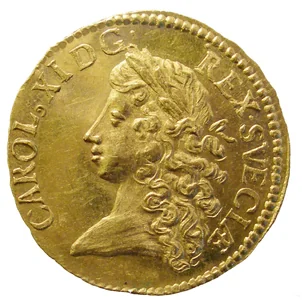
Obverse
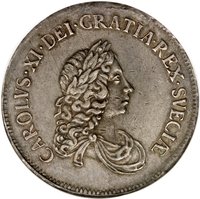
Description:
Carl XI laureate bust left within circular legend.
Inscription:
CAROL.XI DG· REX·SVECIÆ
Script: Latin
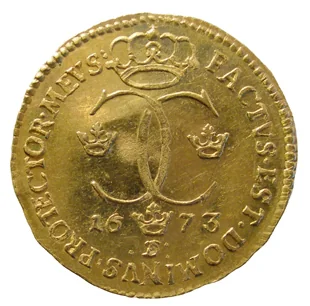
Reverse
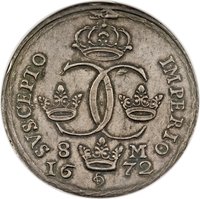
Description:
Double C monogram crowned, three crowns in field, date below. Encircled by legend.
Inscription:
FACTVS·EST·DOMINVS·PROTECTOR·MEVS·
CC
16 73
CC
16 73
Script: Latin
Edge
Mints
| Name | Mark |
|---|---|
| Stockholm | — |
Mintings
| Year | Mint Mark | Mintage | Quality | Collection |
|---|---|---|---|---|
| 1671 | — | 3,861 | ||
| 1672 | — | 5,058 | ||
| 1673 | — | — | ||
| 1674 | — | 16,000 | ||
| 1675 | — | — | ||
| 1676 | — | — |
Historical background
In 1671, Sweden was in the midst of a severe monetary crisis rooted in the policies of the preceding decades. To finance its extensive involvement in the Northern Wars, the state had heavily debased the copper coinage, which alongside silver formed the backbone of the dual-metallism system. The Swedish Riksdaler was officially valued in both metals, but the over-minting of copper plåtmynt (plate money) – large, cumbersome sheets of pure copper – had led to a dramatic inflation. The intrinsic value of the copper coins fell far below their face value, causing public mistrust and market disorder.
This situation was exacerbated by the government's practice of using freshly minted, inferior coin to pay its debts, soldiers, and suppliers, flooding the economy with depreciated currency. Prices soared, and foreign trade suffered as international merchants refused the devalued Swedish money. The financial strain was acute for the crown itself, as its tax revenues were collected in the very depreciated coins it issued, creating a vicious cycle of deficit and further currency debasement.
Consequently, 1671 fell within a period of intense political and economic debate, preceding the major monetary reforms that would come later in the decade. The government, under the regency of young King Charles XI, was grappling with the legacy of wartime finance and seeking solutions. The immediate background was one of a struggling, cash-poor economy where the cumbersome copper plate money symbolized both the kingdom's vast natural resources and its profound fiscal mismanagement.
This situation was exacerbated by the government's practice of using freshly minted, inferior coin to pay its debts, soldiers, and suppliers, flooding the economy with depreciated currency. Prices soared, and foreign trade suffered as international merchants refused the devalued Swedish money. The financial strain was acute for the crown itself, as its tax revenues were collected in the very depreciated coins it issued, creating a vicious cycle of deficit and further currency debasement.
Consequently, 1671 fell within a period of intense political and economic debate, preceding the major monetary reforms that would come later in the decade. The government, under the regency of young King Charles XI, was grappling with the legacy of wartime finance and seeking solutions. The immediate background was one of a struggling, cash-poor economy where the cumbersome copper plate money symbolized both the kingdom's vast natural resources and its profound fiscal mismanagement.
✨ Legendary