

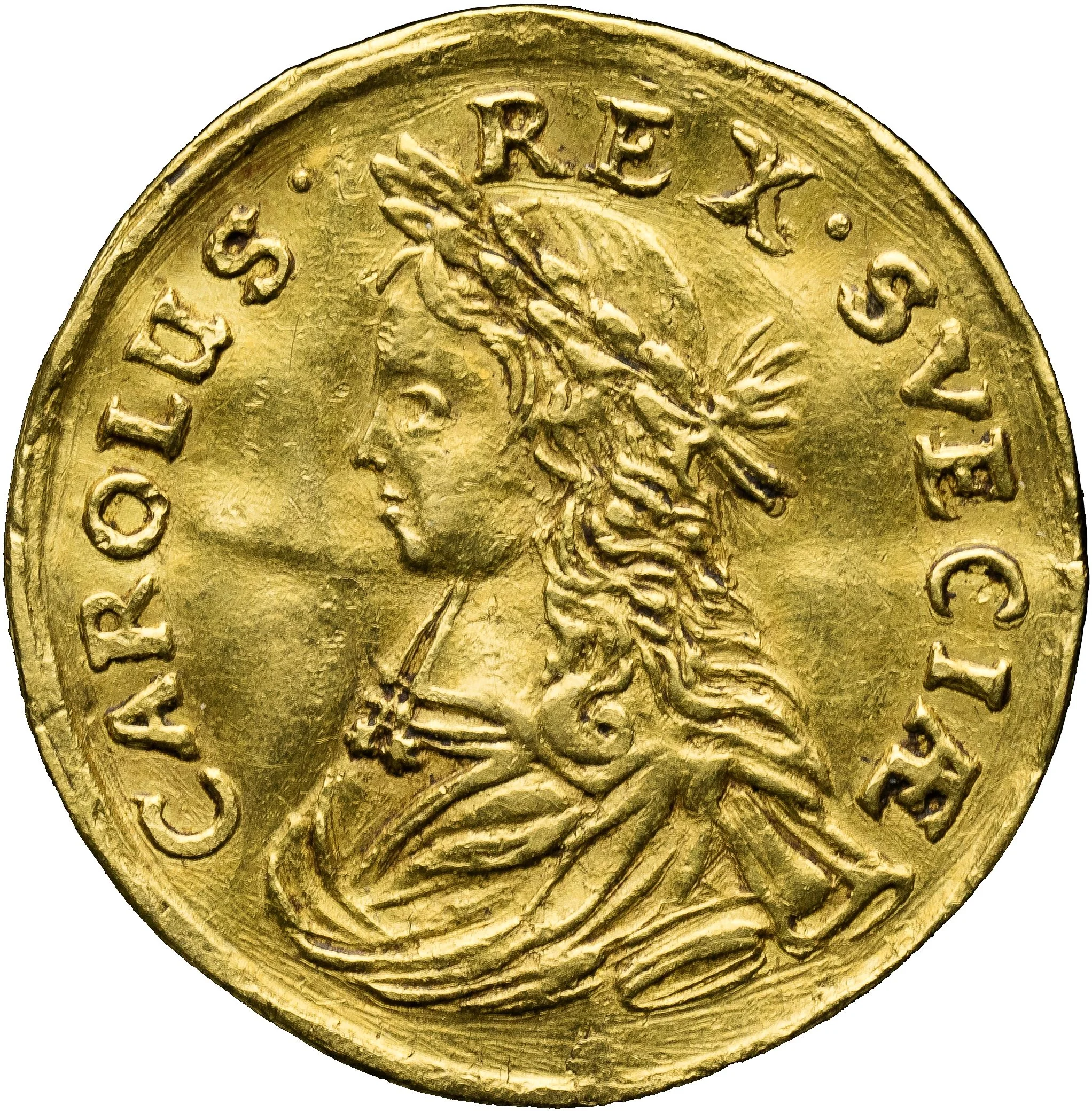

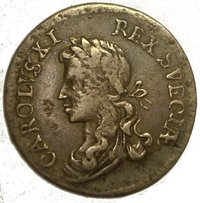
Obverse
Description:
Carl XI laureate bust left within circular legend.
Inscription:
CAROLUS · REX · SVECIÆ
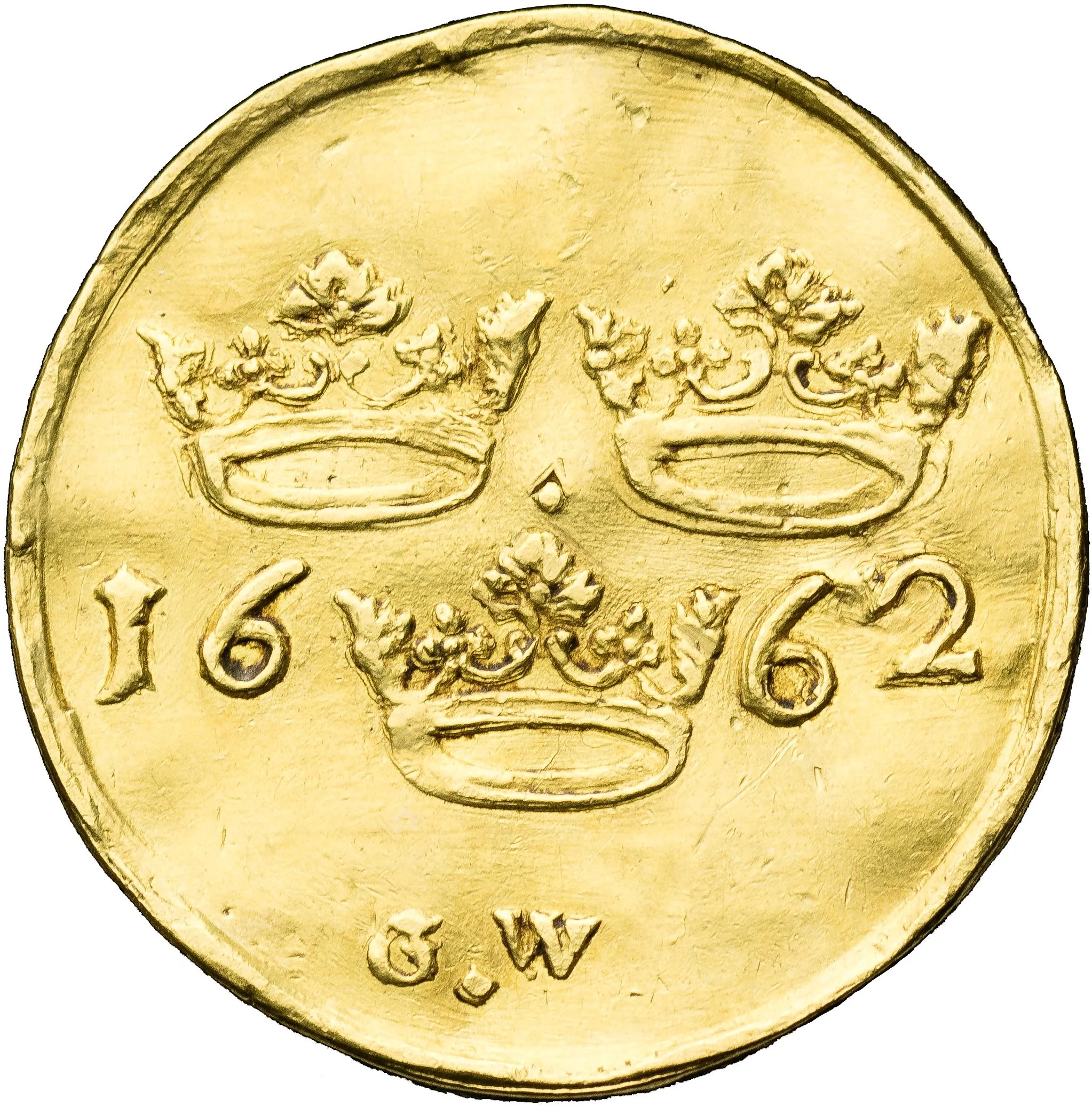
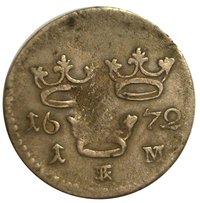
Reverse
Description:
Sweden's three crowns above date, value below.
Inscription:
16 62
G.W
G.W
Edge
Mints
| Name | Mark |
|---|---|
| Stockholm | — |
Mintings
| Year | Mint Mark | Mintage | Quality | Collection |
|---|---|---|---|---|
| 1662 | — | — |
Historical background
In 1662, Sweden found itself in a precarious monetary situation, a direct consequence of the immense costs of the Thirty Years' War (1618–1648). To finance its military campaigns, the Swedish state, under Queen Christina and later King Charles X Gustav, had heavily debased its coinage. The national mint produced vast quantities of low-quality copper mynt and silver coins with reduced precious metal content, leading to severe inflation and a loss of public trust in the currency. This period was marked by a complex and chaotic system where the intrinsic value of coins often fell below their face value, causing economic distress and market instability.
The response to this crisis was the introduction of a pioneering financial instrument: Europe’s first regular banknotes. In 1661, the Stockholm Banco (founded by Johan Palmstruch) received royal permission to issue credit notes, which were formally authorized as currency in 1662. These Kreditivsedlar were intended as a solution, representing a promise to pay the bearer in hard currency at a future date. They aimed to simplify transactions, as Sweden’s primary copper coinage was famously cumbersome—large copper plates (plåtmynt) could weigh up to 20 kilograms. The banknotes were an innovative attempt to create a more flexible medium of exchange based on credit rather than pure bullion.
However, this early experiment with paper money quickly faltered. The Stockholm Banco lacked sufficient copper and silver reserves to back the notes it issued, as Palmstruch lent them out generously. By 1663, just a year after their official launch, the bank had over-issued notes to the point where it could not honour redemptions, leading to a collapse in confidence. The bank failed in 1664, and Palmstruch was imprisoned. Thus, the 1662 currency situation represents a critical juncture—a moment of both profound monetary crisis and groundbreaking innovation, whose immediate failure delayed the adoption of paper money in Sweden for decades but ultimately paved the way for modern central banking.
The response to this crisis was the introduction of a pioneering financial instrument: Europe’s first regular banknotes. In 1661, the Stockholm Banco (founded by Johan Palmstruch) received royal permission to issue credit notes, which were formally authorized as currency in 1662. These Kreditivsedlar were intended as a solution, representing a promise to pay the bearer in hard currency at a future date. They aimed to simplify transactions, as Sweden’s primary copper coinage was famously cumbersome—large copper plates (plåtmynt) could weigh up to 20 kilograms. The banknotes were an innovative attempt to create a more flexible medium of exchange based on credit rather than pure bullion.
However, this early experiment with paper money quickly faltered. The Stockholm Banco lacked sufficient copper and silver reserves to back the notes it issued, as Palmstruch lent them out generously. By 1663, just a year after their official launch, the bank had over-issued notes to the point where it could not honour redemptions, leading to a collapse in confidence. The bank failed in 1664, and Palmstruch was imprisoned. Thus, the 1662 currency situation represents a critical juncture—a moment of both profound monetary crisis and groundbreaking innovation, whose immediate failure delayed the adoption of paper money in Sweden for decades but ultimately paved the way for modern central banking.
✨ Legendary