

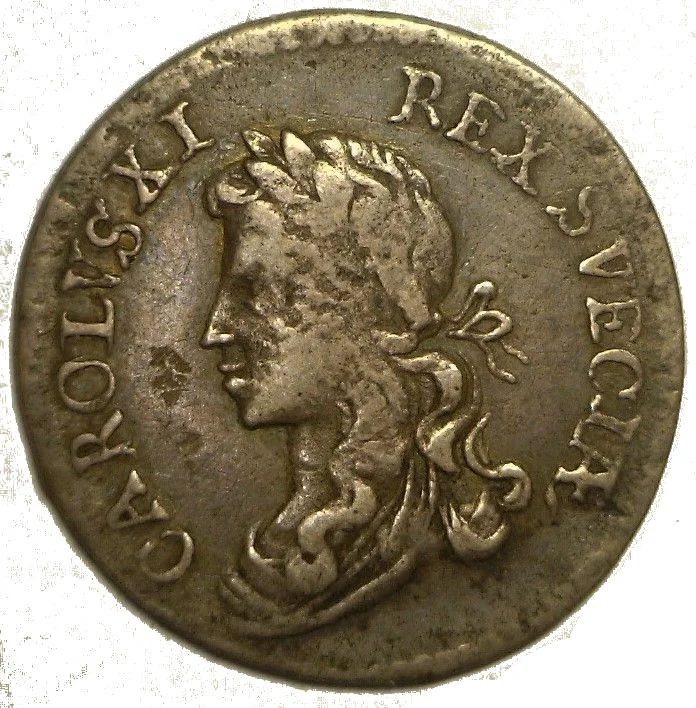
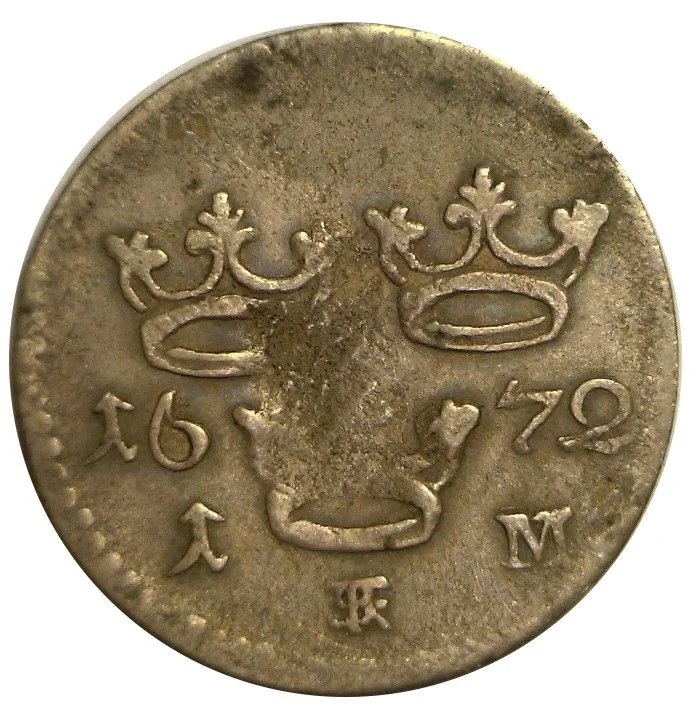
1 mark – Sweden
Add to wishlist
Sweden
Context
Years: 1663–1674
Issuer: Sweden
Ruler: Charles XI
Currency:
(1665—1715)
Demonetized: Yes
Total mintage: 73,000
Material
References
KM: #
Numista: #94726
Value
Bullion value: $9.19
Obverse
Reverse
Inscription:
16 83
I. M.
I - K
I. M.
I - K
Edge
Mintings
| Year | Mint Mark | Mintage | Quality | Collection |
|---|---|---|---|---|
| 1663 | — | 73,000 | ||
| 1664 | — | — | ||
| 1664 | GW | — | ||
| 1664 | IAK | — | ||
| 1664 | IK | — | ||
| 1665 | — | — | ||
| 1669 | — | — | ||
| 1671 | — | — | ||
| 1672 | — | — | ||
| 1673 | — | — | ||
| 1674 | — | — |
Historical background
In 1663, Sweden was navigating a complex monetary landscape dominated by the copper standard, a system unique in Europe. Since 1624, Sweden had officially valued its currency in both silver and copper, but by the mid-17th century, copper had become the de facto base due to the kingdom's vast copper exports, primarily from the great mine at Falun. This led to the production of extraordinarily large and cumbersome copper plate money (plåtmynt), some weighing over 19 kilograms, which were necessary to represent substantial value given copper's lower intrinsic worth compared to silver.
The system was fraught with difficulties. The heavy plate money was impractical for everyday trade, while a chronic shortage of smaller denomination coins stifled commerce. Furthermore, Sweden's participation in the Northern Wars (1655-1660) had drained royal finances, leading to repeated debasements of the silver coinage. By 1663, this created a problematic dual circulation: overvalued silver coins circulated alongside the intrinsic-value copper plates, causing Gresham's Law ("bad money drives out good money") to take effect, as people hoarded the better silver coins.
Recognizing the crisis, the Swedish government under the regency of young King Charles XI undertook a significant monetary reform in 1663. The aim was to stabilize and simplify the system by introducing a new silver standard. The riksdaler was defined as a specific weight of silver, and new, lighter silver coins were minted to replace the debased ones. However, the reform was only partially successful; the heavy copper plate money remained in circulation for large transactions, and the underlying economic strains persisted, meaning Sweden continued to grapple with a cumbersome and dual monetary system for decades to come.
The system was fraught with difficulties. The heavy plate money was impractical for everyday trade, while a chronic shortage of smaller denomination coins stifled commerce. Furthermore, Sweden's participation in the Northern Wars (1655-1660) had drained royal finances, leading to repeated debasements of the silver coinage. By 1663, this created a problematic dual circulation: overvalued silver coins circulated alongside the intrinsic-value copper plates, causing Gresham's Law ("bad money drives out good money") to take effect, as people hoarded the better silver coins.
Recognizing the crisis, the Swedish government under the regency of young King Charles XI undertook a significant monetary reform in 1663. The aim was to stabilize and simplify the system by introducing a new silver standard. The riksdaler was defined as a specific weight of silver, and new, lighter silver coins were minted to replace the debased ones. However, the reform was only partially successful; the heavy copper plate money remained in circulation for large transactions, and the underlying economic strains persisted, meaning Sweden continued to grapple with a cumbersome and dual monetary system for decades to come.

✨ Legendary