

½ Groschen – Kingdom of Bohemia
Context
Year: 1612
Country: Bohemia
Issuer: Kingdom of Bohemia
Ruler: Matthias II
Currency:
(1520—1754)
Demonetized: Yes
References
KM: #Click to copy to clipboard111
Numista: #107486
Obverse
Description:
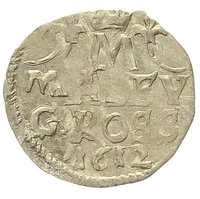
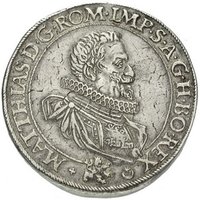
Crowned M splits date and value.
Reverse
Edge
Plain
Mints
| Name | Mark |
|---|---|
| Joachimsthal | — |
Mintings
| Year | Mint Mark | Mintage | Quality | Collection |
|---|---|---|---|---|
| 1612 | aj | — |
Historical background
In 1612, the Kingdom of Bohemia, a key crown land within the Habsburg-ruled Holy Roman Empire, faced a complex and deteriorating currency situation. The primary issue was the proliferation of debased coinage, particularly the Münzmeister coins minted under the authority of local estates. These coins, often struck with lower silver content than their official face value, flooded the market and drove out older, purer coins (a phenomenon known as Gresham's Law). This practice, while providing short-term revenue for the estates and mint masters, eroded public trust and created a chaotic multi-currency system with wildly fluctuating exchange rates.
The root of the problem lay in a conflict of monetary sovereignty. The right to mint coins was a contested privilege between the Habsburg monarch, Emperor Matthias (who had just been confirmed as King of Bohemia in 1611), and the powerful Bohemian Estates. The Estates, seeking to assert their autonomy and finance their affairs, aggressively operated mints at Kutná Hora and elsewhere. The central imperial authority in Vienna was too weak to enforce a uniform monetary standard, leading to a competitive "race to the bottom" in coinage quality that destabilized the economy.
This monetary instability exacerbated social tensions and was a significant point of political contention in the years leading to the Bohemian Revolt of 1618. Merchants and the populace suffered from price inflation and uncertainty, while creditors were paid back in less valuable coin. The currency crisis thus reflected and amplified the broader constitutional and religious conflicts between the Bohemian Estates and the Catholic Habsburg monarchy, making it one of the important economic preconditions for the devastating Thirty Years' War that would soon erupt from Bohemian soil.
The root of the problem lay in a conflict of monetary sovereignty. The right to mint coins was a contested privilege between the Habsburg monarch, Emperor Matthias (who had just been confirmed as King of Bohemia in 1611), and the powerful Bohemian Estates. The Estates, seeking to assert their autonomy and finance their affairs, aggressively operated mints at Kutná Hora and elsewhere. The central imperial authority in Vienna was too weak to enforce a uniform monetary standard, leading to a competitive "race to the bottom" in coinage quality that destabilized the economy.
This monetary instability exacerbated social tensions and was a significant point of political contention in the years leading to the Bohemian Revolt of 1618. Merchants and the populace suffered from price inflation and uncertainty, while creditors were paid back in less valuable coin. The currency crisis thus reflected and amplified the broader constitutional and religious conflicts between the Bohemian Estates and the Catholic Habsburg monarchy, making it one of the important economic preconditions for the devastating Thirty Years' War that would soon erupt from Bohemian soil.

✨ Legendary