

4 escudos – Spain
Add to wishlist
Spain
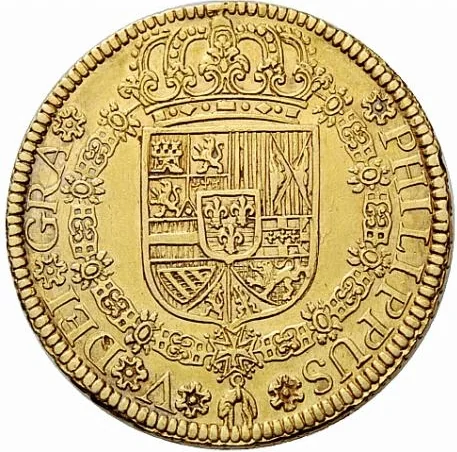
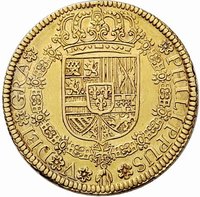
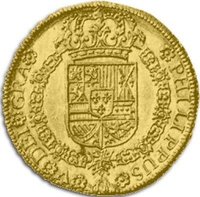
Obverse
Description:
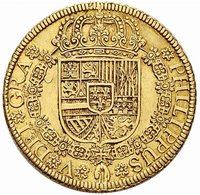
Crowned Spanish coat of arms with the Golden Fleece.
Inscription:
🏵 PHILIPPUS 🏵 🏵 V 🏵 DEI 🏵 GRA 🏵
Script: Latin
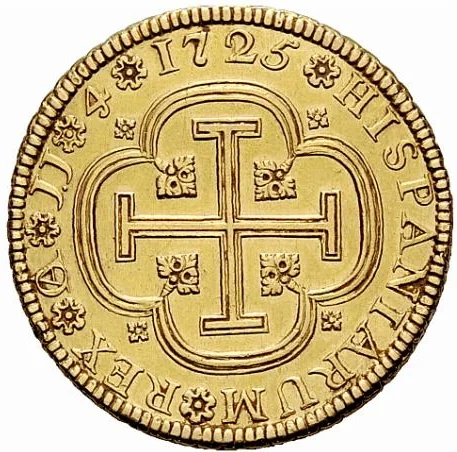
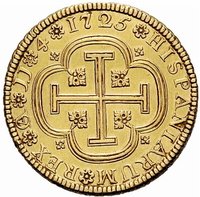
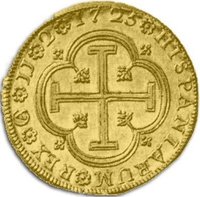
Reverse
Description:
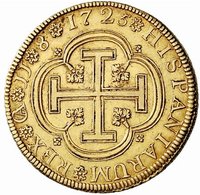
Cross within quatrefoil.
Inscription:
🏵 HISPANIARUM 🏵 REX 🏵 CA 🏵 JJ 🏵 4 🏵 1725
Script: Latin
Edge
Categories
| Symbols> Coat of Arms |
| Symbol> Cross |
Mints
| Name | Mark |
|---|---|
| Cuenca | CA |
Mintings
| Year | Mint Mark | Mintage | Quality | Collection |
|---|---|---|---|---|
| 1725 | CA | — |
Historical background
In 1725, Spain’s currency situation was complex and fraught with instability, a direct legacy of the costly wars and economic policies of the preceding Habsburg dynasty and the early Bourbon monarch, Philip V. The Spanish monetary system was not unified, operating on a bimetallic standard of gold (escudos) and silver (reales), but with a severe shortage of precious metal coinage in circulation. Decades of deficit spending to fund military conflicts, combined with a chronic trade imbalance that drained silver from the American colonies to pay foreign creditors, had led to repeated debasements and the proliferation of heavily clipped and counterfeit coins. This created a chaotic environment where the intrinsic metal value of a coin often exceeded its nominal face value, leading to hoarding and a crippling lack of sound money for everyday commerce.
The primary response to this crisis was a series of drastic monetary reforms enacted between 1718 and 1728, spearheaded by Philip V’s French finance minister, Jean Orry. The most significant measure was the introduction of new gold and silver coins struck to higher, standardized weights and purities at the mints, most notably the pillar dollar or real de a ocho. More controversially, the government attempted to enforce the use of heavily devalued vellón (copper) currency for most domestic transactions through royal decrees. This fiduciary copper coinage, with an artificially imposed value far above its metal content, was intended to alleviate the shortage of precious metal but instead fueled rampant inflation, price volatility, and public distrust.
Consequently, the year 1725 falls within a period of painful transition and experimentation. While the Bourbon reforms aimed to centralize and stabilize the monetary system as part of a broader project of state modernization, the immediate reality was one of confusion and economic distress. The coexistence of old and new coins of varying values, alongside inflated copper currency, made trade difficult and undermined economic recovery. The situation highlighted the profound challenge of restoring fiscal and monetary credibility, a process that would require not just new coinage but also deeper structural reforms to Spanish industry and trade in the decades to follow.
The primary response to this crisis was a series of drastic monetary reforms enacted between 1718 and 1728, spearheaded by Philip V’s French finance minister, Jean Orry. The most significant measure was the introduction of new gold and silver coins struck to higher, standardized weights and purities at the mints, most notably the pillar dollar or real de a ocho. More controversially, the government attempted to enforce the use of heavily devalued vellón (copper) currency for most domestic transactions through royal decrees. This fiduciary copper coinage, with an artificially imposed value far above its metal content, was intended to alleviate the shortage of precious metal but instead fueled rampant inflation, price volatility, and public distrust.
Consequently, the year 1725 falls within a period of painful transition and experimentation. While the Bourbon reforms aimed to centralize and stabilize the monetary system as part of a broader project of state modernization, the immediate reality was one of confusion and economic distress. The coexistence of old and new coins of varying values, alongside inflated copper currency, made trade difficult and undermined economic recovery. The situation highlighted the profound challenge of restoring fiscal and monetary credibility, a process that would require not just new coinage but also deeper structural reforms to Spanish industry and trade in the decades to follow.
✨ Legendary