

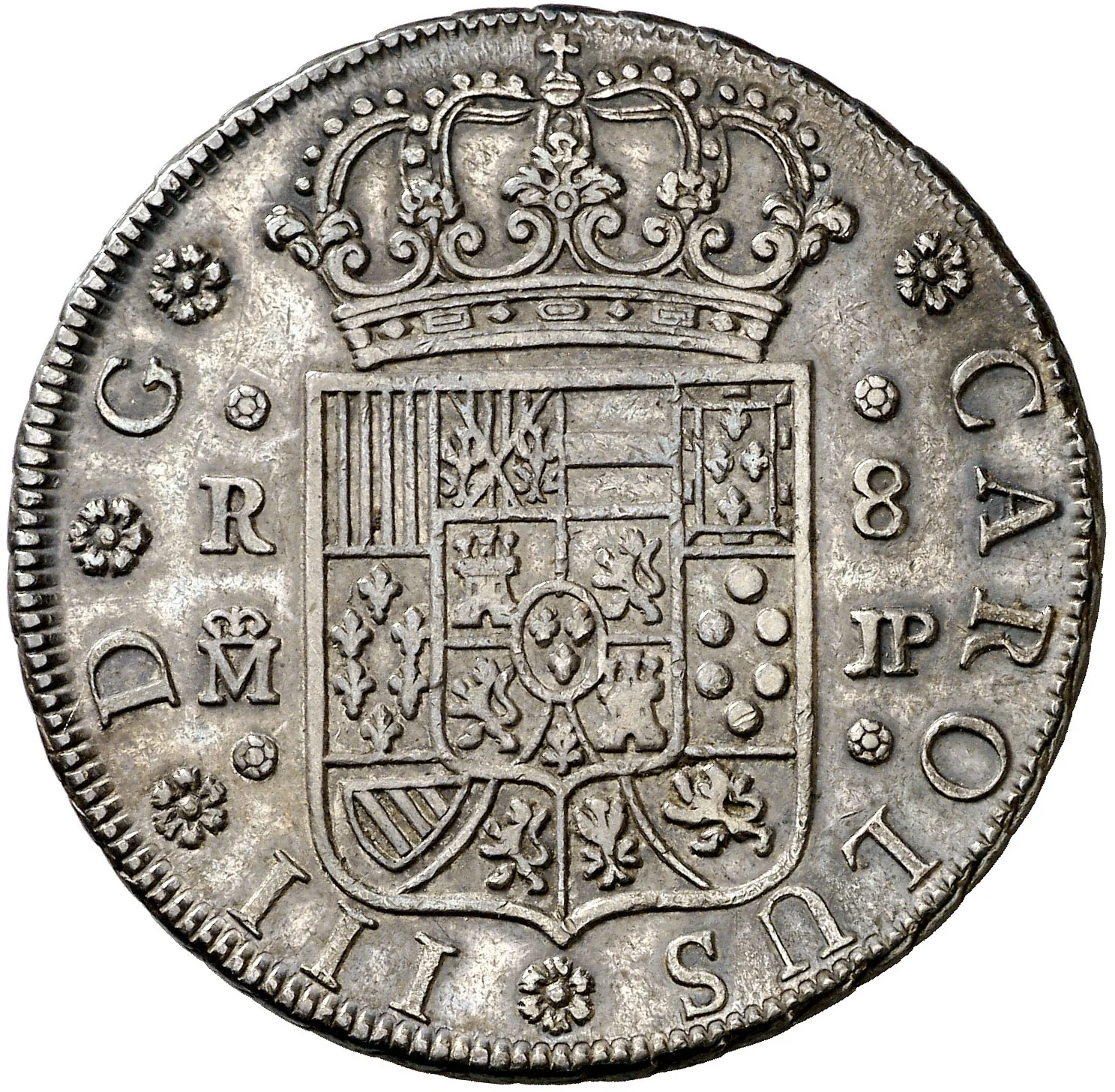
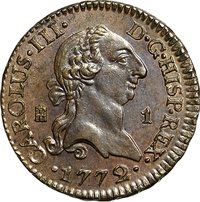
Obverse
Description:
Royal arms of Spain.
Inscription:
✿ CAROLUS ✿ III ✿ D ✿ G ✿
✿ ✿
R 8
M JP
✿ ✿
✿ ✿
R 8
M JP
✿ ✿
Script: Latin
Engraver: Tomás Francisco Prieto Martin
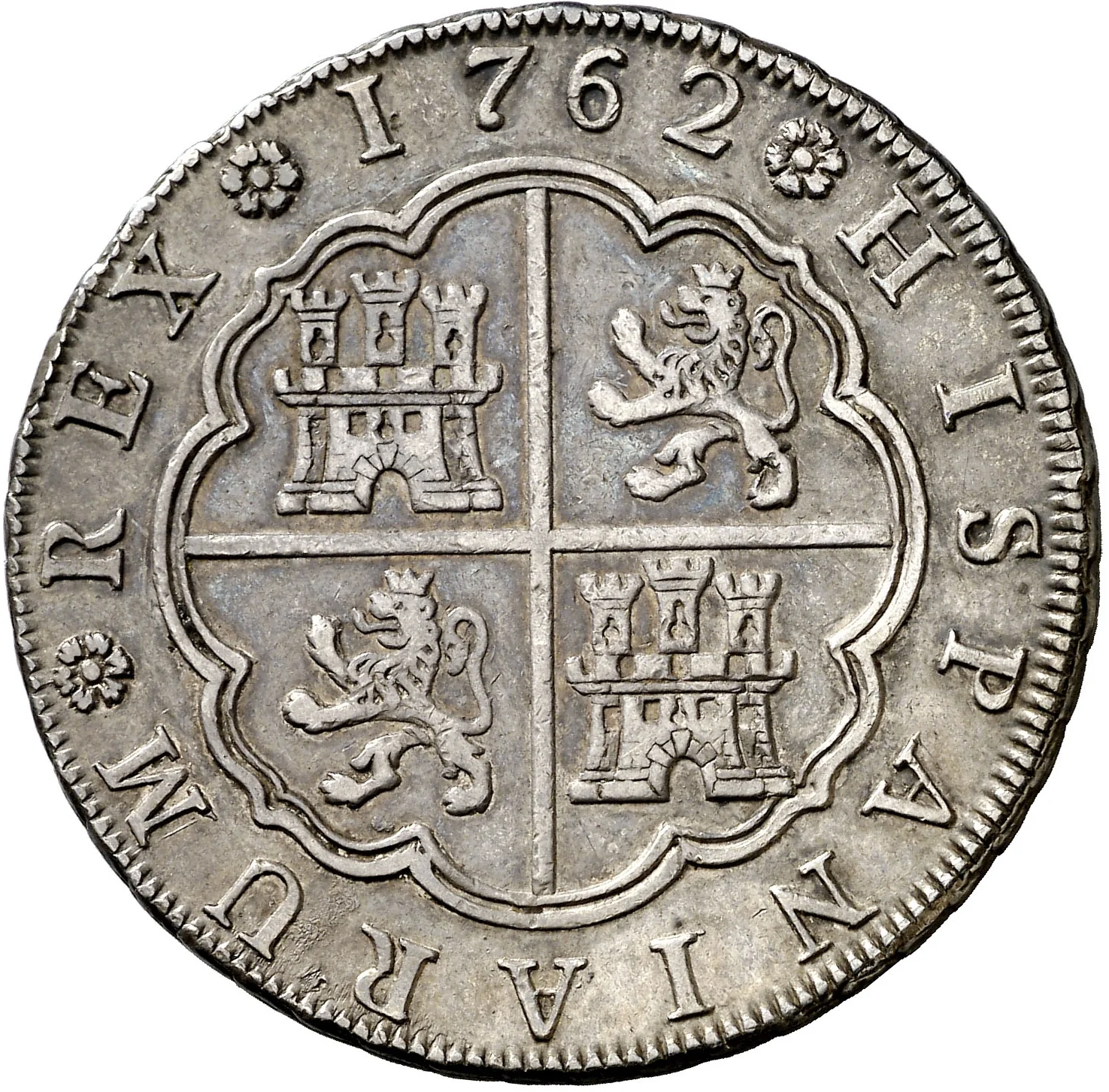
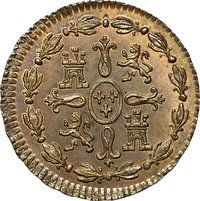
Reverse
Description:
Castile and León's coat of arms in an octolobe.
Inscription:
✿ 1762 ✿ HISPANIARUM ✿ REX
Script: Latin
Engraver: Tomás Francisco Prieto Martin
Edge
Embossed pattern
Categories
| Symbols> Coat of Arms |
Mints
| Name | Mark |
|---|---|
| Royal Mint of Madrid | (M) |
| Royal Mint of Seville | (S) |
Mintings
| Year | Mint Mark | Mintage | Quality | Collection |
|---|---|---|---|---|
| 1762 | MJP | — | ||
| 1762 | SJV | — |
Historical background
In 1762, Spain’s currency system was a complex and strained amalgamation of reales, escudos, and a vast array of circulating foreign coins, reflecting both its global empire and deep-seated fiscal problems. The foundational unit was the real de vellón, a billon coin (with a low silver content), with 8 reales making a peso or "piece of eight." For larger transactions, the gold escudo (worth 16 reales) was used. However, the Spanish economy was flooded with silver and gold coins from its American colonies, alongside Portuguese, French, and other European currencies, leading to chronic confusion and instability in exchange rates across different regions.
The core issue was severe inflationary pressure and repeated currency manipulations by the crown. To finance its involvement in the ongoing Seven Years' War (1756-1763), where Spain entered the conflict in 1761 on the side of France, King Charles III's government resorted to drastic measures. These included the minting of vast quantities of debased coinage, particularly copper moneda provincial, which was mandated for use in public transactions. This deliberate devaluation, intended to raise short-term revenue for the war effort, eroded public trust, distorted prices, and disrupted commerce, as the intrinsic metal value of coins often fell far below their face value.
Consequently, 1762 fell within a period of significant monetary transition and turmoil. The government's attempts to control the money supply and standardize the chaotic system were largely ineffective amidst the wartime emergency. This instability would ultimately prompt more comprehensive reforms later in Charles III's reign, notably the currency decree of 1772 that aimed to retire the debased vellón coinage and establish a new silver-based standard, the real de plata. Thus, the currency situation in 1762 was characterized by wartime expediency, inflationary finance, and a fragmented system in urgent need of the modernization that would follow in the subsequent decade.
The core issue was severe inflationary pressure and repeated currency manipulations by the crown. To finance its involvement in the ongoing Seven Years' War (1756-1763), where Spain entered the conflict in 1761 on the side of France, King Charles III's government resorted to drastic measures. These included the minting of vast quantities of debased coinage, particularly copper moneda provincial, which was mandated for use in public transactions. This deliberate devaluation, intended to raise short-term revenue for the war effort, eroded public trust, distorted prices, and disrupted commerce, as the intrinsic metal value of coins often fell far below their face value.
Consequently, 1762 fell within a period of significant monetary transition and turmoil. The government's attempts to control the money supply and standardize the chaotic system were largely ineffective amidst the wartime emergency. This instability would ultimately prompt more comprehensive reforms later in Charles III's reign, notably the currency decree of 1772 that aimed to retire the debased vellón coinage and establish a new silver-based standard, the real de plata. Thus, the currency situation in 1762 was characterized by wartime expediency, inflationary finance, and a fragmented system in urgent need of the modernization that would follow in the subsequent decade.
✨ Legendary