

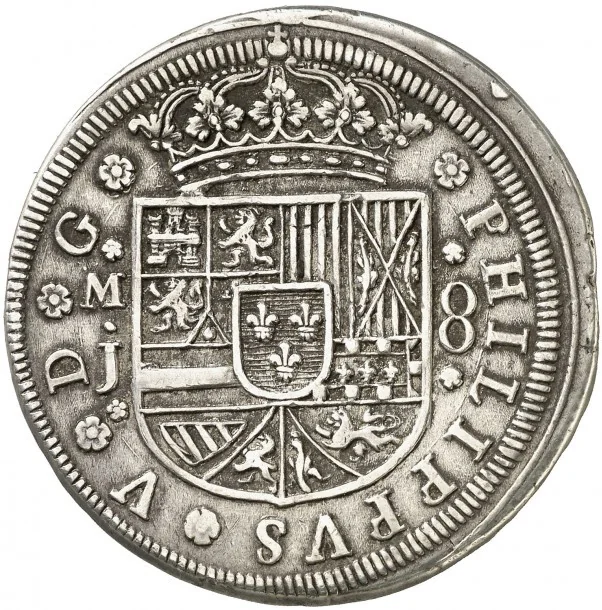
Obverse
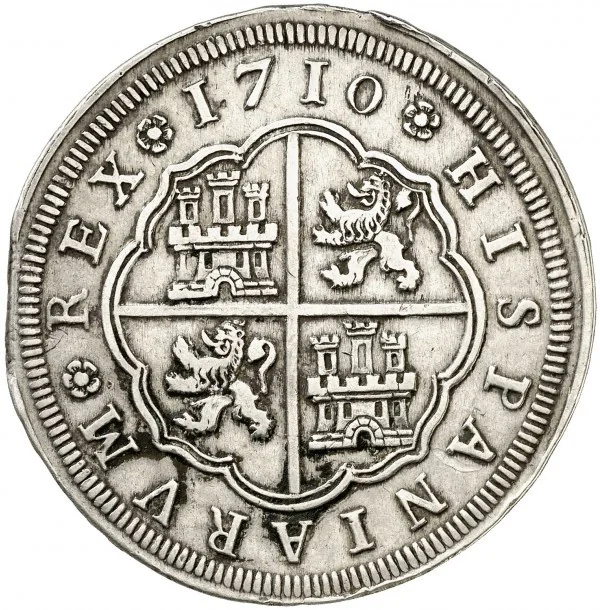
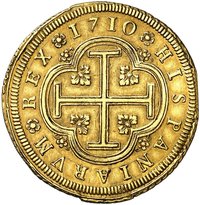
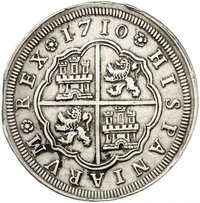
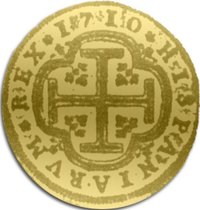
Reverse
Description:
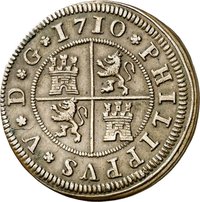
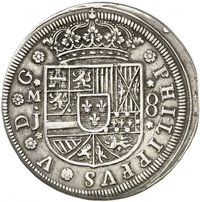
Castile and León's coat of arms in an octolobe.
Inscription:
✿ 1710 ✿ HISPANIARVM ✿ REX
Script: Latin
Edge
Categories
| Symbols> Coat of Arms |
Mints
| Name | Mark |
|---|---|
| Royal Mint of Madrid | M |
Mintings
| Year | Mint Mark | Mintage | Quality | Collection |
|---|---|---|---|---|
| 1710 | MJ | — | ||
| 1711 | MJ | — |
Historical background
In 1710, Spain was embroiled in the War of the Spanish Succession, a conflict that placed immense fiscal strain on the royal treasury. The war, fought over the contested throne between the Bourbon claimant Philip V and the Habsburg Archduke Charles, drained resources through military expenditure and disrupted trade and colonial revenue from the Americas. To finance the war effort, the state resorted to desperate measures, including the repeated debasement of the silver real and the gold escudo. This involved reducing the precious metal content in coins while maintaining their face value, a practice that generated short-term funds but triggered severe inflation and a loss of confidence in the currency.
The monetary system itself was chaotic, characterized by a proliferation of different coins from various Spanish kingdoms and foreign currencies circulating simultaneously. Alongside the official royal coinage, there were vellón coins—made of copper or low-grade silver—whose value was frequently manipulated by royal decree. Philip V's government issued vast quantities of this low-intrinsic-value vellón to pay troops and suppliers, leading to a sharp disparity between the official and market value of money. This effectively created a two-tier economy where goods were priced differently depending on the type of coin used, causing widespread confusion and hampering commerce.
The currency crisis of 1710 was therefore a symptom of the broader political and military crisis. The inflationary spiral eroded public trust and placed additional hardship on a population already suffering from the war's devastation. While Philip V's eventual victory in the war would later allow for monetary reforms, notably the 1718 attempt to stabilize the coinage, the situation in 1710 remained one of profound instability. The state's financial survival took precedence over monetary integrity, making this period a low point in the history of Spanish currency, directly linking the fate of the money in people's pockets to the battlefields of Europe.
The monetary system itself was chaotic, characterized by a proliferation of different coins from various Spanish kingdoms and foreign currencies circulating simultaneously. Alongside the official royal coinage, there were vellón coins—made of copper or low-grade silver—whose value was frequently manipulated by royal decree. Philip V's government issued vast quantities of this low-intrinsic-value vellón to pay troops and suppliers, leading to a sharp disparity between the official and market value of money. This effectively created a two-tier economy where goods were priced differently depending on the type of coin used, causing widespread confusion and hampering commerce.
The currency crisis of 1710 was therefore a symptom of the broader political and military crisis. The inflationary spiral eroded public trust and placed additional hardship on a population already suffering from the war's devastation. While Philip V's eventual victory in the war would later allow for monetary reforms, notably the 1718 attempt to stabilize the coinage, the situation in 1710 remained one of profound instability. The state's financial survival took precedence over monetary integrity, making this period a low point in the history of Spanish currency, directly linking the fate of the money in people's pockets to the battlefields of Europe.
Series: 1710 Spain circulation coins
✨ Legendary